Complete Book · No Charge
A Free Dark Fantasy Graphic Novel, Told in Full
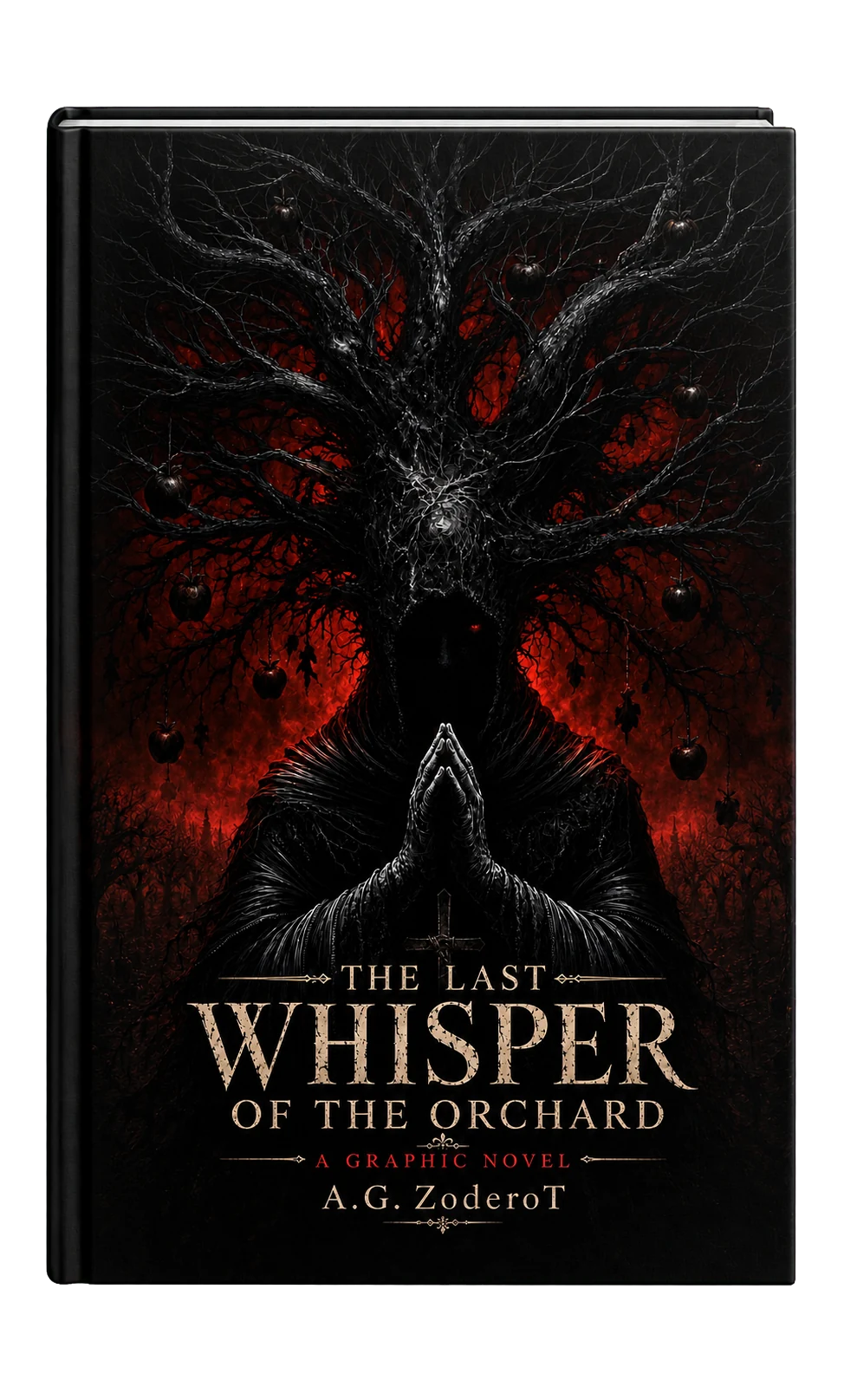
The Last Whisper of the Orchard is a complete gothic dark fantasy graphic novel: painted panels, verse, and a story that runs from first page to last. It costs nothing to read.
Free eBook. Availability and pricing can vary by marketplace.
What "free" means here
Free books in fantasy usually mean one of three things: a sample chapter, a short story written to advertise a series, or a first instalment that stops at a cliffhanger and asks for money. This is none of those. It is the whole graphic novel, every panel, with an ending.
The reason is simple. Illustrated dark fantasy is hard to judge from a description. Nobody can tell from a blurb whether the art will feel alive, whether verse on a page will land or grate, or whether a story about grief will earn its darkness. Reading the book settles all three questions in an evening.
Form
Fully illustrated graphic novel in oil-painted panels, with narration carried in verse.
Length
A complete standalone story. One sitting for most readers, two for those who linger on the art.
Reading order
First in the chronology of The Path of None. No prior reading assumed.
The story you are downloading
Velm is a healer in the village of Kahlon, and he sees things before they happen. His neighbours are grateful for the cures and frightened of the visions, which means he is believed only once fear has already arrived. By then the warning is useless.
Beneath the Whispergrove, prophecy and grief grow into the same thing. Every attempt Velm makes to protect the people he loves moves him closer to the fate that will outlast his name. He surrenders his voice, then his name, then everything he was.
This is the origin of the figure later called the Still One, and the wound underneath the events of The Curse. It is a story about what love becomes when everyone it was meant for is gone, and waiting is all that remains.
The orchard is more than a setting. It becomes memory, grave, witness, and the threshold between a man's private sorrow and the legend that follows him.
Reading an illustrated book on Kindle
Illustrated books behave differently from prose on Kindle, and readers who expect a normal ebook are sometimes caught out. A few practical points, because a beautiful book read badly is a wasted evening.
Screen size decides the experience
Each page is a painted composition. On a phone the panels shrink to the point where detail disappears. A tablet, a computer, or a large e-reader shows the work as it was composed. If a phone is all you have, use landscape orientation and tap to zoom.
You do not need a Kindle device
The Kindle app is free on iOS, Android, Windows, and macOS, and there is a browser reader as well. The same file opens in all of them, and your place syncs between devices.
Colour matters here
The panels are oil-painted, with a great deal of the mood carried in shadow and warmth. On a black and white e-ink screen the story still works, and a colour screen carries considerably more of it.
Read it slower than you think
The verse is short on each page, which tempts fast page-turning. The images carry as much of the story as the words do. Readers who slow down find the ending lands differently.
Why this one costs nothing
There is no hidden condition, so it is worth saying plainly what the arrangement is. Independent illustrated fiction has a discovery problem. It sits in a category most readers browse by cover, competes with large publishers for attention, and asks for trust in an art style nobody can assess from a thumbnail.
Giving away a complete book solves that in the only honest way available. You read the whole thing, you decide whether the work is for you, and no part of that decision depends on a marketing promise. If it is not to your taste, you have lost an evening and no money. If it is, there are six more books waiting and you already know what you are buying.
What helps in return is a review. Reviews on Amazon and Goodreads are what decide whether a book like this becomes visible to anyone beyond the people who already found it. They matter more than advertising, and they cost a few minutes.
Content note, before you start
For mature readers
The book contains graphic violence, death, child harm, mob violence, grief, religious persecution, and disturbing imagery. It is not written for younger readers, and the darkness is not decorative. If any of those subjects would make the book harmful rather than moving for you right now, this is the page to stop on.
Content notes appear on every book on this site. A reader who knows what is coming can decide honestly whether they want it, and that decision belongs to them and not to a marketing page.
Where to go when you finish
The orchard ends where the saga begins. Three honest directions, depending on what the book left you wanting.
If you want the saga
The Curse I
The first gate into Drakko's journey and the numbered core of The Path of None.
Open The Curse I →If you want the order
Reading Order
Chronological prequels, numbered core, deep lore, and continuations, kept separate from publication order.
See the order →If you want more like it
Dark Fantasy Guides
Reading guides to dark fantasy graphic novels, grief, myth, and the books worth the time.
Read the Journal →Questions readers ask
Is it really free?
Yes. It is listed as a free Kindle eBook. Pricing is set per marketplace and can change, so the Amazon page is the accurate source at any given moment.
Do I need a Kindle device?
No. The free Kindle app opens the same file on phones, tablets, computers, and browsers. The book is fully illustrated, so a tablet or a computer screen shows the painted panels far better than a phone does.
Is this a sample or the whole book?
The whole book. Every panel, first page to last, with a real ending. There is no second half waiting behind a purchase.
Do I need to read anything first?
No. It stands alone and comes first chronologically. Readers who prefer to start with the numbered core can open The Curse I instead and lose nothing.
What is a graphic ballad?
It is the form these books use: illustrated panels carrying a story whose narration is written in verse. The full explanation lives in the Journal.