The Art of War
The Art of War Ebook: Which Edition Should You Read?
Type the title into any ebook store and you get pages of copies, many of them free or under a dollar. Under the covers, a lot of them are the same book.
Most of those cheap copies reprint Lionel Giles, the British Museum scholar whose translation came out in 1910. It is out of copyright in the United States, so anyone can sell it, and many do. That is no reason to avoid it. Giles is careful, close to the Chinese, and he numbered every verse, which makes any line easy to find and to check. Several of the best-known English lines are his wording. If you want something else from the book, a modern reading, notes on the history, or a copy worth looking at, there is more to choose from.
What you get in any edition
The book is attributed to Sun Tzu, a general of the state of Wu, around 500 BC. Whoever translates it, the chapters are the same thirteen, and they are short:
- Laying Plans
- Waging War
- Attack by Stratagem
- Tactical Dispositions
- Energy
- Weak Points and Strong
- Manœuvering
- Variation of Tactics
- The Army on the March
- Terrain
- The Nine Situations
- The Attack by Fire
- The Use of Spies
If you want to know what each chapter argues before you buy anything, there is a chapter-by-chapter summary here, and a page of the thirty most quoted verses. Some of the lines that circulate as Sun Tzu are not in the book at all; sixteen of them are checked here.
Eight translations worth knowing
Nearly every English Art of War on sale uses one of these. The year is the first edition.
| Translator | Year | What it is like |
|---|---|---|
| Everard Ferguson Calthrop | 1905 | The first English version, printed in Tokyo. Giles tore into it in his own preface five years later. |
| Lionel Giles | 1910 | Plain, careful, a little stiff, and every verse numbered. Public domain in the United States, so it is the one the free and 99-cent ebooks reprint. |
| Samuel B. Griffith | 1963 | Written by a retired Marine Corps general who had served in China. Long introduction on who has read the book and why. |
| Thomas Cleary | 1988 | Reads Sun Tzu through Taoist thought and brings in the old Chinese commentators. |
| Roger T. Ames | 1993 | Built on the bamboo-strip copy dug up at Yinqueshan in 1972, which differs from the traditional text in places. |
| Ralph D. Sawyer | 1994 | A military historian's version, with a full account of the wars around the text. |
| John Minford | 2002 | Penguin Classics. You get the bare text first, then all of it again with commentary. |
| Victor H. Mair | 2007 | A philologist's translation that spends real time on when and how the book was put together. |
The trouble with free copies
A free or 99-cent Giles can be perfectly good. It can also be a mess. The text has been copied from file to file for decades, and things fall off on the way: verse numbers, chapter titles, Giles' notes. Open the sample before you pay anything, and look for two things. All thirteen chapters in the table of contents, and numbers in front of the verses. If either is missing, keep looking.
The modern translations are in copyright and are priced like any new book. What the money buys is the introduction and the notes, and with Ames, a text that takes the 1972 bamboo find into account.
Illustrated editions
There are three kinds. Comic versions retell the book in panels, C. C. Tsai's among them, published in English by Princeton University Press. Some editions run the text beside old Asian paintings and objects. And a few build every page around the verses themselves.
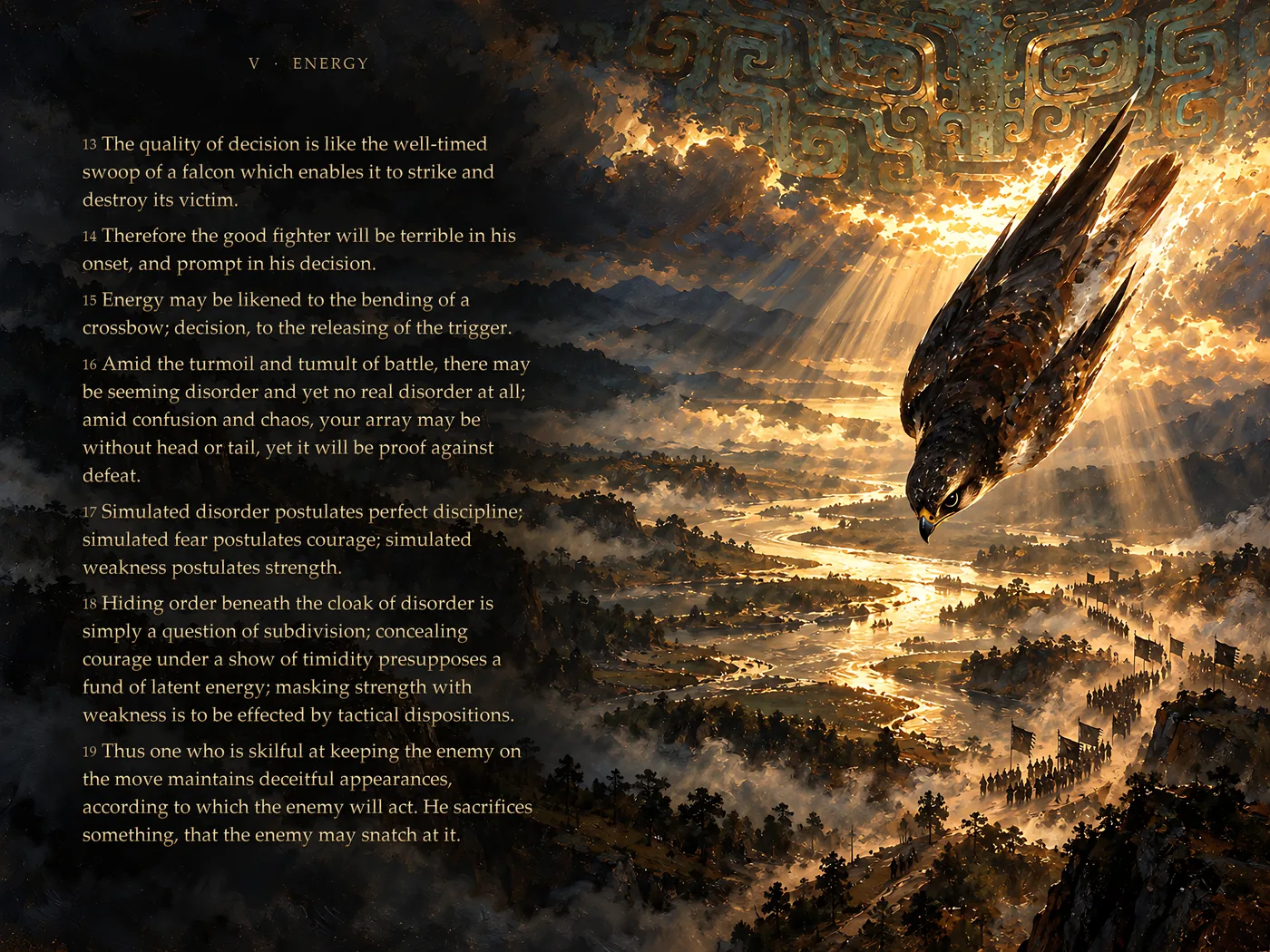
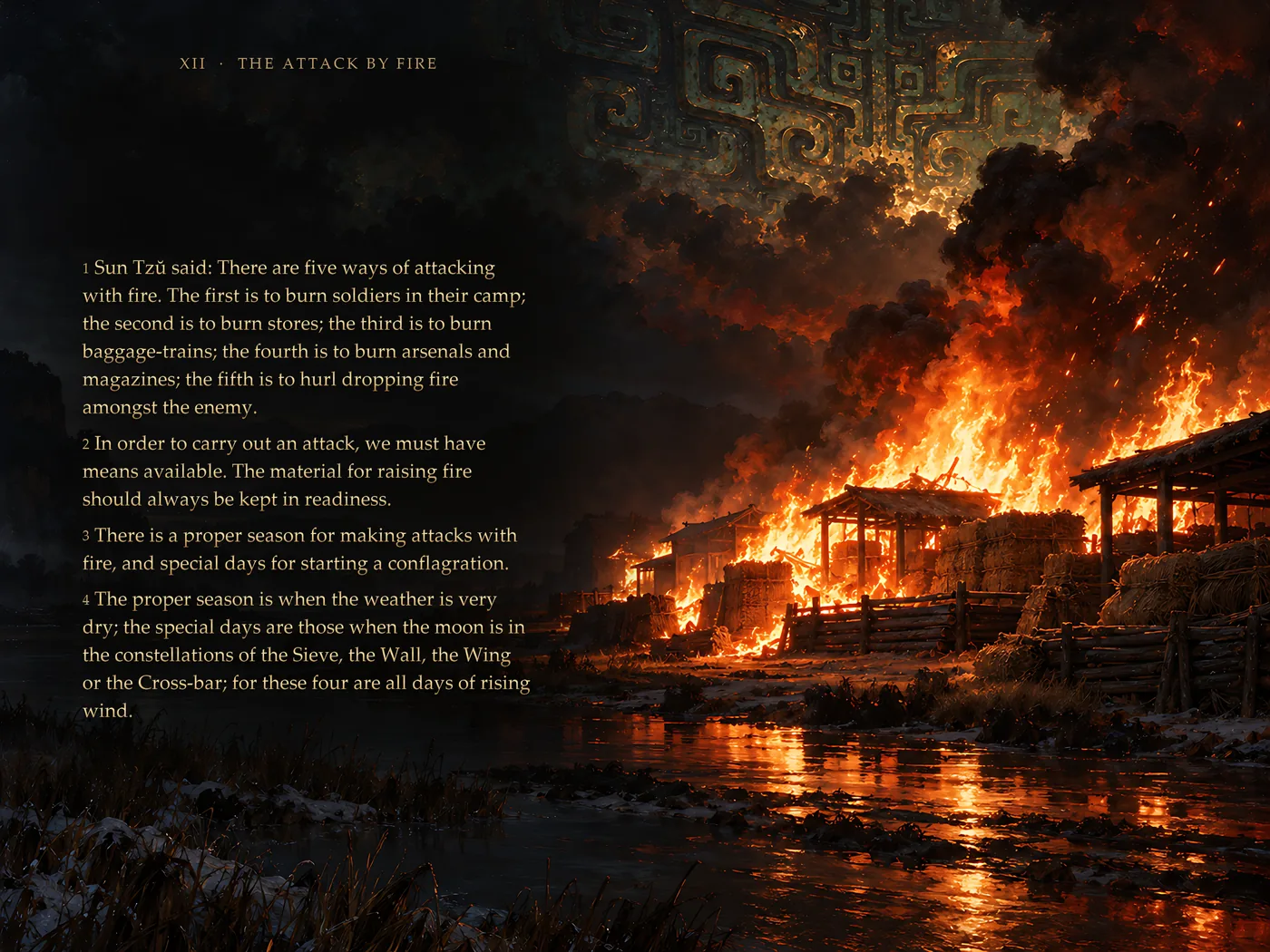
My edition, The Art of War Illustrated, is the third kind. Giles' translation is printed whole, word for word, with his numbers. The only change is typographic: sixteen of his dashes are set as colons. Each chapter opens on its own painting, every spread after that puts a run of verses beside a scene, and one more painting comes after the last line, 85 in all. The scenes stay in Sun Tzu's world, the chariots, bronze weapons, drums and banners of a state around 500 BC. You will not find a horseman anywhere in the book: cavalry reached Chinese armies after his time. The ebook is $0.99.
Choosing one
To read it once and see what the fuss is about, a clean Giles costs nothing. To actually study it, buy Griffith, Sawyer or Minford and read the introduction before the text. Ames is the one for the bamboo-strip version, Cleary for the Taoist one. And if you want a copy you will open again, on a shelf or a tablet, get an illustrated edition.
Questions
Is The Art of War free?
Lionel Giles' 1910 translation is in the public domain in the United States, so free copies of it are legal there. Every later English translation is still in copyright and costs money.
Which translation is the most accurate?
Nobody agrees on one. Giles sticks close to the Chinese. Ames, Sawyer, Minford and Mair know things Giles could not, and Ames builds on the bamboo text found in 1972. Pick by the notes you want next to the verses.
How long is The Art of War?
Thirteen chapters, 383 numbered verses in Giles' version. An evening, or two if you stop to think.
Is there an illustrated Art of War ebook?
Yes. There are comic retellings and editions decorated with old Asian art. The Art of War Illustrated prints Giles' complete text among 85 paintings and costs $0.99 as an ebook.
The Inner Circle
Join the Circle
The next book is already taking shape in the dark.
Be the first to know about new releases, exclusive content, hardcover drops, and glimpses behind the veil of ZoderoT's worlds.
No spam. No noise. Only the signal that matters.