The Art of War · Chapter IV of XIII
Chapter IV: Tactical Dispositions
Sun Tzu's chapter in Lionel Giles' 1910 translation, complete and word for word: verses 1 to 20, numbered as Giles numbered them.
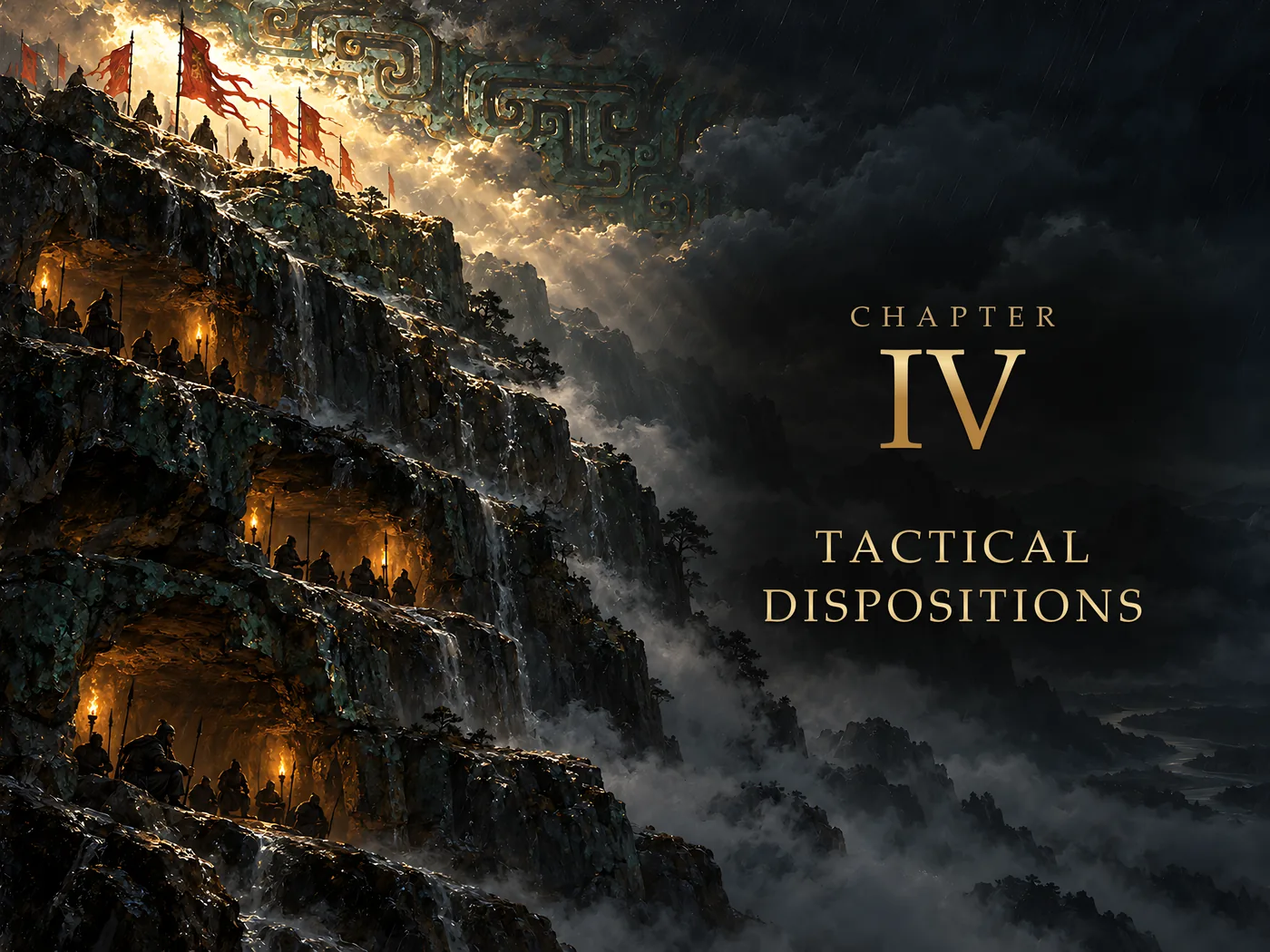
1Sun Tzŭ said: The good fighters of old first put themselves beyond the possibility of defeat, and then waited for an opportunity of defeating the enemy.
2To secure ourselves against defeat lies in our own hands, but the opportunity of defeating the enemy is provided by the enemy himself.
3Thus the good fighter is able to secure himself against defeat, but cannot make certain of defeating the enemy.
4Hence the saying: One may know how to conquer without being able to do it.
5Security against defeat implies defensive tactics; ability to defeat the enemy means taking the offensive.
6Standing on the defensive indicates insufficient strength; attacking, a superabundance of strength.
7The general who is skilled in defence hides in the most secret recesses of the earth; he who is skilled in attack flashes forth from the topmost heights of heaven. Thus on the one hand we have ability to protect ourselves; on the other, a victory that is complete.
8To see victory only when it is within the ken of the common herd is not the acme of excellence.
9Neither is it the acme of excellence if you fight and conquer and the whole Empire says, “Well done!”
10To lift an autumn hair is no sign of great strength; to see sun and moon is no sign of sharp sight; to hear the noise of thunder is no sign of a quick ear.
11What the ancients called a clever fighter is one who not only wins, but excels in winning with ease.
12Hence his victories bring him neither reputation for wisdom nor credit for courage.
13He wins his battles by making no mistakes. Making no mistakes is what establishes the certainty of victory, for it means conquering an enemy that is already defeated.
14Hence the skilful fighter puts himself into a position which makes defeat impossible, and does not miss the moment for defeating the enemy.
15Thus it is that in war the victorious strategist only seeks battle after the victory has been won, whereas he who is destined to defeat first fights and afterwards looks for victory.
16The consummate leader cultivates the moral law, and strictly adheres to method and discipline; thus it is in his power to control success.
17In respect of military method, we have, firstly, Measurement; secondly, Estimation of quantity; thirdly, Calculation; fourthly, Balancing of chances; fifthly, Victory.
18Measurement owes its existence to Earth; Estimation of quantity to Measurement; Calculation to Estimation of quantity; Balancing of chances to Calculation; and Victory to Balancing of chances.
19A victorious army opposed to a routed one, is as a pound’s weight placed in the scale against a single grain.
20The onrush of a conquering force is like the bursting of pent-up waters into a chasm a thousand fathoms deep. So much for tactical dispositions.
For what each chapter argues in plain words, read the summary of Chapter IV. The lines people quote most are collected in Sun Tzu Quotes from The Art of War.
The Inner Circle
Join the Circle
The next book is already taking shape in the dark.
Be the first to know about new releases, exclusive content, hardcover drops, and glimpses behind the veil of ZoderoT's worlds.
No spam. No noise. Only the signal that matters.