Theogony
Prometheus and the Stolen Fire, as Hesiod Tells It
The myth in the earliest Greek source we have, step by step, with Hesiod's lines in Evelyn-White's translation.
The Prometheus most people know is a friend of mankind who suffers for giving us fire. Later writers, the play Prometheus Bound above all, made him that. Hesiod's version, in the Theogony, is older and harder. It is a contest of wits between Prometheus and Zeus, and human beings are the ones who pay for it. It takes up about a hundred lines, 507 to 616, and he tells it backwards: first the punishment, then the crime.
His family
Prometheus is a son of the Titan Iapetus and of Clymene, a daughter of Ocean. Hesiod gives each of his three brothers a line or two. Menoetius is struck by a thunderbolt and sent down to Erebus for his pride. Atlas is made to hold up the sky at the edge of the world. Epimetheus, the fool of the family, is the one who accepts the first woman from Zeus. You can see where all of them sit in the family tree of the gods.
The trick at Mecone
The quarrel begins at a sacrifice. Gods and men have a dispute at Mecone, and Prometheus cuts up an ox to share between them. He hides the good meat under the stomach and makes the bare bones look like the best portion by wrapping them in fat. Then he tells Zeus to choose.
“For when the gods and mortal men had a dispute at Mecone, even then Prometheus was forward to cut up a great ox and set portions before them, trying to befool the mind of Zeus. Before the rest he set flesh and inner parts thick with fat upon the hide, covering them with an ox paunch; but for Zeus he put the white bones dressed up with cunning art and covered with shining fat.”
Hesiod says Zeus saw through it and took the fat anyway, already planning trouble for mortals. It is also his explanation for a real custom: this is why men burn white bones for the gods on their altars.
The stolen fire
Zeus answers by keeping fire from mortal men. Prometheus takes it back.
“But the noble son of Iapetus outwitted him and stole the far-seen gleam of unwearying fire in a hollow fennel stalk.”
The price of fire
Zeus's reply to the theft is a person. He has the Limping God, Hephaestus, shape a maiden out of earth, and Athena dresses her in silver clothes, a veil, garlands and a gold crown. Gods and men alike stare at her. From her, Hesiod says, comes the race of women, and he spends the next lines explaining, in a long and bitter simile about drones in a hive, why he thinks this was a punishment. The Theogony never gives her a name. She is called Pandora only in Hesiod's other poem, Works and Days.
“But when he had made the beautiful evil to be the price for the blessing, he brought her out, delighting in the finery which the bright-eyed daughter of a mighty father had given her, to the place where the other gods and men were. And wonder took hold of the deathless gods and mortal men when they saw that which was sheer guile, not to be withstood by men.”
The eagle
This is the part Hesiod tells first. Prometheus is chained, with a shaft driven through his middle, and an eagle comes every day to eat his liver, which grows back each night.
“And ready-witted Prometheus he bound with inextricable bonds, cruel chains, and drove a shaft through his middle, and set on him a long-winged eagle, which used to eat his immortal liver; but by night the liver grew as much again everyway as the long-winged bird devoured in the whole day.”
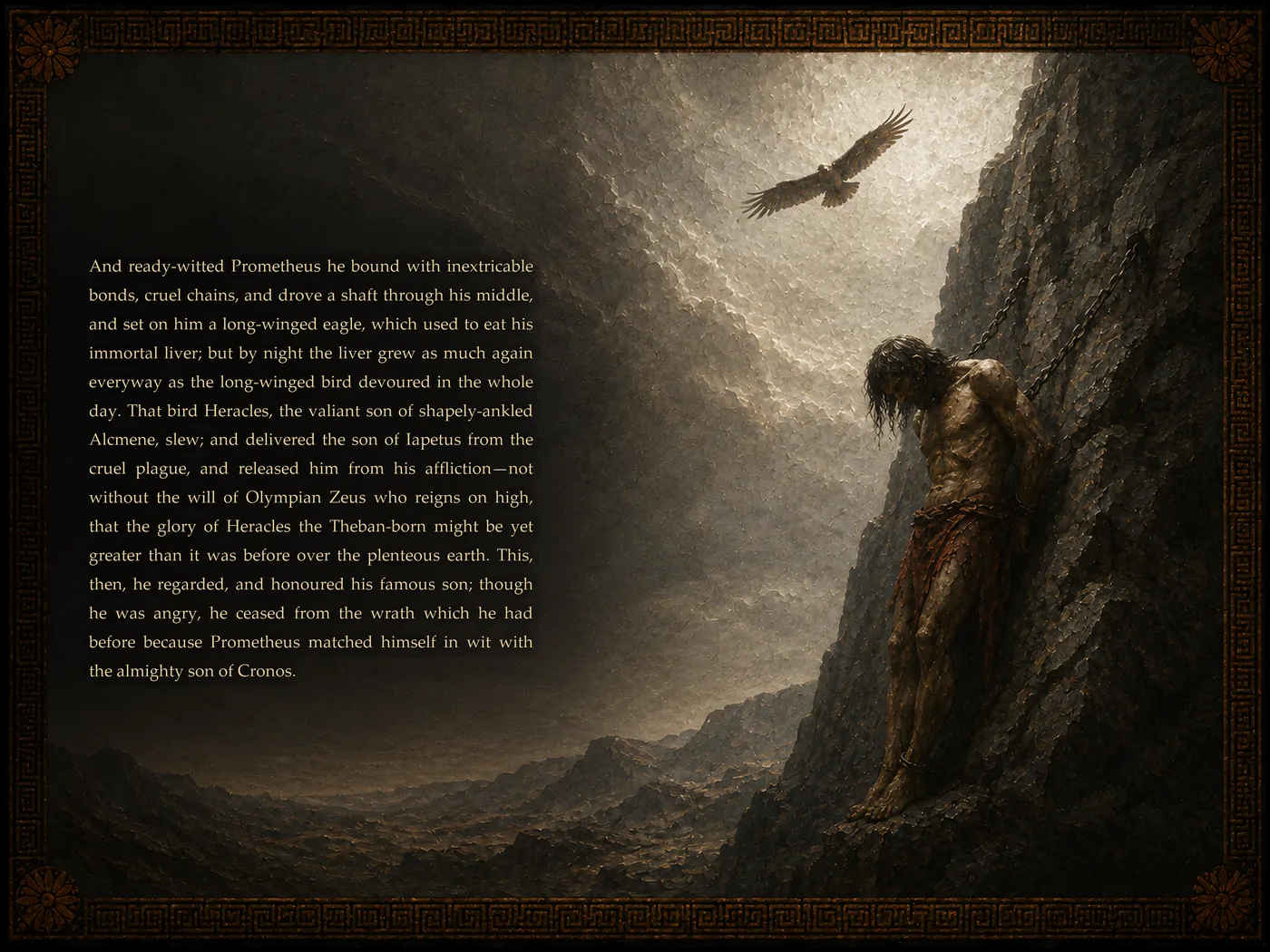
The release comes from Heracles, who kills the eagle. In Hesiod he does it with Zeus's permission, because Zeus wants his son's fame to grow, and Zeus lets go of his anger. Hesiod ends the episode with a flat rule.
“So it is not possible to deceive or go beyond the will of Zeus; for not even the son of Iapetus, kindly Prometheus, escaped his heavy anger, but of necessity strong bands confined him, although he knew many a wile.”
Questions
Why was Prometheus punished?
For outwitting Zeus twice: first with the trick at Mecone, where Zeus was offered bones wrapped in fat, then by stealing back the fire Zeus had withheld from mortals.
Who freed Prometheus?
Heracles. He killed the eagle that ate Prometheus' liver, and in Hesiod he does it with Zeus's consent, so that Heracles' fame would grow.
Is Pandora in the Theogony?
The first woman is there, made by Hephaestus and dressed by Athena as the price of fire, but the Theogony never names her. Hesiod calls her Pandora in his other poem, Works and Days.
What did Prometheus carry the fire in?
A hollow fennel stalk.
For the rest of the poem, read the Theogony part by part.
The Inner Circle
Join the Circle
The next book is already taking shape in the dark.
Be the first to know about new releases, exclusive content, hardcover drops, and glimpses behind the veil of ZoderoT's worlds.
No spam. No noise. Only the signal that matters.