Theogony
Hesiod's Theogony Summary: The Birth of the Greek Gods
From Chaos to the reign of Zeus, part by part, with a passage from each in Hugh G. Evelyn-White's 1914 translation.
The Theogony is Hesiod's account of how the world and the gods came to be: who was born of whom, how Heaven was overthrown by Cronos and Cronos by Zeus, and how Zeus came to rule. It runs to just over a thousand lines. This summary follows the poem in twelve parts, the same divisions used in Theogony Illustrated, and quotes one passage from each exactly as Evelyn-White translated it. The line numbers are those of the Greek text.
1. The Muses
The poem opens with a hymn to the Muses of Helicon, the nine daughters of Zeus and Mnemosyne (Memory). They find Hesiod shepherding his lambs, give him a laurel staff and breathe a divine voice into him so that he may sing of the gods. He ends the hymn by asking them to tell how the world began.
“Shepherds of the wilderness, wretched things of shame, mere bellies, we know how to speak many false things as though they were true; but we know, when we will, to utter true things.”
2. The First Beings
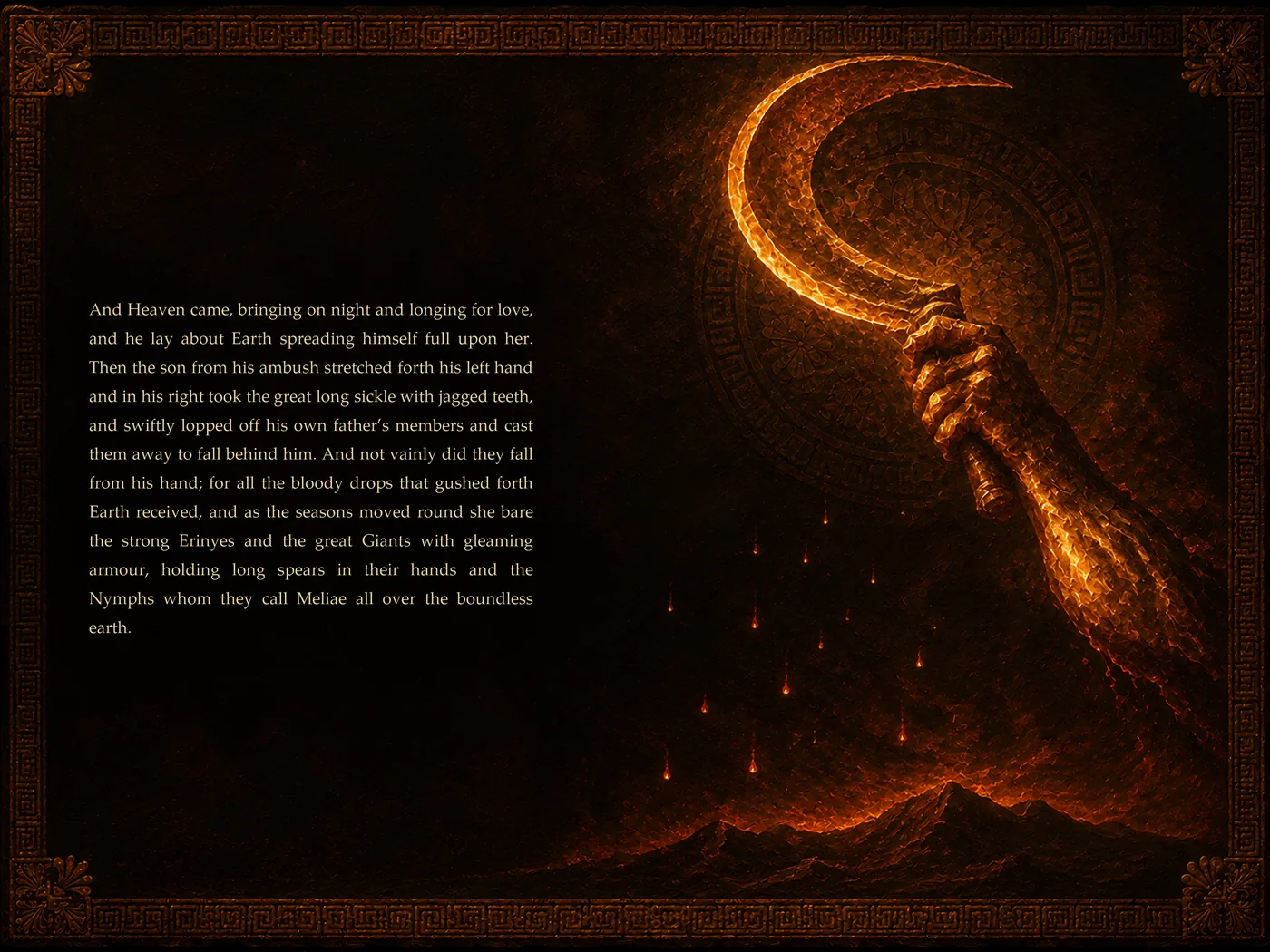
First came Chaos, then Earth, Tartarus and Eros. Earth bears Heaven, and with him the Titans, the one-eyed Cyclopes and three sons with a hundred arms and fifty heads each. Heaven hides his children away inside Earth, so she shapes a great sickle of flint, and Cronos, the youngest Titan, ambushes and maims his father. From the drops of blood come the Erinyes, the Giants and the Meliae; from the foam in the sea rises Aphrodite.
“Verily at the first Chaos came to be, but next wide-bosomed Earth, the ever-sure foundations of all the deathless ones who hold the peaks of snowy Olympus, and dim Tartarus in the depth of the wide-pathed Earth, and Eros (Love), fairest among the deathless gods, who unnerves the limbs and overcomes the mind and wise counsels of all gods and all men within them.”
3. Children of Night and Sea
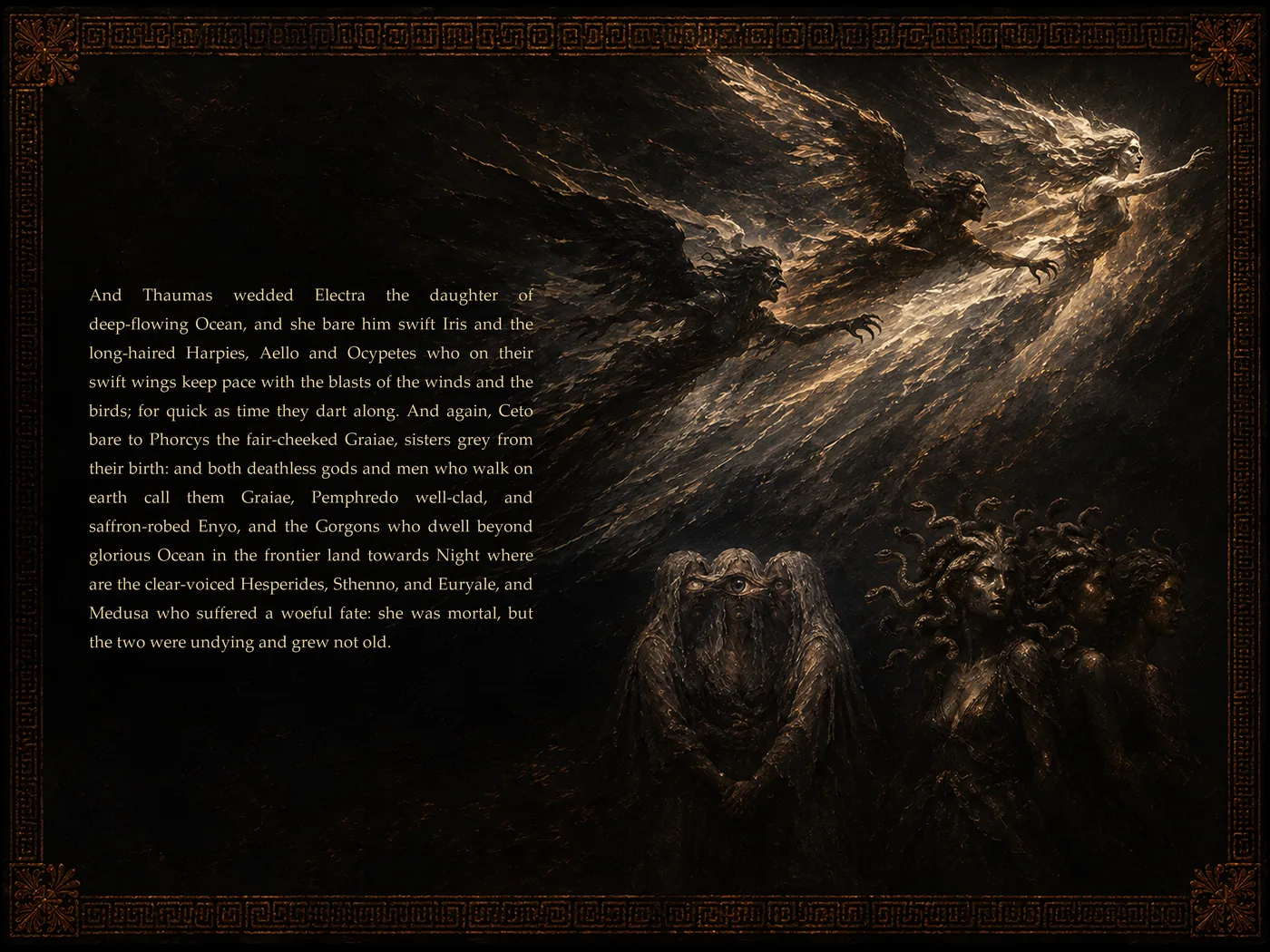
Night, alone, bears Doom, Death, Sleep, Dreams, the Fates, Nemesis and Strife, and Strife in turn bears Toil, Famine, Battles and Lying Words. The Sea's line brings Nereus and his fifty daughters, the swift Harpies, the Gorgons, Pegasus, and the great brood of Echidna: Cerberus, the Hydra of Lerna, the Chimaera, the Sphinx and the Nemean lion.
“And Night bare hateful Doom and black Fate and Death, and she bare Sleep and the tribe of Dreams.”
4. The Registers
Tethys bears to Ocean the great rivers of the world, named one after another, and a host of daughters, with Styx the chief of them. Hesiod counts three thousand daughters of Ocean in all, spread over land and sea.
“For there are three thousand neat-ankled daughters of Ocean who are dispersed far and wide, and in every place alike serve the earth and the deep waters, children who are glorious among goddesses.”
5. Light and Hekate
The Titans' children fill the sky: Sun, Moon and Dawn, the winds and the stars. Styx brings her children Victory, Strength and Force to fight on Zeus's side, and in return her water becomes the great oath of the gods. Then a long praise of Hecate, whom Zeus honours above all and who keeps a share in earth, sea and heaven.
“For to this day, whenever any one of men on earth offers rich sacrifices and prays for favour according to custom, he calls upon Hecate.”
6. The Devouring
Rhea bears Hestia, Demeter, Hera, Hades, Poseidon and Zeus, and Cronos swallows each child as it is born, because he has learned that a son will overthrow him. Rhea hides the newborn Zeus in Crete and gives Cronos a stone wrapped in swaddling clothes to swallow instead. Grown, Zeus makes his father bring up his children and the stone, and frees the sons of Heaven, who give him thunder and the thunderbolt.
“These great Cronos swallowed as each came forth from the womb to his mother’s knees with this intent, that no other of the proud sons of Heaven should hold the kingly office amongst the deathless gods.”
7. Prometheus
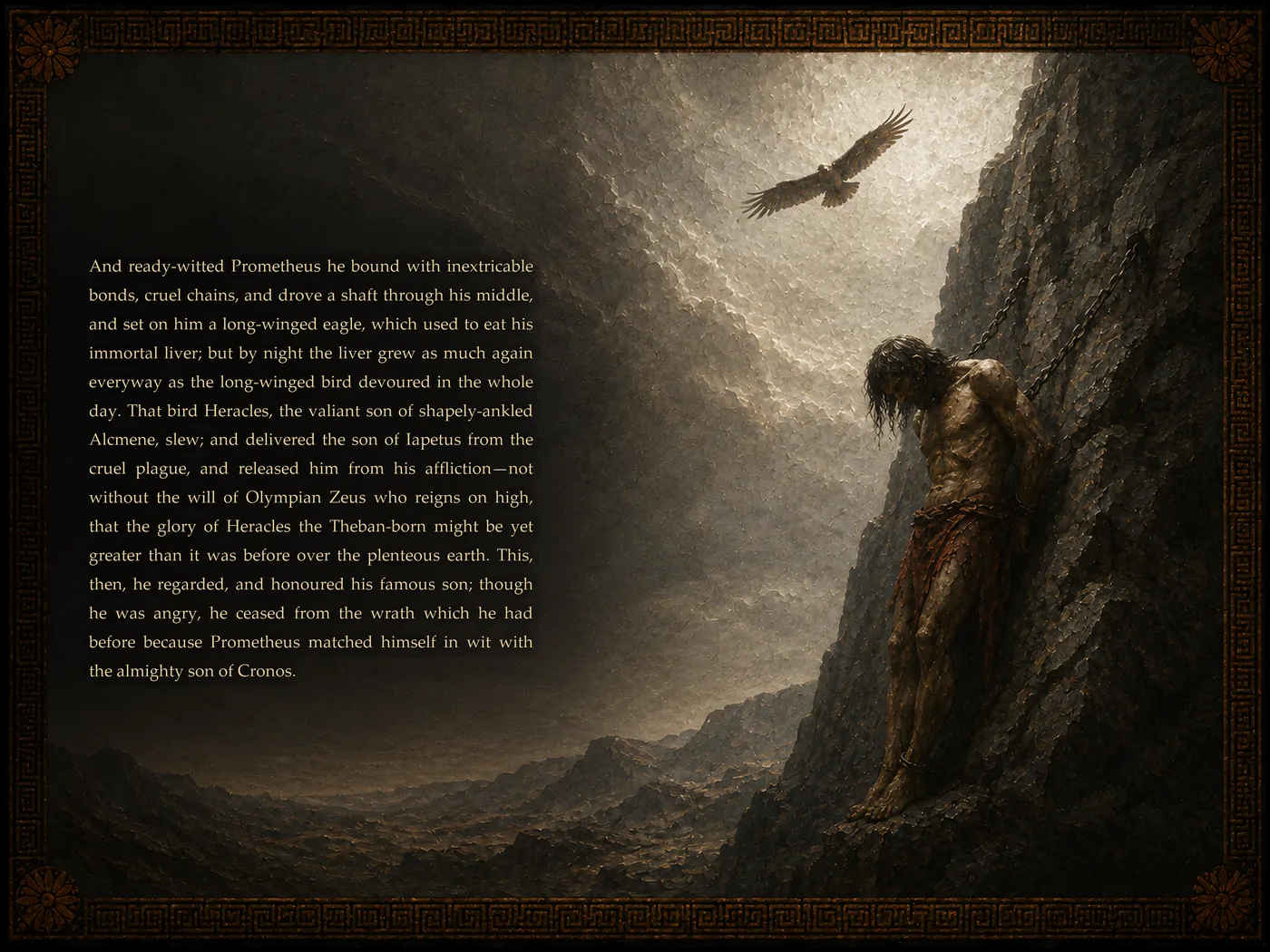
The sons of Iapetus are Atlas, Menoetius, Prometheus and Epimetheus. At Mecone, Prometheus tricks Zeus with a sacrifice of bones wrapped in fat, so Zeus withholds fire from men; Prometheus steals it in a hollow fennel stalk. As the price of fire Zeus has the first woman made and adorned by Hephaestus and Athena, and Prometheus is chained while an eagle eats his liver, until Heracles kills the bird. The myth is told step by step in Prometheus and the stolen fire.
“But the noble son of Iapetus outwitted him and stole the far-seen gleam of unwearying fire in a hollow fennel stalk.”
8. The Titanomachy
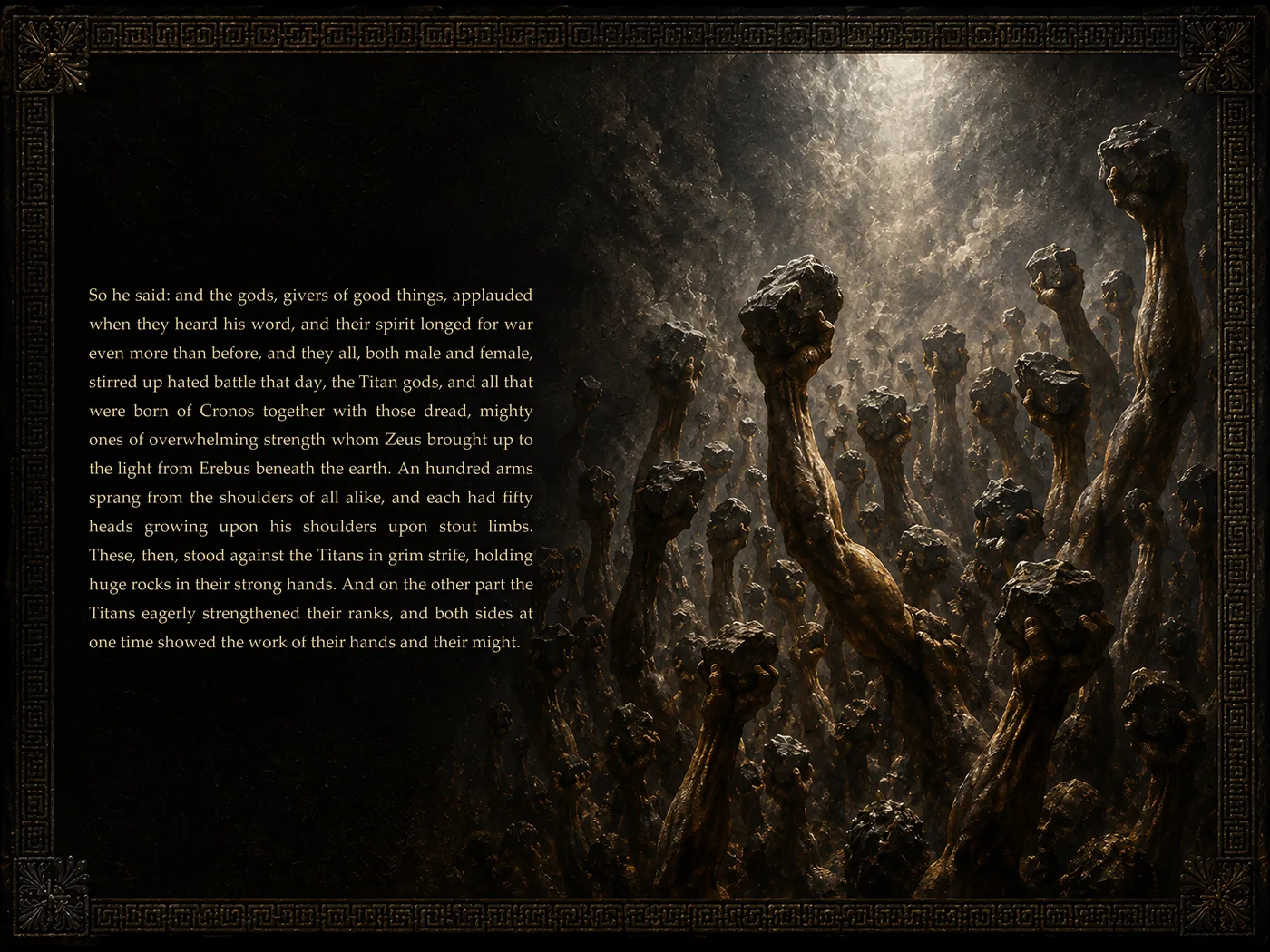
For ten years the Titans fight the children of Cronos with no end in sight. On Earth's advice, Zeus brings the three hundred-armed brothers back to the light, and they join the war. Zeus throws his whole strength into the war, and the world shakes and burns. The hundred-armed brothers overwhelm the Titans with a storm of rocks, bury them beneath the earth and bind them in chains in Tartarus, where the brothers stay as their guards.
“The boundless sea rang terribly around, and the earth crashed loudly: wide Heaven was shaken and groaned, and high Olympus reeled from its foundation under the charge of the undying gods, and a heavy quaking reached dim Tartarus and the deep sound of their feet in the fearful onset and of their hard missiles. So, then, they launched their grievous shafts upon one another, and the cry of both armies as they shouted reached to starry heaven; and they met together with a great battle-cry.”
9. Tartarus
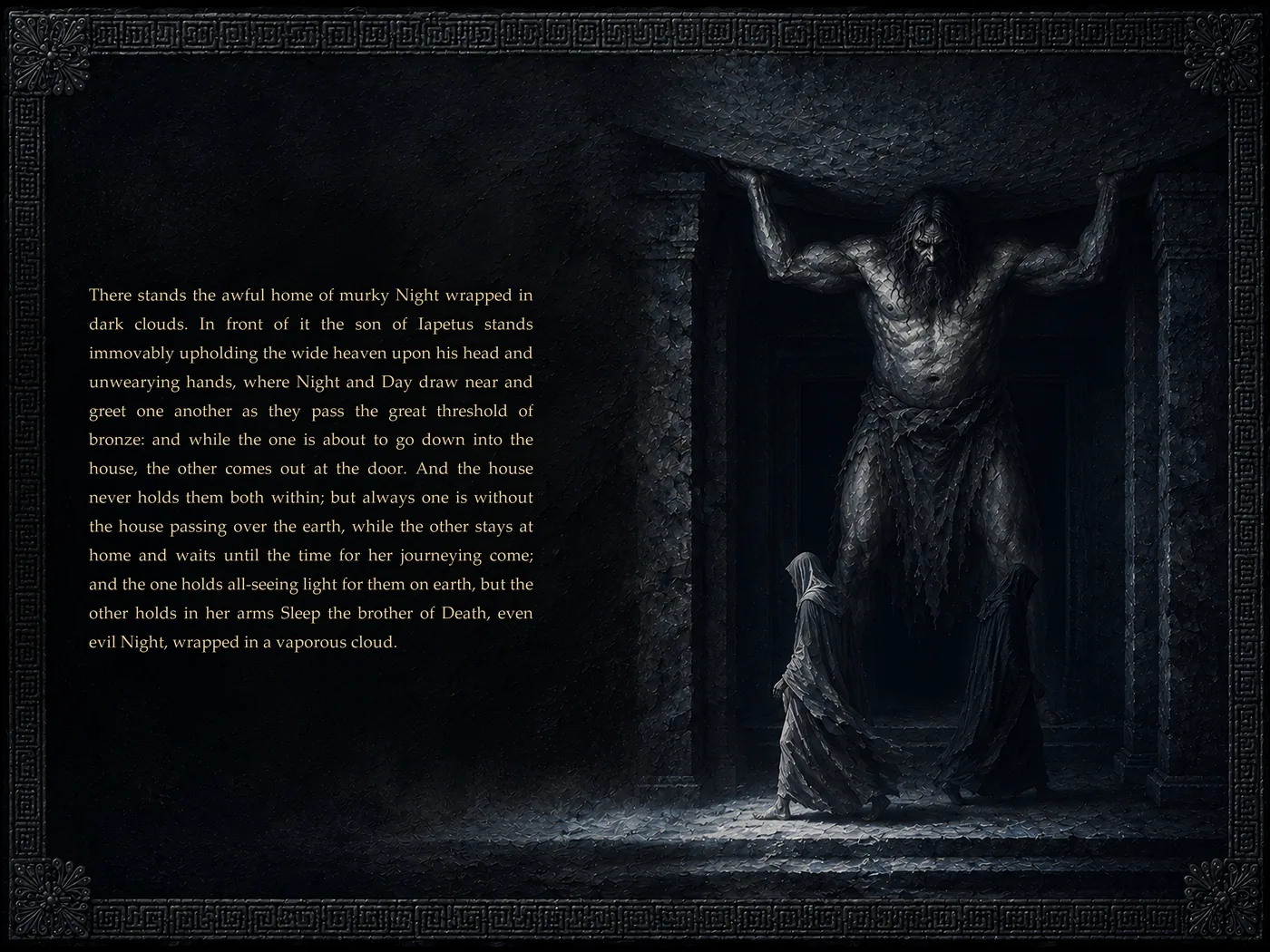
Hesiod describes the underworld: the great gulf a man would fall through for a year, the house of Night where Atlas holds up the sky and Night and Day pass each other at the bronze threshold, the dwellings of Sleep and Death, the halls of Hades and Persephone guarded by their hound, and the water of Styx that punishes a god who swears falsely.
“There stands the awful home of murky Night wrapped in dark clouds. In front of it the son of Iapetus stands immovably upholding the wide heaven upon his head and unwearying hands, where Night and Day draw near and greet one another as they pass the great threshold of bronze: and while the one is about to go down into the house, the other comes out at the door. And the house never holds them both within; but always one is without the house passing over the earth, while the other stays at home and waits until the time for her journeying come; and the one holds all-seeing light for them on earth, but the other holds in her arms Sleep the brother of Death, even evil Night, wrapped in a vaporous cloud.”
10. Typhoeus
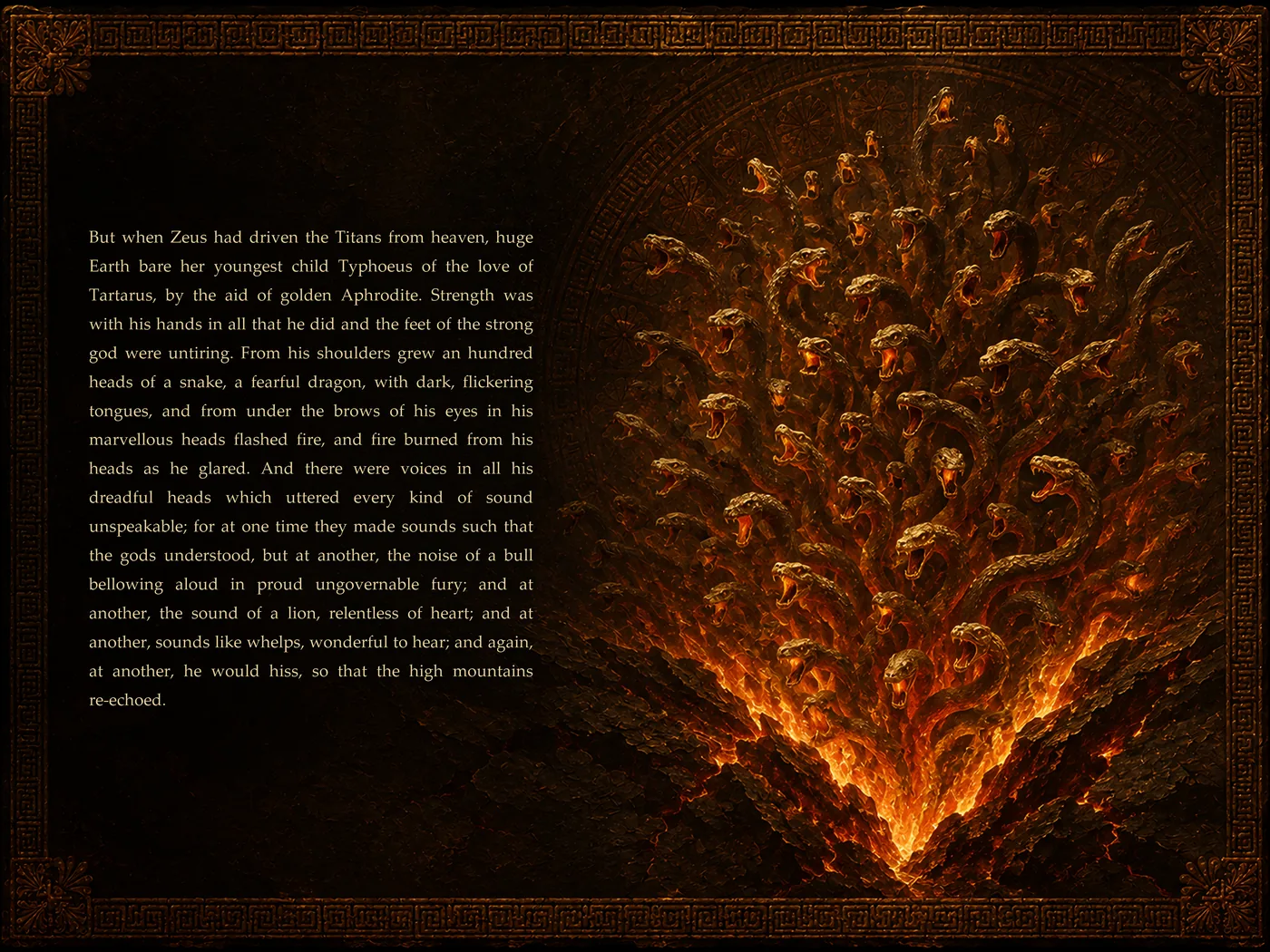
After the Titans fall, Earth bears one last child, Typhoeus, with a hundred serpent heads that speak in every voice. He would have ruled gods and men, but Zeus fights him across a burning world, scorches all his heads and hurls him into Tartarus. From Typhoeus come the wild winds that wreck ships and spoil fields.
“From his shoulders grew an hundred heads of a snake, a fearful dragon, with dark, flickering tongues, and from under the brows of his eyes in his marvellous heads flashed fire, and fire burned from his heads as he glared.”
11. The New Order
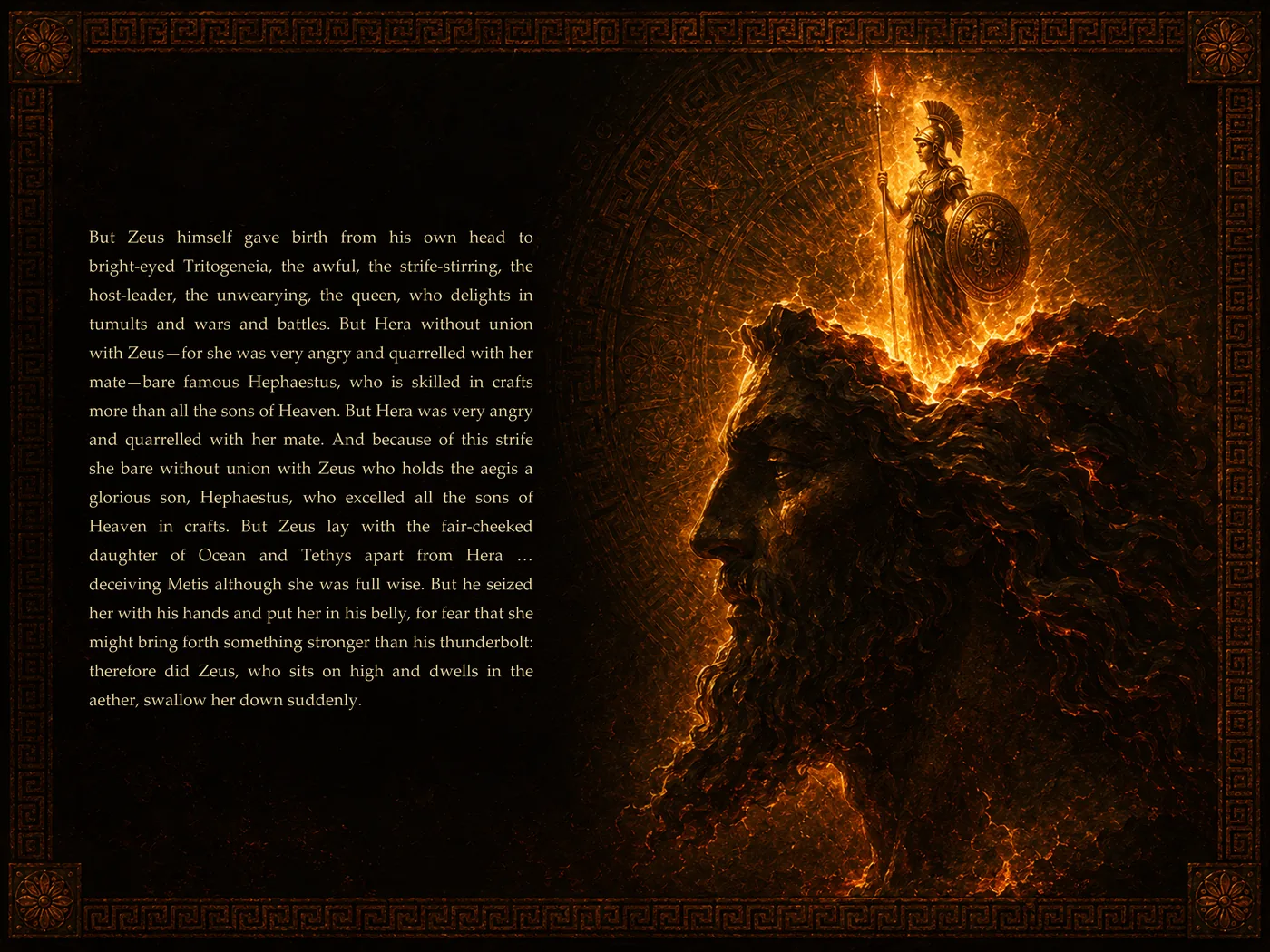
The gods ask Zeus to be their king, and he divides their honours among them. His marriages fill out the Olympian family: he swallows Metis, then fathers the Hours and the Fates with Themis, the Graces with Eurynome, Persephone with Demeter, the Muses with Mnemosyne, Apollo and Artemis with Leto, and Hebe, Ares and Eileithyia with Hera. Athena is born from his head; Hermes, Dionysus and Heracles follow.
“But when the blessed gods had finished their toil, and settled by force their struggle for honours with the Titans, they pressed far-seeing Olympian Zeus to reign and to rule over them, by Earth’s prompting. So he divided their dignities amongst them.”
12. Goddesses and Mortals
The poem closes with goddesses who bore children to mortal men: Demeter and Iasion, Thetis and Peleus, the mother and father of Achilles, Aphrodite and Anchises, the parents of Aeneas, and Circe and Calypso with Odysseus. The last lines call the Muses to sing next of the company of women.
“These are the immortal goddesses who lay with mortal men and bare them children like unto gods.”
Reading the whole poem
Long stretches of the Theogony are lists of names, and on paper a list ought to be dull. Hesiod's are not, because every so often a list breaks open into a scene: the Muses on Helicon, a sickle in the dark, Olympus shaking under the feet of the gods. To see every birth at a glance, follow the Greek gods family tree.
The Inner Circle
Join the Circle
The next book is already taking shape in the dark.
Be the first to know about new releases, exclusive content, hardcover drops, and glimpses behind the veil of ZoderoT's worlds.
No spam. No noise. Only the signal that matters.