Ancient Greek Poetry · The Illuminated Edition
Theogony Illustrated
The birth of the Greek gods, painted opening by opening.
Hesiod's complete Theogony in Hugh G. Evelyn-White's 1914 translation, laid into seventy painted openings across 158 designed pages.
Poem by Hesiod · Translated by Hugh G. Evelyn-White · Illuminated by Alexander Gabriel ZoderoT
Published September 6, 2026 · ASIN B0HFH4NMJ4 · Kindle, paperback and hardcover · Availability and prices vary by marketplace.
70
Painted Openings
158
Designed Pages
1914
Evelyn-White Translation
c. 700 BC
Composed by Hesiod
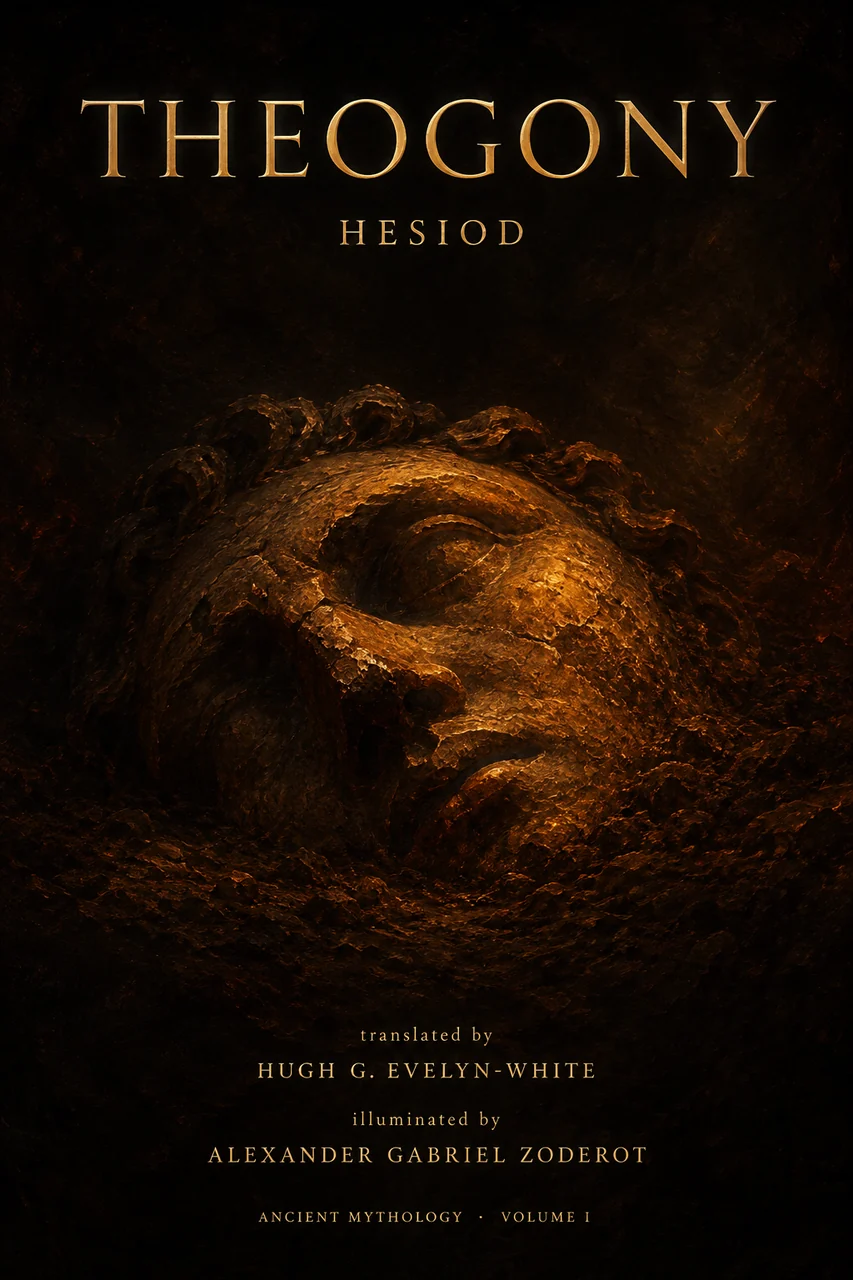
“Verily at the first Chaos came to be, but next wide-bosomed Earth.” Hesiod sets down how the world of the Greek gods began: who was born of whom, how sons overthrew their fathers, and who ended up holding the sky.
This edition presents the Theogony whole. It is neither a retelling nor an illustrated summary of Greek myth. Evelyn-White's translation runs through the entire poem while each painted opening carries its own passage of verse beside the image it inspired.
It is the second of the illuminated editions. The first is The Book of Enoch Illustrated, all 108 chapters of 1 Enoch beside 311 original illustrations.
Edition at a Glance
What This Illustrated Theogony Contains
The complete poem, not a mythology primer, a selection of episodes or a modern paraphrase.
Text
Hesiod's Theogony entire, in the 1914 English translation by Hugh G. Evelyn-White, unaltered.
Scope
From the invocation of the Muses and the first birth of Chaos to the war of the Titans, the fall of Typhoeus and the reign of Zeus.
Visual Edition
Seventy painted openings in black, ember and old gold, each with its verse set on the page beside the painting, across 158 designed pages.
Correct Identity
This is the Theogony. Hesiod's Works and Days is a separate poem and is not included in this volume.
The Opening Invocation
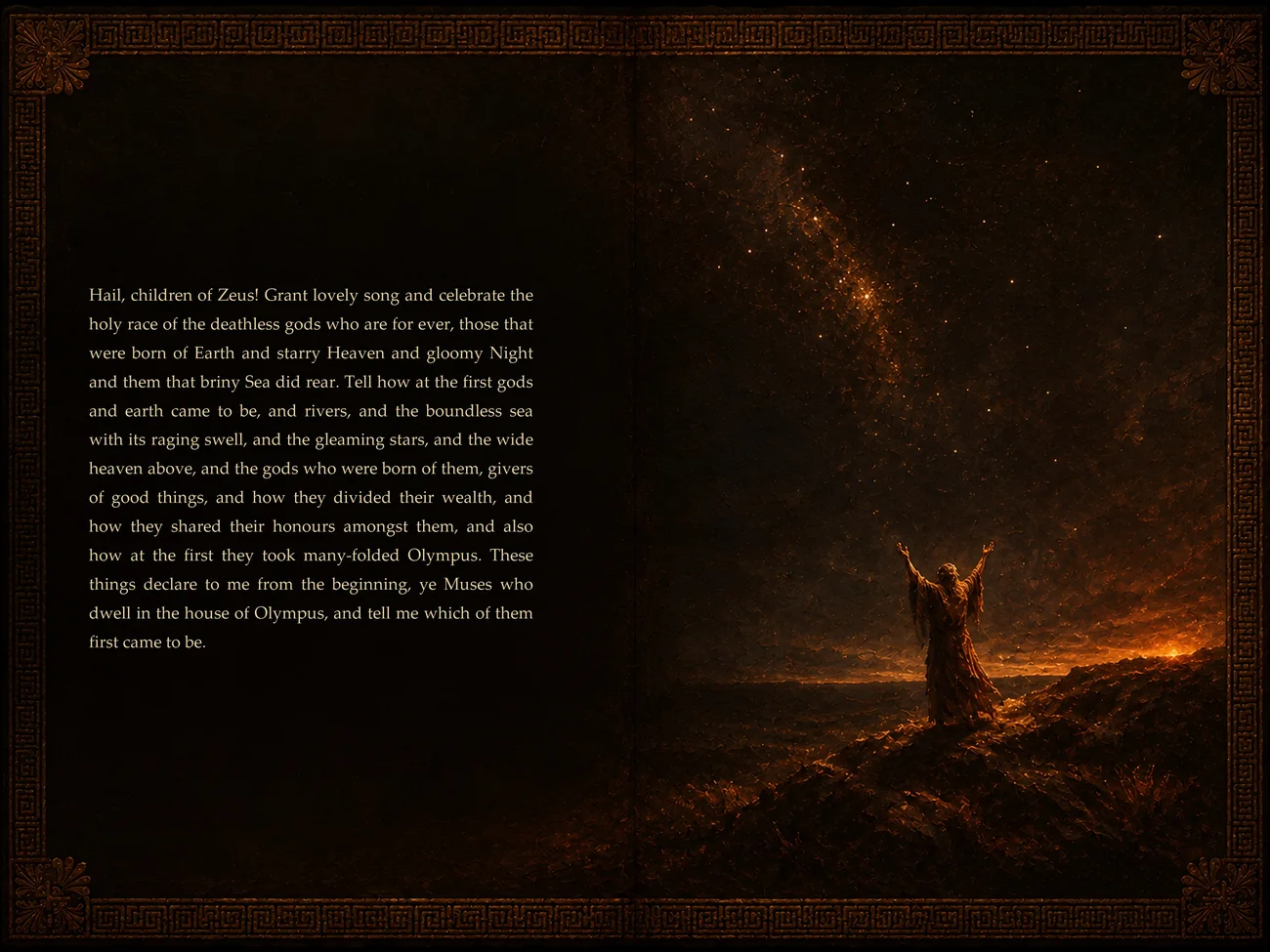
“Tell How at the First Gods and Earth Came to Be”
Theogony Summary
From Chaos to the Reign of Zeus
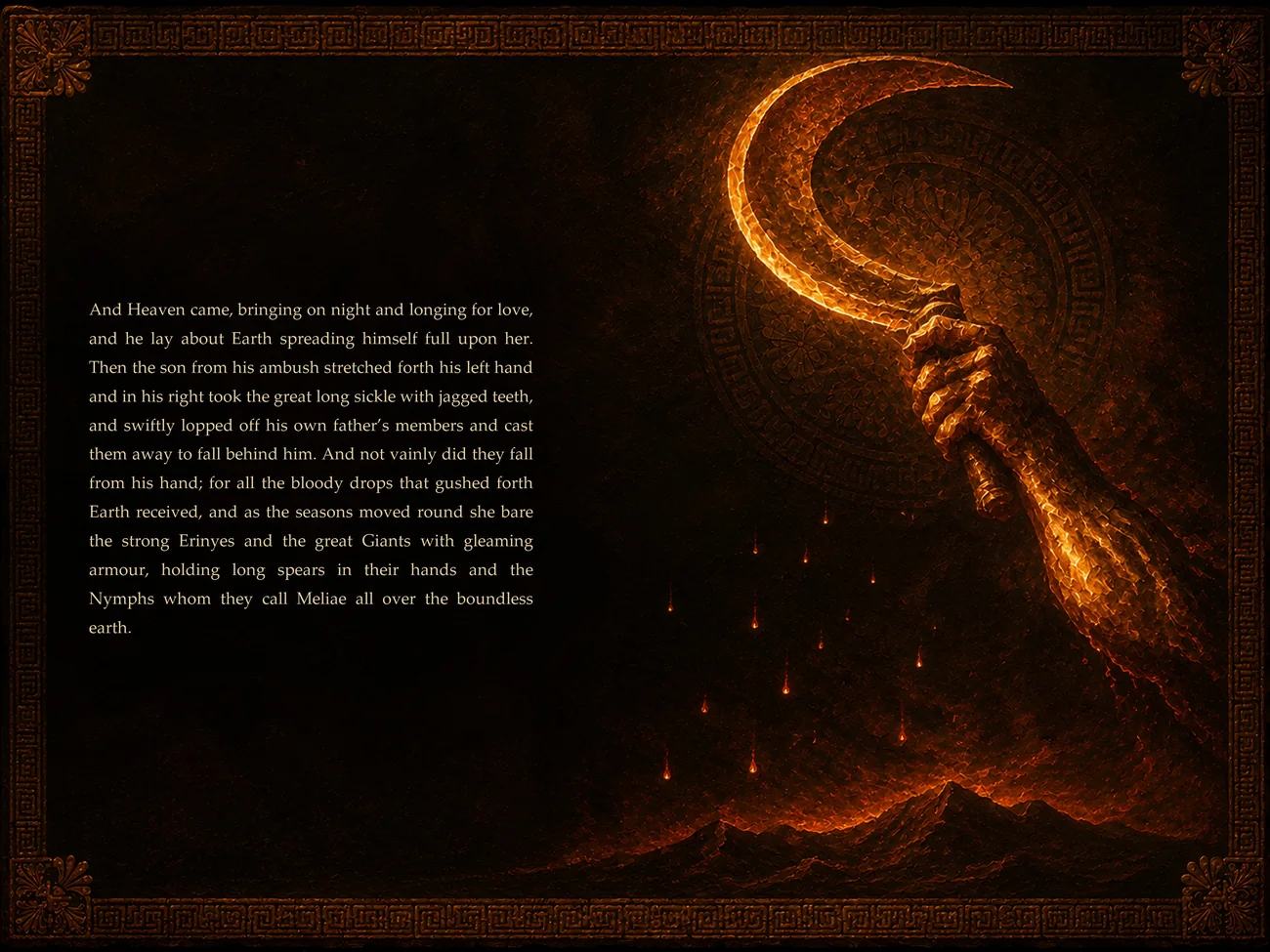
The poem opens with the Muses, then goes back to the very beginning: Chaos, broad Earth, Tartarus and Eros. Earth bears starry Heaven, and from their union come the Titans. Cronus, the youngest, takes the jagged sickle against his father, and from the blood that falls to Earth spring the Erinyes, the Giants and the Meliae.
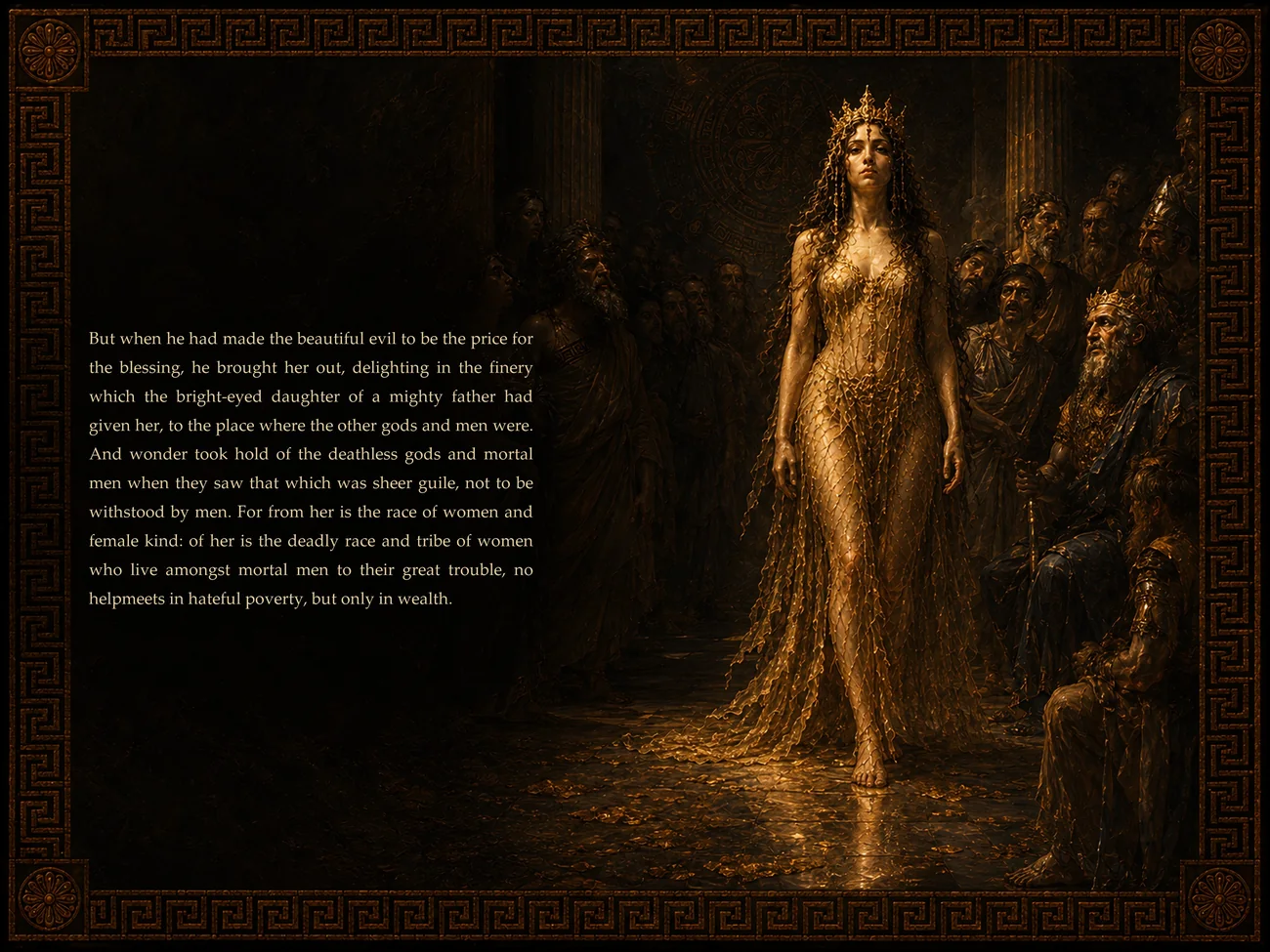
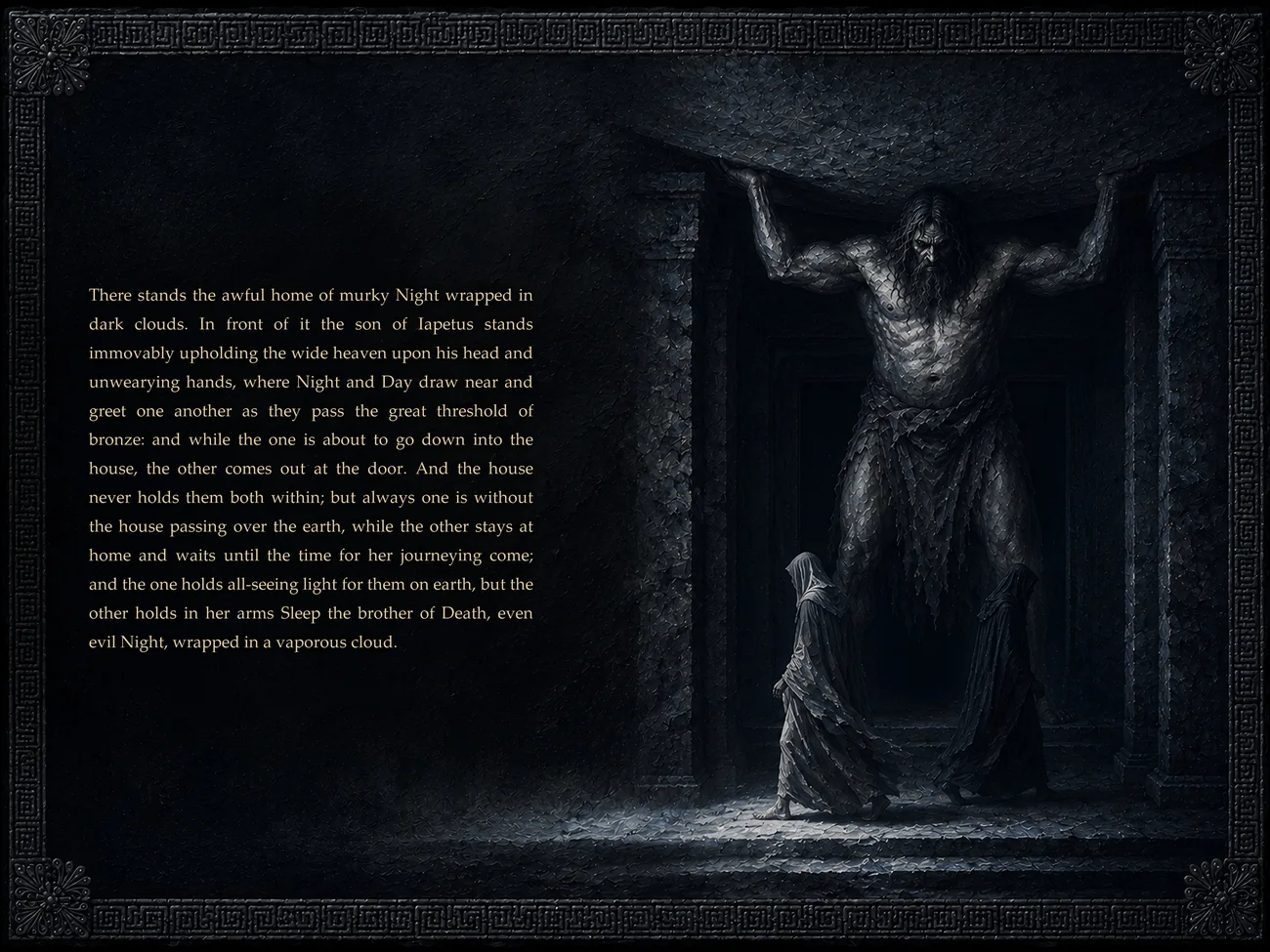
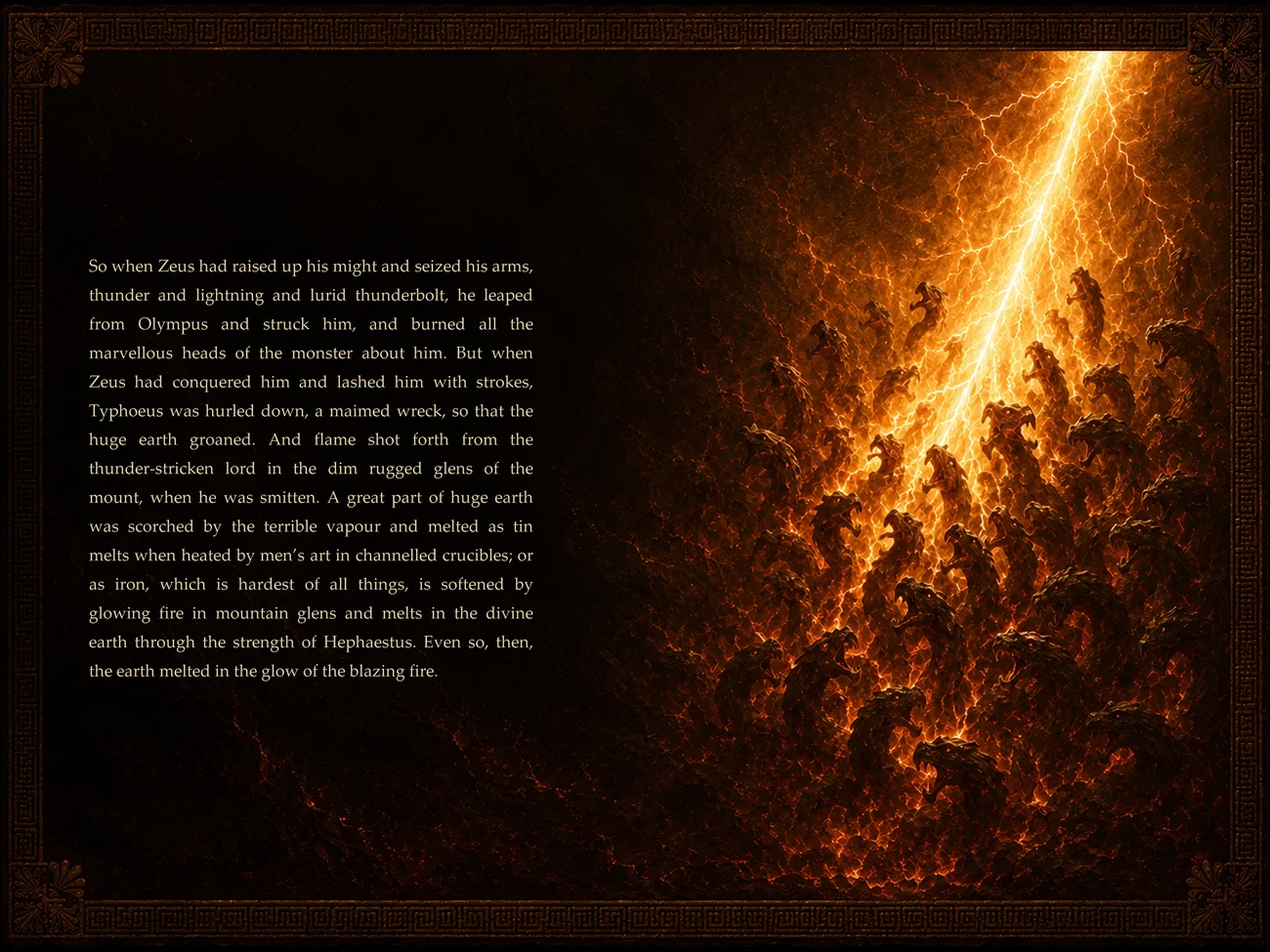
Cronus swallows his own children until Rhea hides the infant Zeus. Tricked by Earth, Cronus brings his children up again, and Zeus, armed with the thunderbolt, leads the war against the Titans with the help of the Hundred-Handed, casting the old gods into Tartarus. Prometheus steals fire, Pandora is sent to men, Atlas holds up the heaven before the house of Night, and Zeus strikes down the monster Typhoeus before the new order of the gods is set.
How to Read the Edition
Read Straight Through, Then Return to the Lines
The Theogony is short enough to read in one sitting, and it rewards that: the genealogies build toward the war of the gods, and the war only lands if you have watched the family grow.
On a second pass, follow a thread: the children of Night, the long lists of rivers and sea nymphs, the story of Prometheus and Pandora, or the Titanomachy itself. Each painted opening holds its own passage of verse, so a page can be read as a single scene.
Inside the Illuminated Edition
Ember, Shadow and Old Gold
Selected openings from the finished book, each shown whole, verse and painting together as they appear on the page.
Digital Reading
Best Viewed in Landscape
Every page of the Kindle edition is a painted opening with its verse set into it. A tablet or computer in landscape mode shows each one at its full width, so the lettering and the painting read together.
Editions
Kindle, Paperback and Hardcover
All three editions are available on Amazon from the same listing. Choose the format there; availability and prices vary by marketplace.
See All Editions on Amazon →Before You Enter
Questions About This Edition
Is this the complete Theogony?
Yes. It contains Hesiod's Theogony whole, in Hugh G. Evelyn-White's 1914 English translation. Nothing is replaced by a summary or a retelling.
Which translation does it use?
Hugh G. Evelyn-White's 1914 English translation, reproduced without alteration.
How many illustrations are included?
The poem is laid into seventy painted openings, across 158 designed pages.
Does it include Works and Days?
No. This edition is the Theogony. Hesiod's Works and Days is a separate poem and is not included.
Was the ancient text rewritten?
No. The creative contribution is the illumination, the paintings and the page design. The words are Evelyn-White's translation.
What device works best for the Kindle edition?
A tablet or computer in landscape mode, so each painted opening is shown at its full width.
Who wrote, translated and illustrated this edition?
The poem is by Hesiod. Hugh G. Evelyn-White made the 1914 English translation. Alexander Gabriel ZoderoT created the paintings and the illuminated page design.
The Oldest Story of the Gods, Painted in Ember and Gold