The Art of War
All Warfare Is Based on Deception: Meaning and Context
The six words everyone knows, read with the verses around them in Chapter I and the lines about deception in the rest of the book.
In Lionel Giles' translation, “All warfare is based on deception” is the eighteenth verse of Chapter I. Sun Tzu says that war is won by making the enemy believe false things about your strength, your position and your intentions, and the verses right after it give examples: look unable when you are able, look far away when you are near. It is a statement about how war works, placed after a long stretch of sober calculation, and it gives no licence to lie in ordinary life. It also has company: deception turns up in nearly every chapter of the book.
What does “All warfare is based on deception” mean?
The verse is short enough to quote whole:
“All warfare is based on deception.”
The Chinese behind it is bīng zhě guǐ dào yě, which says roughly that warfare is a way of trickery. Giles condensed that into a claim about foundations. The verses around it suggest what he means: without deception, war is a contest of numbers, and the larger army wins. Deception is how the smaller side changes the sum.
The next verse says how:
“Hence, when able to attack, we must seem unable; when using our forces, we must seem inactive; when we are near, we must make the enemy believe we are far away; when far away, we must make him believe we are near.”
These are four pairs, and each one is about what the enemy is led to believe: that you cannot attack, that you are idle, that you are near, that you are far. The verb in every case is seem or make him believe. Sun Tzu is describing impressions given by how an army moves and behaves.
What comes before and after verse 18?
Chapter I opens with calculation. Sun Tzu names five constant factors and seven considerations for comparing two armies and forecasting the result, in verses 3 to 14. Then he tells the general to adapt: “According as circumstances are favourable, one should modify one’s plans.” (I. 17). Deception comes straight after that, in a run of short tricks:
“Hold out baits to entice the enemy. Feign disorder, and crush him.”
Verse 22 adds “Pretend to be weak, that he may grow arrogant.” and verse 24 says “Attack him where he is unprepared, appear where you are not expected.” Verse 25 closes the passage with “These military devices, leading to victory, must not be divulged beforehand.” Then the chapter returns to where it began. The general who wins makes many calculations in his temple before the battle, and the one who loses makes few (I. 26). Deception sits between two passages about careful planning, and the planning comes first.
Where else does Sun Tzu write about deception?
The main passages, in order:
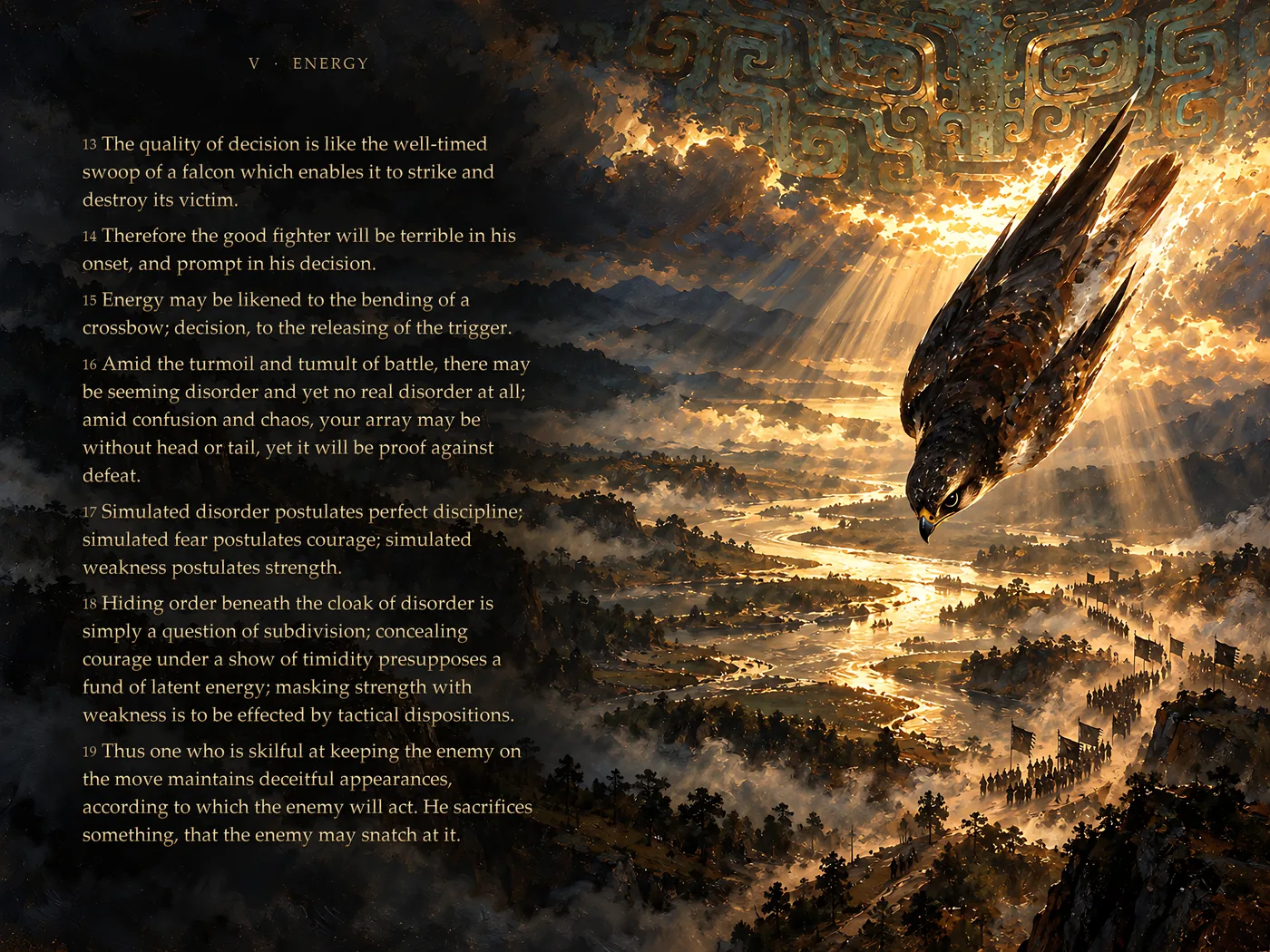
- Chapter V, verse 17: “Simulated disorder postulates perfect discipline; simulated fear postulates courage; simulated weakness postulates strength.” (V. 17). A false show of chaos only works if the army underneath it is in order. Verse 19 adds the bait: “He sacrifices something, that the enemy may snatch at it.”
- Chapter VI, verse 27: “All men can see the tactics whereby I conquer, but what none can see is the strategy out of which victory is evolved.” (VI. 27). The visible part of a campaign is the smaller part of it.
- Chapter VII, verse 15: “In war, practise dissimulation, and you will succeed. Move only if there is a real advantage to be gained.” (VII. 15).
- Chapter XI, verse 36: the general “must be able to mystify his officers and men by false reports and appearances, and thus keep them in total ignorance.” (XI. 36). This is the one verse where the deceived party is the general's own army.
- Chapter XIII, verse 12: doomed spies are sent out “doing certain things openly for purposes of deception”, and our own spies let the enemy know of them (XIII. 12). A spy who is meant to be caught carries a lie with him.
Means, not goal
Does Sun Tzu make deception the goal?
He treats it as a means. The best result in his scheme is to win without a fight, and he says so in Chapter III:
“Hence to fight and conquer in all your battles is not supreme excellence; supreme excellence consists in breaking the enemy’s resistance without fighting.”
The verse on dissimulation ends with a condition, “Move only if there is a real advantage to be gained.” A trick that wins nothing is wasted effort.
He also expects to be deceived in turn. Chapter IX is largely a guide to reading what the enemy shows you, and it says “If his place of encampment is easy of access, he is tendering a bait.” (IX. 20). Chapter VII puts the rule plainly: “Do not swallow a bait offered by the enemy.” (VII. 35). A general who knew only how to deceive would be an easy mark.
How is the line misused?
Mostly it gets lifted out of the book and put to work. In business advice it becomes permission to bluff in a negotiation or mislead a client. In columns on dating and office politics it becomes a method for handling people you see every day. Sun Tzu wrote for a ruler at war with an enemy state, where nobody expects the other side to be truthful, and his audience was the enemy's general. Carrying the verse over to a colleague or a customer is a decision you make, and the text does not make it for you.
The verse is also quoted as if it were the whole book. Taken alone it makes Sun Tzu sound like a cynic. Read with its neighbours it belongs to a manual that argues for planning, speed, cheap victories and care for the men, and says in Chapter X, “Regard your soldiers as your children, and they will follow you into the deepest valleys” (X. 25). The hardest verse for that picture is XI. 36, where the general deceives his own army, and a fair reading has to admit it.
A third misuse treats verses 19 to 24 as a list of tricks to copy. They are examples of one principle: the enemy acts on what he believes about you. The examples belong to a world of chariots and drums. The principle is the part that travels.
How should you read it today?
As a description of any contest in which each side acts on a picture of the other. A chess player, a trade negotiator and a campaign manager all work inside it: what the other party can see of you shapes what they do. Two practical readings follow from the text. Guard what you reveal, which is the advice of Chapter VI: “conceal your dispositions, and you will be safe from the prying of the subtlest spies, from the machinations of the wisest brains” (VI. 25). And check what you are shown, which is the purpose of the bait verses.
A slogan cannot carry the conditions Sun Tzu attached: a real enemy, a real advantage to be gained, and calculation first. Used without them, the line is a licence for bad behaviour with a famous name on it. The same book has a page on knowing the enemy and knowing yourself, which is the honest half of the calculation, and a page on who Sun Tzu was and how little is certain about him.
For the verse in its place, the whole of Chapter I is short and the full text is online. The summary places Chapter I among the other twelve, the quotes page collects thirty verses, and sixteen lines wrongly or loosely credited to him are checked against the text.

Questions
What does “All warfare is based on deception” mean?
Sun Tzu says that war is won by making the enemy believe false things about your strength, position and intentions. The verses after it give examples. It describes how war works and gives no licence to lie in ordinary life.
Where is “All warfare is based on deception” in The Art of War?
Chapter I, Laying Plans, verse 18, in Lionel Giles' 1910 translation. Other translators word the line differently.
Did Sun Tzu say people should lie to each other?
The text does not say that. His deception is aimed at an enemy in war, it is tied to a real advantage to be gained, and it comes after careful calculation. He ranks winning without a fight above any trick.
What else does Sun Tzu say about deception?
Chapter V says that simulated disorder needs perfect discipline underneath, Chapter VII says to practise dissimulation, Chapter XI has the general mystify his own men, and Chapter XIII describes doomed spies who carry false news to the enemy.
What does the Chinese behind the line say?
The Chinese reads bīng zhě guǐ dào yě, which says roughly that warfare is a way of trickery. Giles turned it into a statement about what war is based on.
The Inner Circle
Join the Circle
The next book is already taking shape in the dark.
Be the first to know about new releases, exclusive content, hardcover drops, and glimpses behind the veil of ZoderoT's worlds.
No spam. No noise. Only the signal that matters.