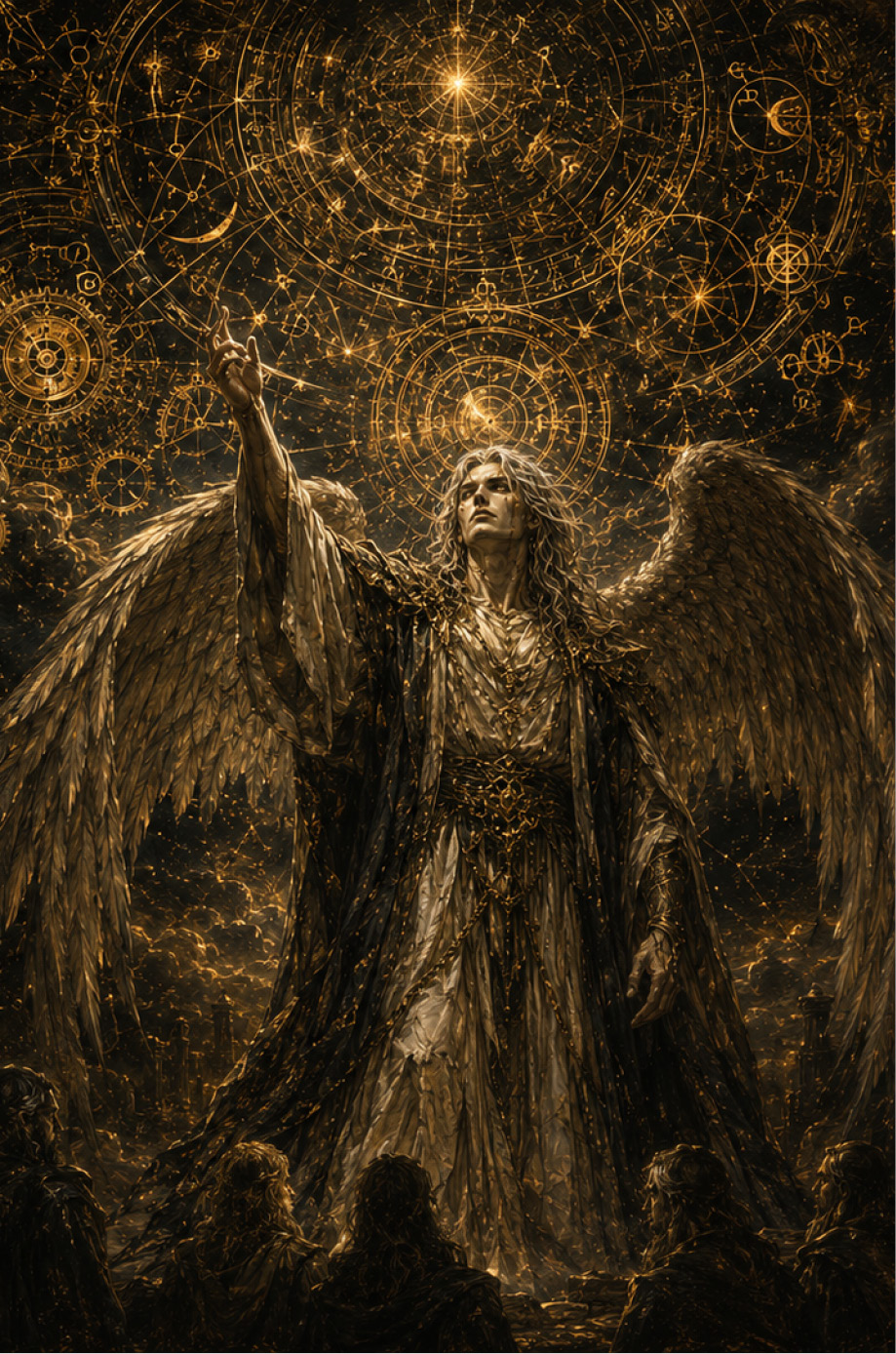
The Book of the Watchers is the opening major section of 1 Enoch, conventionally covering chapters 1–36. It expands two brief passages in Genesis: Enoch walking with God and being taken (Genesis 5:21–24), and the “sons of God” taking human wives before the Flood (Genesis 6:1–4).
What emerges is far stranger than a longer fallen-angel story. It is an argument about knowledge, authority, violence, and the boundary between heaven and earth. The Watchers disclose arts they were not authorised to give. Their children magnify appetite into devastation. Enoch receives revelation through a different route: he is summoned, shown, and commanded to speak.
Chapters 1–5: Judgement Before the Story
The book opens with blessing and judgement, not with the descent on Hermon. Enoch's words concern a distant generation, the righteous who will survive a time of trouble, and the coming of the Holy Great One. The natural world becomes evidence: luminaries keep their courses, seasons arrive, trees and waters fulfil their appointed work.
Human beings are the contrast. Creation observes order while sinners abandon it. This opening gives the rest of the book its moral frame. The Watchers' crime will not be disturbing merely because angels cross a boundary; it will be disturbing because their rebellion produces disorder in a creation whose patterns testify to rightful order.
1 Enoch 1:9 later appears in close correspondence with Jude 14–15. The connection is important, but the chapter first belongs to the architecture of 1 Enoch itself: divine judgement answers a world whose violence has reached beyond ordinary human measure.
Chapters 6–8: The Oath on Mount Hermon
Two hundred Watchers desire human women. Semyaza, their leader, fears that the others will abandon the plan and leave him to bear the punishment alone. They answer by binding themselves under a shared oath. The mountain receives its name from that act of mutual binding: Hermon becomes the landscape of collective transgression.
The Watchers take wives, and giant offspring are born. The giants consume what human beings produce; when that is no longer enough, they turn against humans and then against the rest of creation. Appetite loses every limit. Blood fills the earth.
Chapter 8 adds illicit instruction. Azazel teaches the making of swords, knives, shields, breastplates, metals, ornament, cosmetics, and precious stones. Other Watchers teach enchantments, root-cutting, astrology, celestial signs, the courses of the moon, and related arts. Lists vary across textual witnesses, so individual spellings and assignments should not be treated as perfectly stable.
Why is forbidden knowledge central?
The narrative does not condemn knowledge in itself. Enoch also receives hidden knowledge, and later sections of 1 Enoch devote enormous attention to the ordered heavens. The difference is authority, purpose, and consequence. The Watchers disclose knowledge through rebellion, and the immediate result is domination, seduction, warfare, and disorder. Enoch receives knowledge as witness and is instructed how it should be transmitted.
Chapters 9–11: Heaven Hears the Earth
Michael, Uriel, Raphael, and Gabriel look down and see bloodshed. The cry of the dead rises to the gates of heaven. The Most High responds with a sequence of commands that separates the principal offenders and addresses the damage they caused.
Uriel is sent to warn Noah of the coming destruction. Raphael is commanded to bind Azazel and cast him into darkness, beneath rough and jagged stones, until the day of judgement. Gabriel is sent against the giant offspring. Michael is commanded to bind Semyaza and his associates for their unions with women.
Azazel receives particular blame: the earth is said to have been corrupted through the works taught by him. Yet the text does not reduce the entire rebellion to Azazel alone. Semyaza leads the oath and descent; Azazel embodies a distinct line of corrupting instruction. Flattening them into one character erases an important tension in the story.
Judgement is followed by a vision of healing. Violence is removed, the earth is cleansed, righteousness appears, and creation becomes fruitful. The book's imagination is severe, but destruction is not its final purpose. Judgement clears the ground for restored order.
Chapters 12–16: Enoch's Failed Intercession
Enoch is introduced as a righteous scribe whose eyes have been opened. The Watchers ask him to write a petition requesting forgiveness and long life. He reads their plea and then receives a vision. The answer reverses the expected relationship between heavenly beings and a human: the Watchers should have interceded for humanity, but they now ask a human to intercede for them.
The petition fails. Enoch returns with judgement. The Watchers abandoned their proper heavenly state, took wives, produced giants, and disclosed destructive knowledge. They will not receive peace. They will witness the death of their children and remain bound until final judgement.
Where do evil spirits come from?
Chapters 15–16 draw a careful distinction. The Watchers are heavenly beings. The giants are their embodied offspring from human women. When the giants die, spirits proceed from their bodies and remain upon the earth as destructive spirits. They afflict, attack, and cause trouble until the final judgement.
This explanation became highly influential in discussions of demonology. It is inaccurate to call every being in the sequence simply a “fallen angel.” The text differentiates Watchers, living giants, and the spirits of dead giants.
Chapters 17–19: Fire, Winds, and the Prison of Stars
Enoch's guides carry him beyond familiar geography. He sees places of fire, treasuries of winds, the foundations of the earth, waters, rivers, and a location where heavenly fire runs like water. The journey is not modern cartography. It is revealed geography: moral and cosmic order expressed as places that can be visited and witnessed.
He sees a terrible place where stars that transgressed are imprisoned. The text associates cosmic disorder with punishment just as it associated the Watchers' descent with disorder on earth. The boundaries of creation are morally charged.
At the close of this movement, Enoch is shown the place where the rebellious angels who joined women are confined. The women connected to them are described through the imagery of sirens. Textual and translation difficulties make careless certainty unwise here; the larger point is confinement awaiting final judgement.
Chapter 20: The Seven Holy Angels
Chapter 20 provides a compact list of seven angels and their functions: Uriel, Raphael, Raguel, Michael, Saraqael, Gabriel, and Remiel in the familiar Charles translation. Spellings vary between translations because names pass through Aramaic, Greek, Ge'ez, and modern editorial decisions.
The list helps readers orient the journeys. Uriel is repeatedly associated with cosmic places and heavenly luminaries; Raphael with human spirits; Raguel with punishment in the world of luminaries; Michael with the better part of humankind and chaos; Saraqael with spirits who sin; Gabriel with Paradise, serpents, and cherubim; Remiel with those who rise.
Chapters 21–32: Prisons, the Dead, Jerusalem, and Paradise
Enoch sees a chaotic prison for stars and heavenly powers. He then travels to a great mountain and to hollow places where the spirits of the dead are separated while awaiting judgement. Chapter 22 is important because it imagines an intermediate condition: the dead are held in distinct compartments according to their state and the nature of their deaths.
He sees fire in the west, rivers of fire, seven magnificent mountains, and a fragrant central mountain associated with the divine throne. The journeys then move towards the centre of the earth, where he sees a blessed place and a deep accursed valley prepared for judgement.
In chapters 28–32, the landscape changes through deserts, aromatic trees, mountains, and the Garden of Righteousness. Enoch sees the tree of wisdom from which the ancestors ate. The sequence places judgement, sacred centre, and Paradise within one revealed world. Geography becomes a way of holding memory and destiny together.
Chapters 33–36: The Ends of the Earth
The final chapters take Enoch to the extremities of the earth. He sees portals through which stars, winds, and other forces emerge. The tour moves through cardinal directions and returns repeatedly to gates, courses, and ordered operations.
This ending can feel remote from the dramatic Watcher narrative, but it completes the opening contrast. The Watchers violated their appointed place; the created forces continue through appointed gates and courses. Cosmology is therefore part of the ethical argument, not an unrelated appendix.
What Is the Book of the Watchers Actually About?
At one level it explains evil by expanding Genesis 6. Heavenly rebellion introduces illicit knowledge; giants spread violence; the spirits of dead giants continue affliction. This moves part of the origin of evil beyond Adam and Eve without removing human responsibility.
At another level it distinguishes two kinds of revelation. Knowledge taken and distributed through rebellion becomes domination. Knowledge shown to Enoch makes him a witness responsible to speak. The book is not anti-knowledge. It is concerned with knowledge severed from rightful order and moral responsibility.
Finally, it insists that violence is heard. The blood and suffering of creation rise to heaven. Judgement may be delayed, but the cries are not lost. That promise explains why the book begins with the vindication of the righteous before it tells how the world became corrupt.
How the Book Builds Its Case
The book's repetitions are purposeful. Again and again, Enoch is shown boundaries: the place of a star, the course of a wind, the dwelling assigned to the dead, the mountain reserved for a future purpose. None of this is scenery. Each boundary makes a claim about responsibility. A created being has a place and task; disaster follows when power refuses either.
This does not make the work a simple scheme in which every suffering person is blamed for disorder. Its most urgent image is the cry of blood rising from the earth. Victims are heard before judgement is described. The accusation is directed towards the Watchers, giants, and violent human world, not towards those injured by them. That moral asymmetry is easy to miss when the story is reduced to sensational lore.
Its promised restoration is therefore more than a return to calm. The earth is healed because the sources of devastation have been confronted. The book imagines justice as both disclosure and repair: hidden teaching is exposed, rebels are confined, and a damaged creation is allowed to bear fruit again. The severity of its images serves that hope for an order in which violence no longer has the last word.
The Book of the Watchers is remembered for arresting images: two hundred angels on Hermon, immense children, a desert prison, a tree of wisdom. Its power comes equally from the order in which those images arrive. Before the descent is narrated, the opening establishes a universe in which stars, seasons, and trees keep their appointed courses. The Watchers therefore enter a moral cosmos, not an empty stage on which anything might happen.
The story narrows from creation to a shared oath, from oath to teaching, from teaching to violence, and from violence to a cry that reaches heaven. That progression prevents the giants from becoming mere monsters. Their hunger is the visible consequence of a disorder that begins in a refusal of proper limits. The heavenly judgement is correspondingly divided: each figure is judged in relation to a distinct act, while the earth itself is promised cleansing and renewal.
Enoch stands at the hinge of the book. He is neither the commander who can cancel the sentence nor a passive tourist in heaven. He writes, carries words, sees, and reports. His failed intercession shows that revelation does not place a human witness above justice. The Watchers ask for mercy after the ruin they have caused; the reply insists that beings appointed to watch over human beings cannot demand from a human the advocacy they withheld.
Genesis 6 and 1 Enoch: Expansion, Not Replacement
Genesis 6:1–4 is famously compressed. It names the “sons of God,” human daughters, the Nephilim, and the approach of the Flood without explaining every relationship. The Book of the Watchers supplies a dramatic interpretation: heavenly beings descend, marry women, teach illicit arts, and father giants. That interpretation became influential, but it remains one interpretation of Genesis and not the only way Jewish or Christian readers have understood the passage.
Later readers have proposed several identifications for the sons of God: angels, royal rulers, or the godly line of Seth. Those debates belong to the reception of Genesis and should not be settled by pretending that 1 Enoch simply quotes a longer lost chapter of Genesis. Its value is that it shows one ancient Jewish way of reading a difficult biblical text, in a work with its own theology, imagery, and literary aims.
The word Nephilim also deserves restraint. Genesis uses it in its own terse setting; the Greek tradition behind many English Bibles uses “giants” in related contexts; 1 Enoch develops giant offspring at length. These terms overlap in later imagination, but a careful reader lets each text speak in its own scene before making them identical.
Reading Semyaza, Azazel, and the Angels
Semyaza and Azazel are not interchangeable villains. Semyaza voices the fear that the others will leave him bearing the penalty, then binds the group in a collective oath. His role makes the descent a chosen solidarity in wrongdoing. Azazel's teaching of weapons, ornament, and metalwork gives the corruption another texture: violence is taught, displayed, and made socially attractive. The book can place special blame on Azazel without forgetting the responsibility of the assembled Watchers.
The holy angels are likewise not a decorative list. Uriel's warning to Noah joins the story to the Flood; Raphael's binding of Azazel answers the spreading corruption of the earth; Gabriel confronts the giants; Michael addresses the Watchers. Their differentiated commissions portray judgement as ordered action, not an indiscriminate storm. The seven-angels list in chapter 20 helps a first-time reader recognise that this revealed world has offices, names, and tasks.
Why the Journeys Matter
After chapter 16, the narrative can seem to abandon its plot for a strange travelogue. It has not. The prisons of stars, treasuries of winds, hollow places for the dead, fragrant mountains, and portals at the earth's edges all answer the same question raised by the descent: does creation have a moral order, and what becomes of those who violate it?
Ancient cosmological language should not be read as failed modern science. The journeys make invisible justice visible through place. A bound star, a sealed valley, a divided dwelling for the dead, and a garden reserved for the righteous are images of accountability. They also make the reader wait. Much of the book concerns places prepared for a judgement not yet completed, which is why it can address communities living amid apparent disorder.
A Patient Way to Read Chapters 1–36
Read the opening and closing journeys together. The first speaks of obedient luminaries; the last follows gates and courses through which heavenly forces move. Between them lies the Watchers' refusal of an appointed boundary. That frame makes the book more coherent than a catalogue of exotic lore.
Then distinguish narration from explanation. Chapters 6–11 tell how the crisis unfolds; chapters 12–16 interpret the status and future of Watchers, giants, and their spirits; the remaining chapters let Enoch see the wider geography of judgement. Notes are helpful, especially on names and textual variants, but the argument is clearest when the sections are allowed to build upon one another.
Finally, resist using the work as a simple codebook for every later demonological or apocalyptic claim. It has had a long afterlife, yet its first demand is literary attention. The Book of the Watchers is a grave meditation on knowledge without responsibility, power without restraint, and a heaven that hears the earth's blood.
How to Read Chapters 1–36
- Read chapters 1–5 as the thesis, not disposable introduction.
- Keep Semyaza and Azazel distinct.
- Separate Watchers, giants, and the spirits proceeding from dead giants.
- Notice the contrast between illicit instruction and Enoch's authorised revelation.
- Treat the journeys as moral cosmology rather than forcing them into a modern map.
- Compare translations when names or lists differ.
After chapter 36, continue into the Book of Parables instead of assuming the Watcher story is the whole of 1 Enoch. The complete guide to 1 Enoch maps all five principal books.
How to Read the Watchers Carefully
The Book of the Watchers rewards close reading because its episodes do not all make the same claim. The descent explains a proliferation of forbidden knowledge and violence; Enoch's journeys widen the frame to include ordered cosmic places; the judgement scenes insist that neither earthly oppression nor angelic rebellion escapes divine notice. Reducing the work to a list of demon names or a literal map of heaven misses the argument made by that sequence.
Translation choices also shape modern impressions. Terms rendered as angels, spirits, giants, watchers, or heaven carry histories across Aramaic, Greek, Ge'ez, and English. A popular edition may smooth those differences for readability, while a scholarly edition may mark variants and difficult terms. Neither approach is automatically wrong, but readers should know which kind of book they have opened before building a doctrine or historical claim on a single English word.
It is also prudent to distinguish the Book of the Watchers from later reception. The text became important for Jewish and Christian discussions of evil, demons, giants, and illicit arts, but later interpreters did not always preserve its emphasis or agree on its meaning. Reading its own narrative first makes those later debates easier to recognize rather than accidentally importing them into every line.
Its moral logic is especially easy to lose in modern retellings. The Watchers are condemned for crossing a boundary, and more heavily for teaching practices that magnify human harm, while the powerful on earth are not excused from the violence that follows. Enoch's role is not that of an adventurous monster-hunter. He is a mediator and scribe whose authorized access to heavenly knowledge stands in deliberate contrast to the knowledge seized and misused by the rebels.
Questions readers ask
What chapters are the Book of the Watchers?
The Book of the Watchers is conventionally identified as 1 Enoch chapters 1 through 36.
Who leads the Watchers in 1 Enoch?
Semyaza is presented as the leader concerned that he alone may bear the punishment for the plan. Azazel has a distinct and especially prominent role in teaching weapons, metalworking, ornament, and other corrupting arts.
Are the Watchers the same as their giant children?
No. The Watchers are heavenly beings who descend and take human wives. Their offspring are giants. After the giants die, destructive spirits proceed from them according to 1 Enoch 15-16.
Does Enoch save the Watchers?
No. Enoch carries their written petition, but the request is rejected. He returns with a message of judgement rather than forgiveness.
Sources and Further Reading
- Annette Yoshiko Reed, “Angelic Descent and Apocalyptic Epistemology”.
- Library of Congress, Translation of the Enoch Scroll.
- James C. VanderKam, “The Book of Enoch and the Qumran Scrolls”.
- Annette Yoshiko Reed, Fallen Angels and the History of Judaism and Christianity, on the Watchers and their reception.