The Book of Enoch
Who Was Enoch in the Bible?
Six verses of Genesis, two names in genealogies, one verse in Hebrews and two in Jude. That is the whole of what most Bibles say about Enoch, and it is stranger than its length suggests.
In the line of Adam that ends with Noah, Enoch is the seventh man, the father of Methuselah, and the only one whose death Genesis never records. Jude calls him “the seventh from Adam” and quotes a prophecy in his name that survives in the Book of Enoch. Those two facts explain why a figure with so few verses has a whole literature attached to him.
Genesis 5: the man who walked with God
Genesis 5 is a list. Each entry gives a man's age when his son was born, the years he lived afterwards and his age at death, and eight of the entries close on the same three words: “and he died.” Enoch's entry closes differently.
“And Jared lived an hundred sixty and two years, and he begat Enoch: And Jared lived after he begat Enoch eight hundred years, and begat sons and daughters: And all the days of Jared were nine hundred sixty and two years: and he died. And Enoch lived sixty and five years, and begat Methuselah: And Enoch walked with God after he begat Methuselah three hundred years, and begat sons and daughters: And all the days of Enoch were three hundred sixty and five years: And Enoch walked with God: and he was not; for God took him.”
Three hundred and sixty-five years is the shortest life in the chapter by more than four hundred years. The next shortest, Lamech, reaches seven hundred and seventy-seven. “Walked with God” appears twice in four verses, and Genesis uses the phrase of only one other man, Noah, in chapter 6.
Did Enoch die?
Genesis does not say so. “He was not; for God took him” is the whole account, and the Letter to the Hebrews reads it as a departure without death:
“By faith Enoch was translated that he should not see death; and was not found, because God had translated him: for before his translation he had this testimony, that he pleased God.”
The other figure the Bible takes up alive is Elijah, carried off while he and Elisha are still walking and talking:
“And it came to pass, as they still went on, and talked, that, behold, there appeared a chariot of fire, and horses of fire, and parted them both asunder; and Elijah went up by a whirlwind into heaven.”
The other Enoch
Genesis has two men called Enoch. The first is a son of Cain, and a city carries his name:
“And Cain knew his wife; and she conceived, and bare Enoch: and he builded a city, and called the name of the city, after the name of his son, Enoch. And unto Enoch was born Irad: and Irad begat Mehujael: and Mehujael begat Methusael: and Methusael begat Lamech.”
The Enoch who walked with God belongs to a different branch. He is the seventh from Adam through Seth, where Cain's son is only the third.
Enoch in the genealogies and in Hebrews
1 Chronicles 1:3 lists him as “Henoch” between Jered and Methuselah, and Luke's genealogy of Jesus passes through him: “which was the son of Enoch” (Luke 3:37). Hebrews 11 names him second in its list of the faithful, after Abel.
Jude quotes the Book of Enoch
The longest passage about Enoch in the New Testament is a quotation. Jude 14 and 15:
“And Enoch also, the seventh from Adam, prophesied of these, saying, Behold, the Lord cometh with ten thousands of his saints, To execute judgment upon all, and to convince all that are ungodly among them of all their ungodly deeds which they have ungodly committed, and of all their hard speeches which ungodly sinners have spoken against him.”
The prophecy comes from the first chapter of 1 Enoch. In R. H. Charles' 1917 translation it reads:
“And behold! He cometh with ten thousands of His holy ones To execute judgement upon all, And to destroy all the ungodly: And to convict all flesh Of all the works of their ungodliness which they have ungodly committed, And of all the hard things which ungodly sinners have spoken against Him.”
The ten thousands are in both, and so is the judgement upon all, and so are the deeds “which they have ungodly committed.” Jude is quoting a book that most Bibles do not contain, which is where the question of why the Book of Enoch is not in the Bible begins.
What the Book of Enoch adds
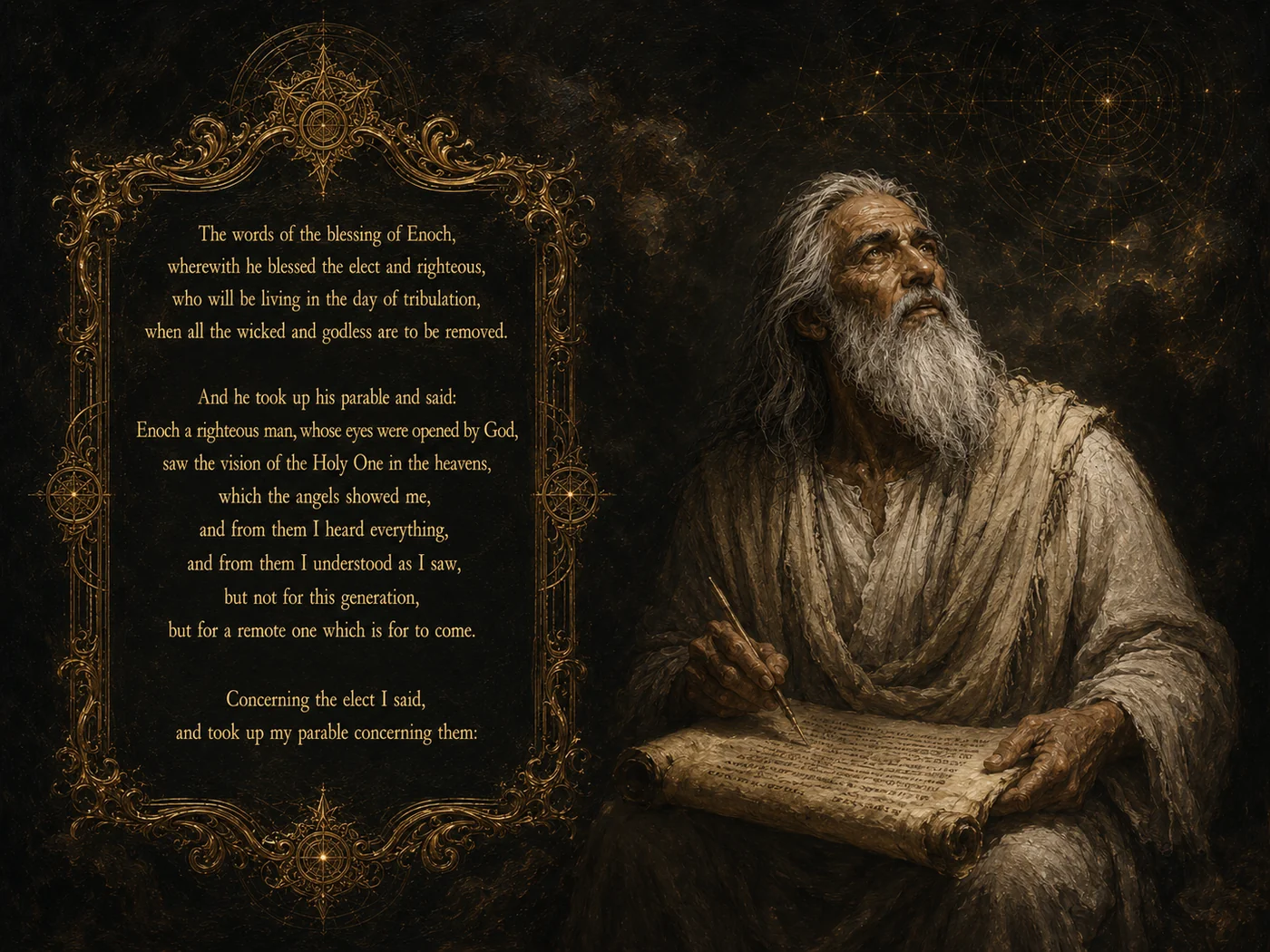
In 1 Enoch the man of Genesis 5 becomes a scribe. The Watchers, the angels who came down to the daughters of men, ask him to carry their petition to heaven, and the answer comes to him by name:
“Fear not, Enoch, thou righteous man and scribe of righteousness: approach hither and hear my voice.”
The book also gives him a year that Genesis leaves out. After his visions, seven holy ones set him down at the door of his house with a task:
“Declare everything to thy son Methuselah, and show to all thy children that no flesh is righteous in the sight of the Lord, for He is their Creator. One year we will leave thee with thy son, till thou givest thy (last) commands, that thou mayest teach thy children and record (it) for them, and testify to all thy children”
The rest of 1 Enoch, from the Watchers and the giants to the heavenly journeys and the calendar of the lights, is set out in the Book of Enoch summary. All 108 chapters, with 311 illustrations, are in The Book of Enoch Illustrated.
Questions readers ask
Did Enoch die?
Genesis does not record his death. It says “he was not; for God took him” (Genesis 5:24), and Hebrews 11:5 says he “was translated that he should not see death.”
How old was Enoch when God took him?
Three hundred and sixty-five years, according to Genesis 5:23. It is the shortest life in the list of Genesis 5.
Who was Enoch's son?
Methuselah, born when Enoch was sixty-five (Genesis 5:21). Genesis gives Methuselah nine hundred and sixty-nine years.
Are there two Enochs in the Bible?
Yes. Cain's son Enoch, after whom Cain named a city (Genesis 4:17), and Enoch the son of Jared, the seventh from Adam, who walked with God (Genesis 5:18 to 24).
Is the Book of Enoch in the Bible?
Not in most Bibles. It belongs to the scriptures of the Ethiopian Orthodox Tewahedo Church, and the Letter of Jude quotes it. Why it was left out elsewhere.