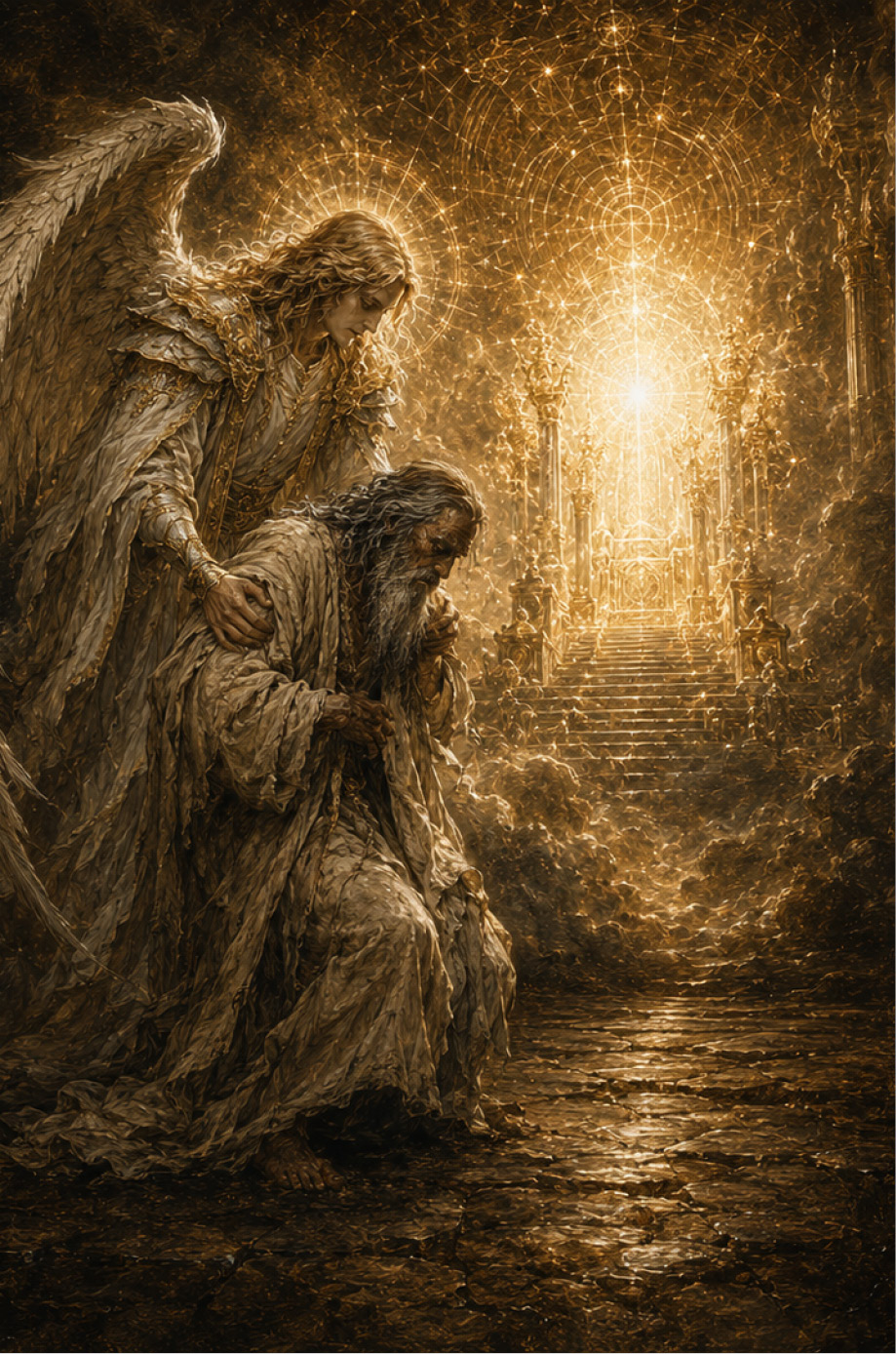
The Book of Enoch, usually called 1 Enoch, is an ancient Jewish apocalyptic collection attributed to Enoch, the seventh patriarch from Adam. It expands a few cryptic biblical lines into vast visions of rebellious heavenly beings, giant offspring, cosmic journeys, heavenly tablets, judgement, and the vindication of the righteous.
It is better understood as a collection than as a single book written at one moment. Its parts developed over centuries, broadly from the last centuries BCE into the early centuries around the beginning of the Common Era. Modern scholarship studies those layers separately while also reading the Ethiopic form as the complete work transmitted to us.
Book of Enoch: Quick Facts
- Which Enoch? 1 Enoch, also called the Ethiopic Book of Enoch.
- Length: 108 chapters in the standard complete Ethiopic form.
- Structure: five principal books plus introductory and concluding material.
- Languages: complete in Ge'ez, with ancient Aramaic fragments and some Greek witnesses.
- Main subjects: the Watchers, giants, heavenly journeys, cosmic order, symbolic history, judgement, and the righteous.
- New Testament connection: Jude 14-15 closely corresponds to 1 Enoch 1:9.
Why It Is Called 1 Enoch
1 Enoch is not the same work as 2 Enoch or 3 Enoch. The numbering is modern shorthand used to keep three different writings apart. They come from different linguistic, historical, and religious settings. The full 1 Enoch vs 2 Enoch vs 3 Enoch comparison maps their languages, contents, manuscript traditions, and dates.
The illustrated edition presented here contains 1 Enoch only, complete in 108 chapters. It does not combine unrelated later Enochic works under one cover.
Who Wrote the Book of Enoch, and When?
The collection speaks with the authority of Enoch, the biblical patriarch described in Genesis as the seventh generation from Adam. This is an ancient literary attribution, not a conclusion that modern historians draw about a single named writer.
Scholars generally understand 1 Enoch as a composite work produced by multiple writers and editors. Its major sections come from different periods. The Library of Congress places the emergence of the collection broadly between the fourth century BCE and the first century CE. Precise dates for individual sections remain debated, especially for the Book of Parables.
This layered origin explains the changes in voice and subject. The reader moves from a narrative of angelic rebellion to journeys through the cosmos, parables of judgement, astronomical instruction, symbolic history, and ethical exhortation. Those differences are part of the text's formation and not evidence that chapters have been randomly joined in a modern edition.
The Watchers and the Giants
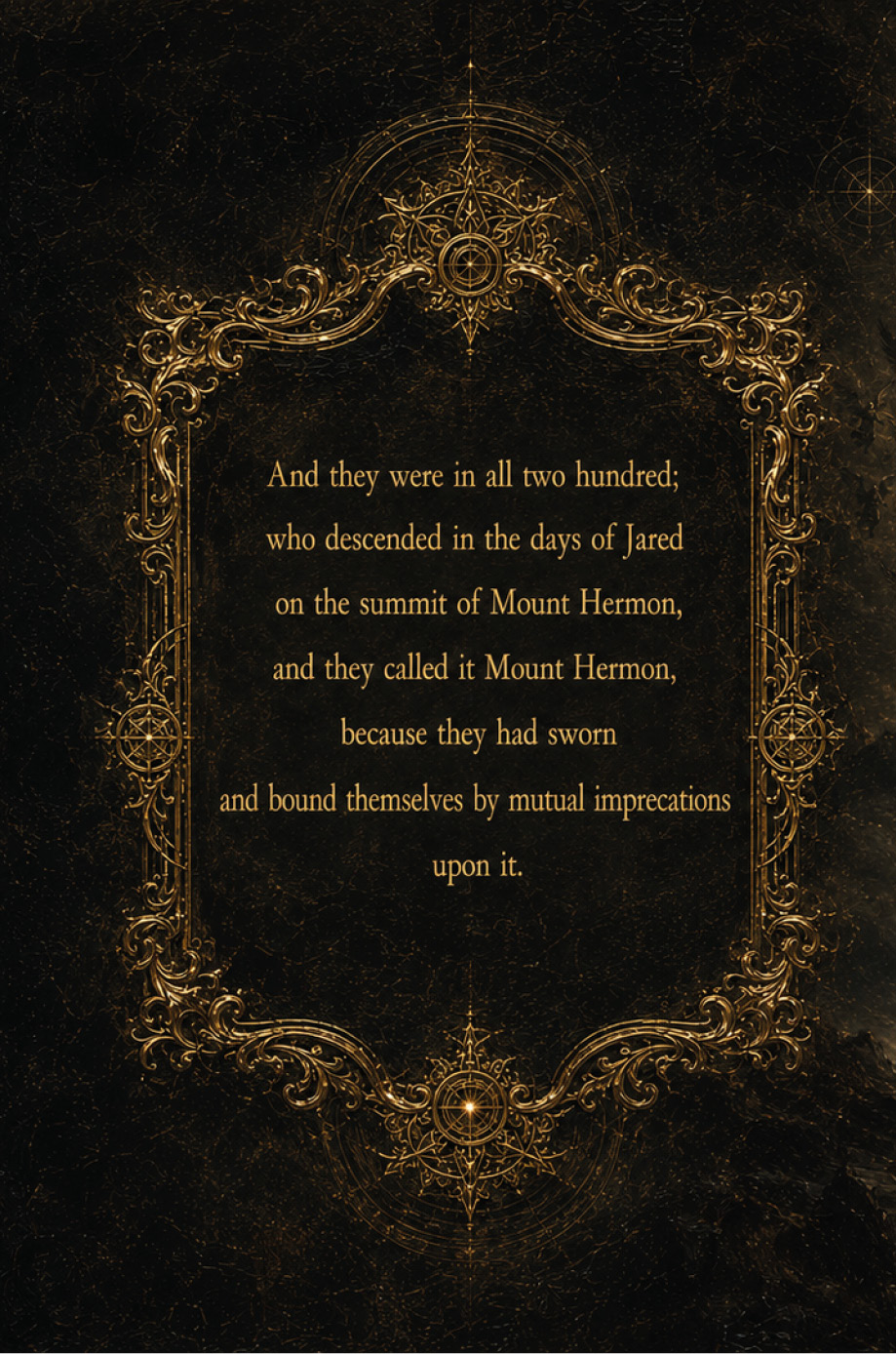
The best-known part of 1 Enoch is the Book of the Watchers. It elaborates on the brief account in Genesis 6:1-4, where the "sons of God" take human women and the Nephilim appear on earth. In 1 Enoch, two hundred Watchers descend upon Mount Hermon and bind themselves by an oath led by Semyaza; Azazel is especially associated with forbidden instruction. The separate chapter-by-chapter guide to 1 Enoch 1–36 follows the descent, petition, judgement, and cosmic journey.
Their transgression is more than forbidden union. They disclose knowledge that the narrative presents as destructive or premature: weapons and metalworking for war, enchantments, celestial signs, and other arts. Their giant offspring consume the earth's abundance and turn upon creation. Violence spreads until the archangels intervene and judgement is pronounced.
Readers often use Nephilim as a convenient name for these offspring. The terminology varies across biblical texts and translations; R. H. Charles frequently renders them simply as giants. The important point is the story's moral architecture: heavenly rebellion introduces illicit power, that power magnifies violence, and both the rebels and their offspring become subject to judgement.
Book of Enoch Summary
The book opens with a vision of divine judgement and the restoration of the righteous. It then recounts the rebellion of the Watchers. Their leader Semyaza binds the group by an oath on Mount Hermon, while Azazel becomes especially associated with weapons, ornament, and corrupting instruction. The giants devastate the earth, and the cries of creation rise to heaven.
The archangels receive commands against the Watchers and their offspring. Enoch acts as an intermediary, but the rebels' petition is rejected. He is then led through places normally hidden from human sight: the storehouses of the elements, mountains and rivers, the prison of the stars, the realm of the dead, and the location prepared for judgement.
The later books widen the scale. The Parables concern the righteous, kings, judgement, and the figure called the Elect One or Son of Man. The Luminaries describe a revealed calendar and the ordered courses of the heavens. The Dream Visions retell sacred history through animals. The Epistle contrasts the fate of sinners and the righteous across a structured vision of time.
What happens to the giants?
The giant offspring are destroyed, but 1 Enoch gives their violence an afterlife: the spirits proceeding from the dead giants remain upon the earth as destructive spirits. This is one of the work's influential explanations for the origin of evil spirits and is distinct from simply identifying every demon with a fallen Watcher.
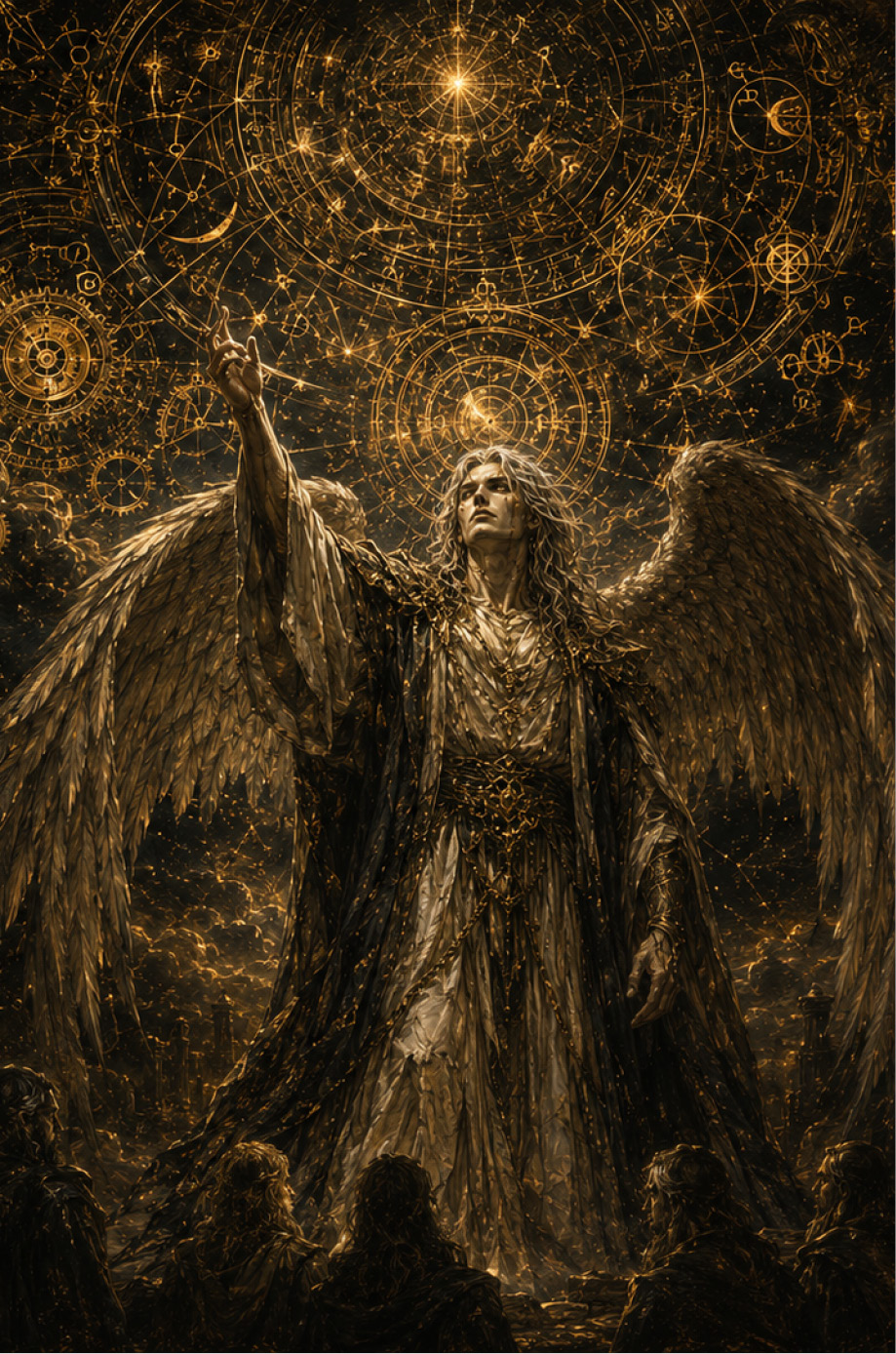
The Five Books Inside 1 Enoch
The complete Ethiopic Book of Enoch is conventionally arranged into five principal sections. Chapter divisions vary slightly in scholarly discussion around embedded materials, but the familiar reading structure is:
- The Book of the Watchers, chapters 1-36: the descent and judgement of the Watchers, Enoch's intercession, and journeys through the hidden places of creation.
- The Book of Parables, chapters 37-71: three visionary parables concerning judgement, the righteous, heavenly secrets, and the figure called the Elect One or Son of Man.
- The Book of the Heavenly Luminaries, chapters 72-82: a detailed account of the courses of the sun, moon, stars, seasons, and calendar revealed by Uriel.
- The Book of Dream Visions, chapters 83-90: Enoch's dreams, including the Animal Apocalypse, which retells history through symbolic animals.
- The Epistle of Enoch, chapters 91-105: ethical instruction, the Apocalypse of Weeks, warnings to sinners, and promises for the righteous. Chapters 106 to 108 follow as short appendices.
This structure is one reason a complete edition matters. The Watchers occupy only the opening movement. The later books expand from primordial rebellion into cosmology, symbolic history, ethics, and eschatological judgement.
Was Enoch Found Among the Dead Sea Scrolls?
Yes, parts of 1 Enoch survive among the Dead Sea Scrolls. Aramaic manuscripts representing several Enochic compositions were found at Qumran, especially in Cave 4. The Israel Antiquities Authority's digital archive, for example, identifies 4QEnoch as an Aramaic manuscript from Qumran Cave 4.
These fragments are important because they demonstrate that Enochic writings circulated in Jewish communities before and around the beginning of Christianity. They do not supply the entire book in Aramaic. The complete surviving form comes from a different history of transmission.
How the Complete Text Survived
The full collection was preserved in Ge'ez, the classical language of Ethiopia. The Library of Congress describes 1 Enoch as a work entirely preserved in the Ethiopian Orthodox Bible and emphasizes the role of Ethiopian Jewish and Christian communities in its transmission.
Calling Enoch simply a "lost book" therefore hides part of the truth. It ceased to circulate as a complete work in much of the West, but it was not lost to Ethiopian tradition. Greek excerpts, quotations, and Aramaic fragments also survived. A more accurate description is that the complete text was preserved in Ethiopia while becoming unavailable or marginal elsewhere.
Is the Book of Enoch Authentic?
The word authentic can conceal two different questions. As an ancient text, 1 Enoch is unquestionably authentic: Aramaic manuscript fragments from Qumran establish that substantial Enochic writings circulated before and around the beginning of Christianity. It is not a medieval invention presented under an ancient title.
That does not mean historians regard the surviving collection as a manuscript personally written by the antediluvian patriarch Enoch. The work uses pseudonymous attribution, a common ancient practice in apocalyptic literature, and its sections reflect multiple periods of composition. Historical antiquity, traditional attribution, and religious canonicity are therefore three separate questions.
Is the Book of Enoch in the Bible?
The answer depends on which religious canon is meant. 1 Enoch is not part of the Jewish canon or the biblical canon used by most Christian churches. It does, however, hold canonical or scriptural authority within Ethiopian Orthodox tradition. The longer guide, Why Is the Book of Enoch Not in the Bible?, follows that history without reducing it to a claim that one universal institution removed the book.
Canon developed differently across communities. Historical importance and canonical status are also separate questions: a writing can be non-canonical for a community and still be crucial evidence for the religious imagination of the Second Temple period.
Does Jude Quote the Book of Enoch?
Jude 14-15 explicitly introduces a prophecy attributed to Enoch, and its wording closely corresponds to 1 Enoch 1:9. The relationship is visible in the text and noted in modern Bible editions; compare Jude 14-15 in several translations.
That makes 1 Enoch directly relevant to the literary world of the New Testament. It does not, by itself, resolve later debates about whether the whole work should be canonical. Biblical writers can cite or echo material without every source receiving the same status as the writing that cites it.
What Is the R. H. Charles Translation?
Robert Henry Charles's 1917 English translation is a landmark scholarly edition now in the public domain. Its language can feel formal or archaic, and later scholarship has refined many textual questions, but Charles remains historically influential and widely read. A digitized scan is available through Wikimedia Commons.
The illuminated edition uses Charles's text word for word across all 108 chapters. It does not modernize, summarize, decode, or silently rewrite the translation. The new contribution is visual: 311 original illustrations and a page design built around the ancient testimony.
How to Read the Book of Enoch
For a first reading, follow chapters 1 through 108 in order. The opening five chapters establish the themes of judgement and vindication before the Watcher narrative begins. Reading only the famous chapters about fallen angels leaves out most of the collection's cosmology, symbolic history, and ethical argument.
For a second reading, choose a focused path:
- Watchers, Azazel, and giants: chapters 6-16.
- Enoch's cosmic journeys: chapters 17-36.
- Parables, judgement, and the Son of Man: chapters 37-71.
- Sun, moon, calendar, and heavenly order: chapters 72-82.
- Animal Apocalypse and symbolic history: chapters 83-90.
- Ethics, the Apocalypse of Weeks, and final exhortation: chapters 91-108.
Charles's translation rewards slow reading. Keep in mind that its older English reflects early twentieth-century scholarship. When a verse raises a historical or textual problem, consult a recent academic translation or commentary alongside it rather than treating any single English rendering as the entire manuscript tradition.
A Complete Illustrated Book of Enoch
The Book of Enoch (Illustrated): The Complete Illuminated Edition presents all five books across 639 fully designed pages. Enoch is credited as the ancient author, R. H. Charles as translator, and Alexander Gabriel ZoderoT as illustrator.
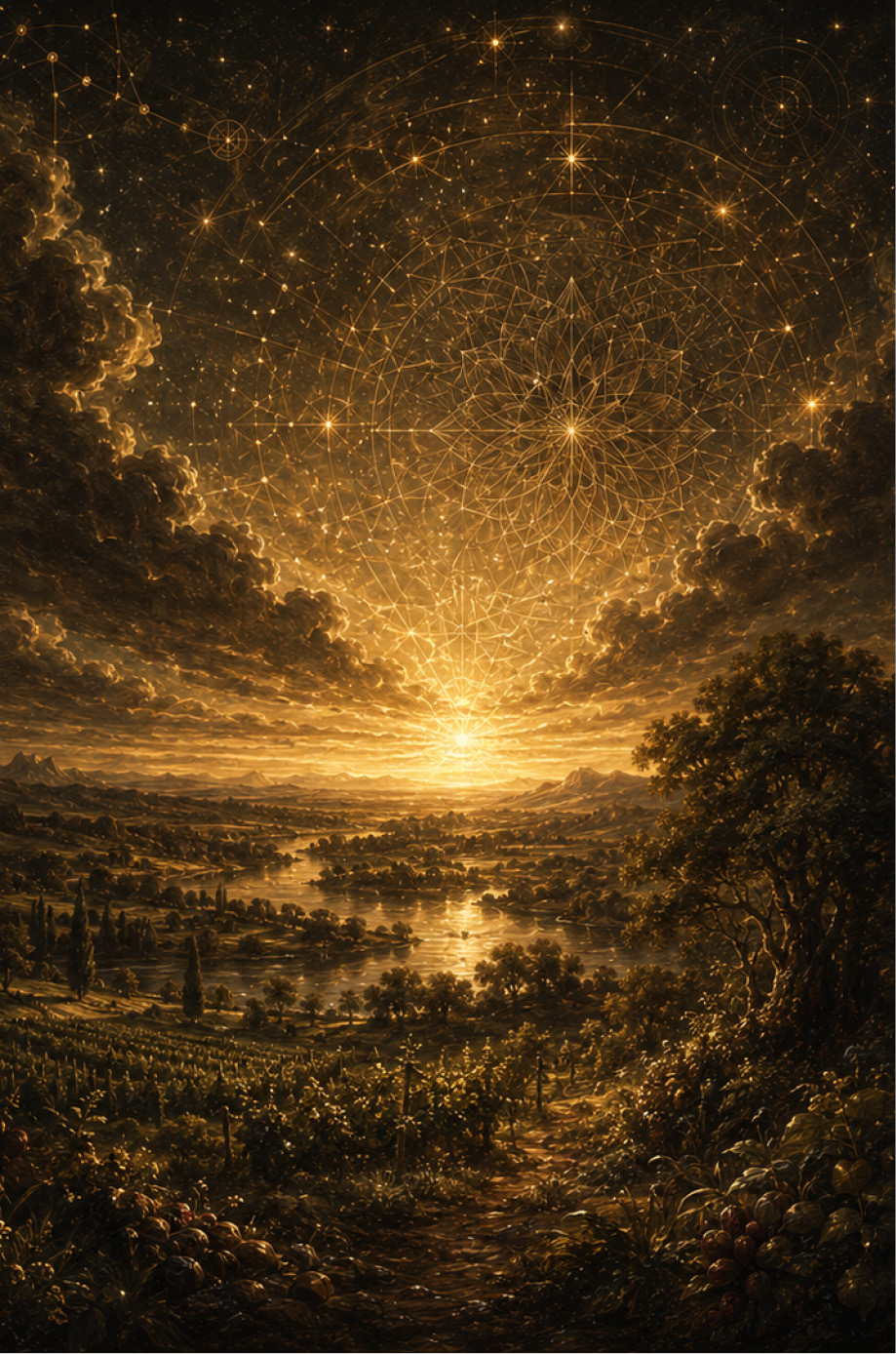
The artwork draws on old-master chiaroscuro, luminous gold, monumental landscapes, celestial diagrams, and apocalyptic scale. It gives a visual form to the Watchers, Enoch's journeys, the prisons of the stars, the heavenly luminaries, and the courts of judgement while leaving the complete text intact.
Because the pages are composed as illuminated spreads, the Kindle edition is best viewed in landscape mode on a tablet, computer, or other large screen. Amazon's print editions are black and white. Exclusive full-color hardcovers with coated pages are available by direct request through the website.
Who Is This Edition For?
This edition is for readers interested in ancient Jewish apocalyptic literature, the background of Watcher and giant traditions, the religious world around the Dead Sea Scrolls, illustrated sacred texts, and the visual history of revelation. It is also for readers who have encountered sensational claims about Enoch and want the complete primary text instead of a modern "decoding" presented in its place.
Approach it as an ancient collection with a complicated history, not as a shortcut to secret certainty. Its power lies in the scale of its questions: what happens when knowledge is separated from wisdom, how violence corrupts creation, whether the cosmos has a moral order, and what judgement means for both heaven and earth.
Frequently Asked Questions
Is 1 Enoch the same as 2 Enoch or 3 Enoch?
No. They are separate works from different periods and traditions. This edition contains 1 Enoch only.
Who are the Watchers?
In 1 Enoch, they are heavenly beings who descend, take human wives, disclose forbidden knowledge, and face divine judgement.
Are the Nephilim in the Book of Enoch?
1 Enoch expands the Genesis 6 story by describing giant offspring born from the Watchers and human women. English translations often call them giants.
Was Enoch found among the Dead Sea Scrolls?
Yes. Aramaic fragments of Enochic works were found at Qumran, including manuscripts from Cave 4. The complete surviving text is preserved in Ge'ez.
Is the Book of Enoch in the Bible?
It is not canonical in most Jewish and Christian traditions, but it has a canonical or authoritative place in Ethiopian Orthodox tradition.
Does Jude quote Enoch?
Jude 14-15 attributes a prophecy to Enoch and closely corresponds to 1 Enoch 1:9. That relationship does not alone decide the later canonical status of the whole book.
Is this illustrated edition complete?
Yes. It contains all 108 chapters in R. H. Charles's 1917 translation, with 311 original illustrations across 639 designed pages.
Who wrote the Book of Enoch?
The text is attributed to the biblical patriarch Enoch, but scholars understand 1 Enoch as a composite collection produced and edited by multiple ancient writers over several centuries.
How many chapters are in 1 Enoch?
The standard complete Ethiopic form contains 108 chapters arranged into five principal books, with introductory and concluding materials.
Is the Book of Enoch authentic?
It is an authentic ancient Jewish apocalyptic collection with pre-Christian Aramaic manuscript evidence at Qumran. That is different from claiming that the historical Enoch personally wrote the surviving collection.
What is the best reading order?
Read chapters 1-108 in order the first time. Later readings can follow individual themes such as the Watchers, heavenly journeys, Parables, Luminaries, Dream Visions, or Epistle.
What a First Reading Should Notice
1 Enoch can feel unfamiliar because it does not behave like a modern novel or a single biblical book with one continuous plot. It is a collection. One section tells the Watchers' descent; another follows the motions of the luminaries; another retells history through animals; another addresses ethical conduct and final judgement. The same patriarch gives the collection a centre, but the voices and concerns are deliberately varied.
That variety is a reason to read slowly. The Watchers story explains why many readers first arrive, but it is not the whole of Enoch. The astronomical material is not a detour from the book's moral world: ordered heavenly courses provide a contrast to rebels who abandon their assigned place. The Dream Visions reward decoding, though their real subject is history seen under divine judgement. The Epistle turns revelation towards conduct, patience, and the fate of the righteous and wicked.
Read ancient claims in their ancient setting
The text attributes itself to Enoch, the seventh patriarch from Adam. Modern scholars generally describe it as a composite collection produced over time by ancient Jewish writers and editors. Those statements answer different questions. The first tells us how the work presents its authority; the second describes what manuscript evidence, language, and literary development lead historians to conclude. Neither needs to be concealed for the other to be heard.
Similarly, terms such as Watchers, giants, Nephilim, demons, and fallen angels have acquired long later histories. 1 Enoch has its own distinctions. The Watchers are heavenly beings; their giant offspring devastate the earth; chapters 15–16 connect destructive spirits with the dead giants. Later theology and popular fiction often combine these figures, but the book itself rewards a closer reading.
Choosing and Using an Edition
A good edition identifies its translation and supplies notes on manuscripts, names, and textual difficulties. The complete text is preserved in Ge'ez, while Aramaic fragments from Qumran and Greek witnesses illuminate parts of its earlier transmission. No English version removes every question; differences in wording or chapter arrangement should invite comparison rather than suspicion.
The R. H. Charles translation remains influential and readable, and this illustrated edition uses the 1917 text as stated. Readers who want to pursue a difficult passage may compare another scholarly translation and its introduction. That is especially useful for angelic names, calendar passages, and sections whose ancient witnesses are incomplete. Comparison is not an attempt to make the book less mysterious; it is a way to let its actual textual history come into view.
Why 1 Enoch Still Matters
1 Enoch is not important merely because it contains dramatic supernatural material. It preserves an ancient Jewish attempt to speak about violence that seems larger than any one human act, a cosmos whose order carries moral weight, and judgement that is delayed but not forgotten. It also helps modern readers see that the religious world around the New Testament was rich with texts, interpretations, and expectations beyond a later fixed table of contents.
Approached on those terms, the book does not need conspiracy theories or forced certainty to be compelling. It is an old, many-voiced work whose survival through Ge'ez manuscripts and whose earlier Aramaic witnesses at Qumran make it one of the most consequential texts outside most modern biblical canons.
Sources and Further Reading
- Library of Congress: Ethiopian Perspectives on the Book of Enoch
- Israel Antiquities Authority: 4Q Enoch manuscript record
- Cambridge University Press: The Ethiopic Book of Enoch, overview by Michael A. Knibb
- Jude 14-15 in parallel English translations
- R. H. Charles, The Book of Enoch (1917), public-domain scan