The Epic of Gilgamesh
The Gilgamesh Flood Story and Noah: What the Two Accounts Share
Utnapishtim's flood in Tablet XI, set beside the story of Noah: what matches, what differs, and which is older.
The two stories share a plot. The gods, or God, decide to destroy humankind with a flood. One man is warned, builds a boat and saves his family and the animals. The boat comes to rest on a mountain, birds are sent out to look for land, and the survivor makes a sacrifice. The Mesopotamian story is the older of the two. Its flood tradition was written down in Akkadian and Sumerian by about 1600 BC, and Tablet XI of the Epic of Gilgamesh is a late retelling of it. Most historians of the ancient Near East think the biblical account is related to these texts. How and when it came to be related is still argued.
Thompson's spellings are Uta-Napishtim and Shurippak, and they appear only inside the quotations. This page writes Utnapishtim and Shuruppak. The biblical account is summarised from Genesis 6 to 9 and not quoted.
What is the flood story in the Epic of Gilgamesh?
The story is told inside the poem, in Tablet XI, by the man who lived through it. Gilgamesh has crossed the world and the Waters of Death to find Utnapishtim, whom the gods made immortal, and he asks how that happened. Utnapishtim answers with a story. The whole poem is summarised in The Epic of Gilgamesh: Summary, Tablet by Tablet.
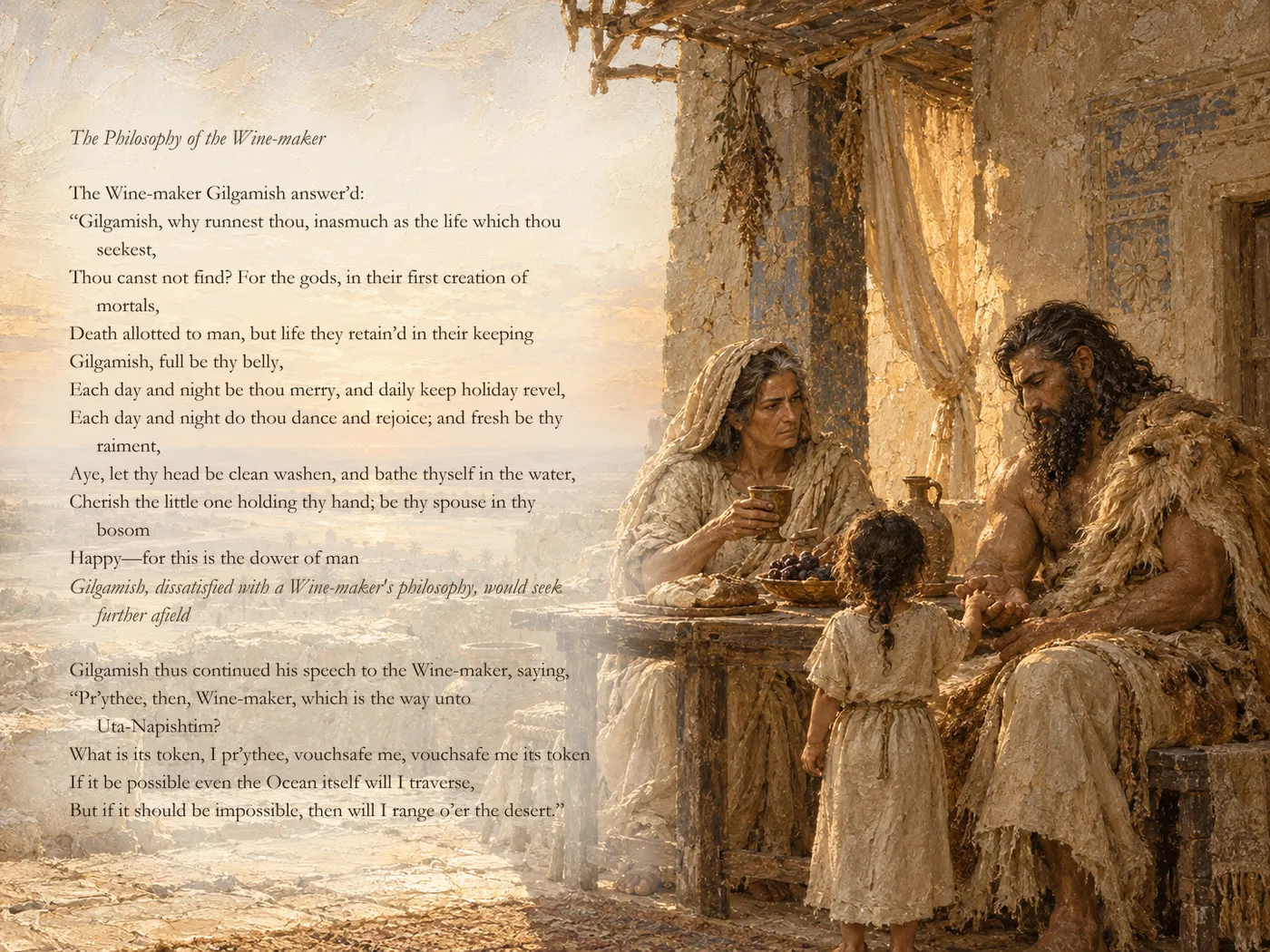
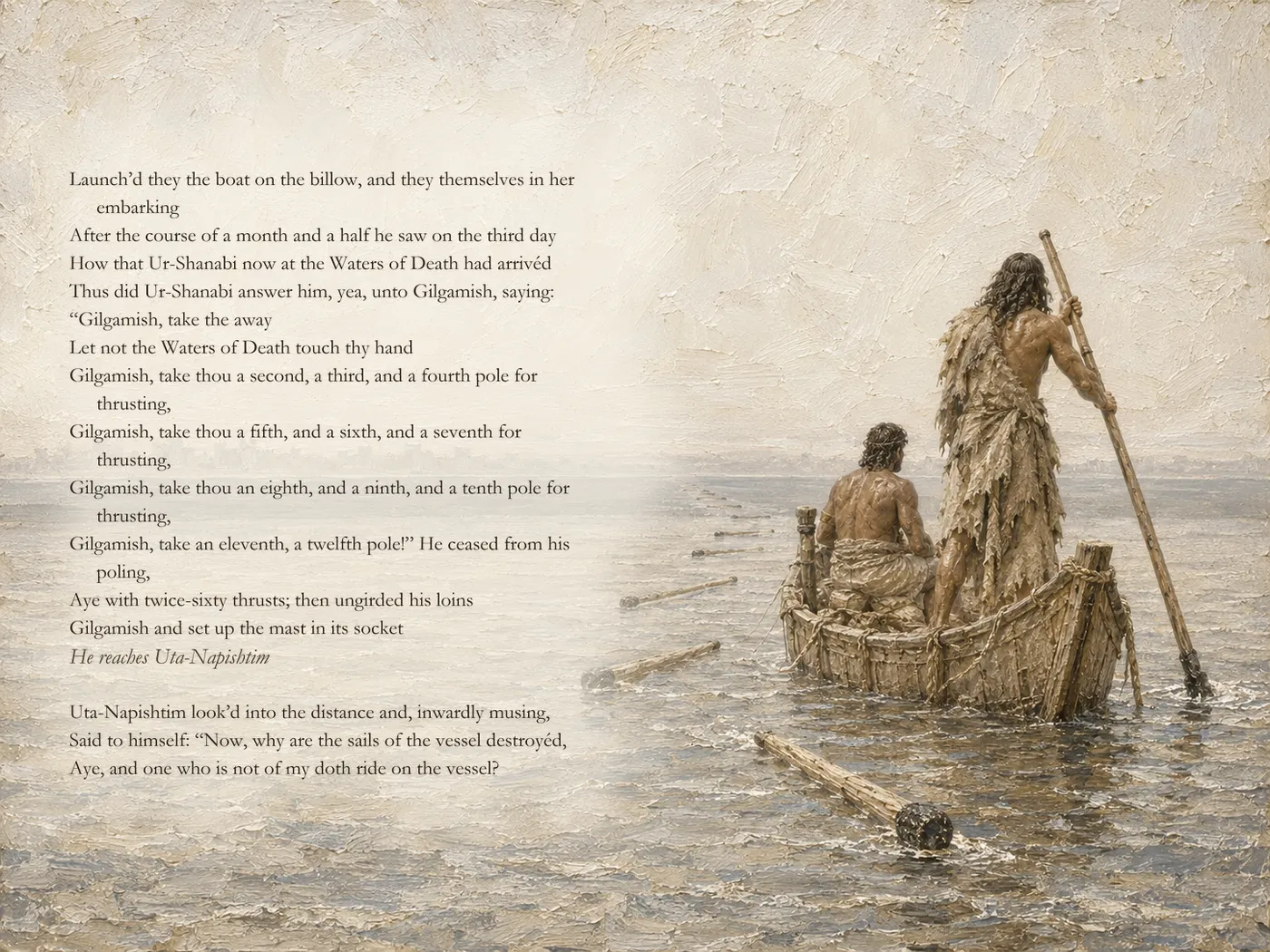
The city of Shuruppak stands on the Euphrates, and the great gods resolve to send a deluge on it. Ea, one of the gods in council, passes the plan on to a reed hut, so that the man inside can overhear it.
Wall, wall! Hearken, O Reed-hut, consider, O Wall! O thou Mortal,
Thou of Shurippak, thou scion of Ubara-Tutu, a dwelling
Pull down, and fashion a vessel therewith; abandon possessions,
Life do thou seek, and thy hoard disregard, and save life; every creature
Utnapishtim pulls down his house and builds a boat of seven storeys, each divided into nine rooms and sealed with bitumen and pitch. He loads it with his silver and gold, his family and kin, the craftsmen, cattle and wild animals, and the seed of every living thing. Then a black cloud rises at dawn with Adad, the storm god, rumbling inside it, and other gods follow with fire and ruin. The gods themselves are frightened by what they have loosed.
Fleeing, they rose to the Heaven of Anu, and crouch’d in the outskirts,
Cow‘ring like curs were the gods while like to a woman in travail
Ishtar did cry, she shrieking aloud, e’en the sweet-spoken Lady
Ishtar cries out that she spoke evil in the gods' assembly when she agreed to the destruction of her own people. The storm lasts six days and seven nights.
Six days, a se’nnight the hurricane, deluge, and tempest continued
Sweeping the land: when the seventh day came, were quelléd the warfare,
When it stops, Utnapishtim opens the hatch and weeps. His ship has grounded on Mount Nisir. On the seventh day he sends out three birds in turn.
Then, when the seventh day dawn’d, I put forth a dove, and released her,
But to and fro went the dove, and return’d for a resting-place was not
Then I a swallow put forth and released; to and fro went the swallow,
She too return’d, for a resting-place was not; I put forth a raven,
Her, too, releasing; the raven went, too, and th’ abating of waters
Saw; and she ate as she waded and splash’d, unto me not returning
He frees the animals and makes an offering on the peak.
Heap’d up beneath them; the gods smelt the savour, the gods the sweet savour
Smelt; aye, the gods did assemble like flies o’er him making the off’ring
Enlil arrives in a rage that anyone survived. Ea answers that the guilty should pay for their own sins and not everyone, and that a lion, a jackal, a famine or a plague would have thinned mankind more mercifully.
O, instead of thy making a flood, let a lion come, man to diminish;
O, instead of thy making a flood, let a jackal come, man to diminish;
Enlil relents. He takes Utnapishtim and his wife by the hand, touches their foreheads, and makes them like gods.
Uta-Napishtim hath hitherto only been mortal,
Now, indeed, Uta-Napishtim and also his wife shall be equal
Like to us gods; in the distance afar at the mouth of the rivers
Side by side
How does the Gilgamesh flood compare with Noah's flood?
| Tablet XI | Genesis 6 to 9 | |
|---|---|---|
| The man | Utnapishtim of Shuruppak | Noah |
| Who warns him | The god Ea, speaking to a reed hut | God, speaking to him directly |
| Why the flood comes | The poem gives no reason; the gods in council decide | Human wickedness and violence |
| The boat | Seven storeys, nine rooms to each, sealed with bitumen and pitch | Three decks, 300 cubits long, sealed inside and out with pitch |
| Who goes aboard | His family and kin, craftsmen, a boatman, and the seed of all living things | His wife, his three sons and their wives, and animals of every kind |
| The storm | Six days and seven nights | Forty days and nights of rain, with the waters rising for 150 days |
| Where it lands | Mount Nisir | The mountains of Ararat |
| The birds | A dove, a swallow and a raven; the raven does not return | A raven, then a dove three times; the second dove brings back an olive leaf |
| The sacrifice | An offering on the peak; the gods gather round the smell like flies | Burnt offerings of clean animals; God smells them and promises not to destroy the earth again |
| How it ends | Enlil makes Utnapishtim and his wife immortal and sends them far away | God makes a covenant with Noah and every living creature, with the rainbow as its sign |
What is different about the two accounts?
The first difference is the gods. In Tablet XI a council of gods decides on the flood, and they quarrel over it. Ishtar mourns, Enlil rages, Ea argues, and by the end they are crowding round a sacrifice because they are hungry. In Genesis one God sends the flood and ends it.
The second is the reason. Genesis gives it plainly. Tablet XI does not. Ea's rebuke to Enlil hints at one, since it says that the sinner should answer for his sin, but the poem never names the sin. The reason survives in an older Babylonian poem, Atrahasis, where the gods send the flood because humankind has grown so numerous and noisy that Enlil cannot sleep.
The third is the reward. Noah's rescue is followed by a promise to all living things. Utnapishtim's is a private gift: he and his wife become immortal and are taken away to live at the mouth of the rivers. The gift cannot be repeated, and he says so when Gilgamesh asks for the same.
Who will assemble the gods for thy need, that the life which thou seekest
Thou mayst discover? Come, fall not asleep for six days, aye, a se’nnight!”
The fourth is the purpose of the story. In the epic, the flood is a tale told to a man who wants to live for ever. Its point is that one couple received eternal life by a decision of the gods, and Gilgamesh has no such decision to hope for. What sent him looking for Utnapishtim, the death of Enkidu, is told in Who Is Enkidu?
Which is older, and how do we know?
The Gilgamesh flood gave scholars their first proof that the biblical story had Mesopotamian relatives. In 1872 George Smith, an assistant at the British Museum, was sorting clay fragments from Ashurbanipal's library at Nineveh when he read an account of a boat landing on a mountain and a bird sent out to find land. He announced it to the Society of Biblical Archaeology in London on 3 December 1872. The Daily Telegraph then paid for him to go back to Nineveh, and in 1873 he found a fragment of the missing lines.
Those tablets date from the seventh century BC, but the story on them is far older. The evidence, in order:
- About 1700 BC: the Babylonian poem Atrahasis, whose hero's name means exceedingly wise, tells the same flood, with the warning through a reed wall and the boat.
- About 1600 BC: a broken Sumerian tablet from Nippur tells of a flood survivor named Ziusudra.
- The Late Bronze Age: a fragment of the Gilgamesh epic found at Megiddo, in modern Israel, shows that the poem was known in Canaan.
- The seventh century BC: the Nineveh tablets of Tablet XI, which follow Atrahasis closely enough for scholars to call them an adaptation.
- The third century BC: Berossus, a Babylonian priest writing in Greek, names the hero of the flood Xisouthros.
Atrahasis, Ziusudra and Utnapishtim are names for the same traditional hero. Genesis has no comparable trail. The oldest surviving copies of the biblical text are more than a thousand years younger than the Atrahasis tablet, and most scholars date the writing of the flood narrative to the first millennium BC, in a range from about the tenth to the fifth century that is still debated.
What do scholars conclude, and where do they disagree?
Most scholars of the ancient Near East hold that the biblical story draws on the Mesopotamian tradition, directly or at some remove. They agree that the Mesopotamian flood was written down first, and that the order of events in the two accounts matches too closely to be coincidence.
They disagree about the route. Some propose contact in Babylon, where Judeans lived after 586 BC. Others favour a much earlier passage through Canaan, pointing to the Megiddo fragment. A third group suggests a shared older source from which both drew.
Whether a real flood lies behind either story is a separate question. River floods left deposits at Mesopotamian cities such as Shuruppak and Kish, and some scholars link the legend to a great local flood. Others find the evidence for any single event thin.
Readers of faith take the comparison in different ways. Some see the Mesopotamian accounts as distorted memories of the event that Genesis records truly. Others see the Bible as reshaping a tradition shared across the region to say something new about one God and human conduct. The tablets show that the stories are connected. They cannot settle which reading is right, and this page does not try to.
The poem that holds the flood story is Volume II of Ancient Mythology, one of the Illuminated Classics, after Hesiod's Theogony, which tells where the Greek gods came from and has no flood of its own. For the reality behind the poem's hero, see Was Gilgamesh a Real King?, and for lines worth remembering, Epic of Gilgamesh Quotes.
Questions
Is the Gilgamesh flood story the same as Noah's?
No. They share a plot, a warning, a boat, a landing on a mountain, birds and a sacrifice, but they differ in the gods, the reason for the flood, the size of the boat, the length of the storm and the reward.
Who is Utnapishtim?
He is the survivor of the flood in the Epic of Gilgamesh, a man of the city of Shuruppak whom the gods made immortal. Gilgamesh travels to the end of the world to ask him how to escape death. His name is generally read as meaning he found life.
Which is older, the Gilgamesh flood or the Bible's?
The Mesopotamian flood. Atrahasis, about 1700 BC, tells the same story, and the Nineveh tablets of Tablet XI are from the seventh century BC. Most scholars place the writing of the biblical flood narrative in the first millennium BC.
Was there a real flood behind the story?
Nobody knows. River floods left deposits at Mesopotamian cities such as Shuruppak and Kish, and some scholars link the legend to a great local flood. Whether any one event lies behind the stories is disputed.
Where can I read Tablet XI for free?
Thompson's 1928 translation is in the public domain in the United States. The Epic of Gilgamesh Illustrated sets it among 100 paintings and is a free ebook on Payhip.
The Inner Circle
Join the Circle
The next book is already taking shape in the dark.
Be the first to know about new releases, exclusive content, hardcover drops, and glimpses behind the veil of ZoderoT's worlds.
No spam. No noise. Only the signal that matters.