The Epic of Gilgamesh
Was Gilgamesh a Real King? The History Behind the Epic
Probably, but nobody can prove it. What the King List says, what the ground at Uruk shows, and how a king became a hero.
Probably. Most scholars think a man named Gilgamesh ruled the Sumerian city of Uruk in the early to middle part of the third millennium BCE, around 2700 BCE by the usual guess. No inscription made in his own lifetime has been found, and everything in the epic that makes him a hero is poetry: the forest monster, the Bull of Heaven, the flood story he hears, the plant of youth.
The case for a real king rests on a king list, a city and a cult. Against it stands one blank: no contemporary record. Every date below is approximate.
What does the Sumerian King List say about Gilgamesh?
The Sumerian King List is a record, written in Sumerian, of the cities that held kingship in turn and the kings who ruled them. Its oldest copies date from around 2000 BCE, centuries after the period it describes. It begins with kings who reign for tens of thousands of years, then a flood, after which kingship passes to Kish. The first dynasty of Uruk follows, and Gilgamesh is the fifth name in it.
The entry says that his father was a phantom, that he was lord of Kulaba, a district of Uruk, and that he ruled for 126 years. The reign length is the first sign that the list mixes history with legend. So are two of his neighbours in the dynasty: Lugalbanda and Dumuzi both turn up as gods in other texts. The list also sets dynasties one after another when several ruled at the same time in different cities, so it cannot be read as a calendar.
When did Gilgamesh live?
The King List gives no dates, so the date is worked out. Scholars place him in the Early Dynastic period, which runs from roughly 2900 to 2350 BCE, in its early to middle part. Around 2700 BCE is the figure repeated most often. It is an estimate, resting on where the list puts him and on a few inscriptions of other rulers, and a historian who says 2600 or 2800 is not far off.
Writing was already centuries old at Uruk by then, so a king of that time could in principle have left inscriptions. None of Gilgamesh's has turned up.
What does Uruk itself show?
Uruk is real. Its ruins, called Warka today, lie in southern Iraq, away from the river that has since moved. Archaeologists have worked there since the nineteenth century, and German teams have dug there on and off since 1912. It was one of the first cities anywhere. The earliest known writing, bookkeeping tablets in an early form of cuneiform, was found at Uruk and dates to about 3300 BCE, give or take.
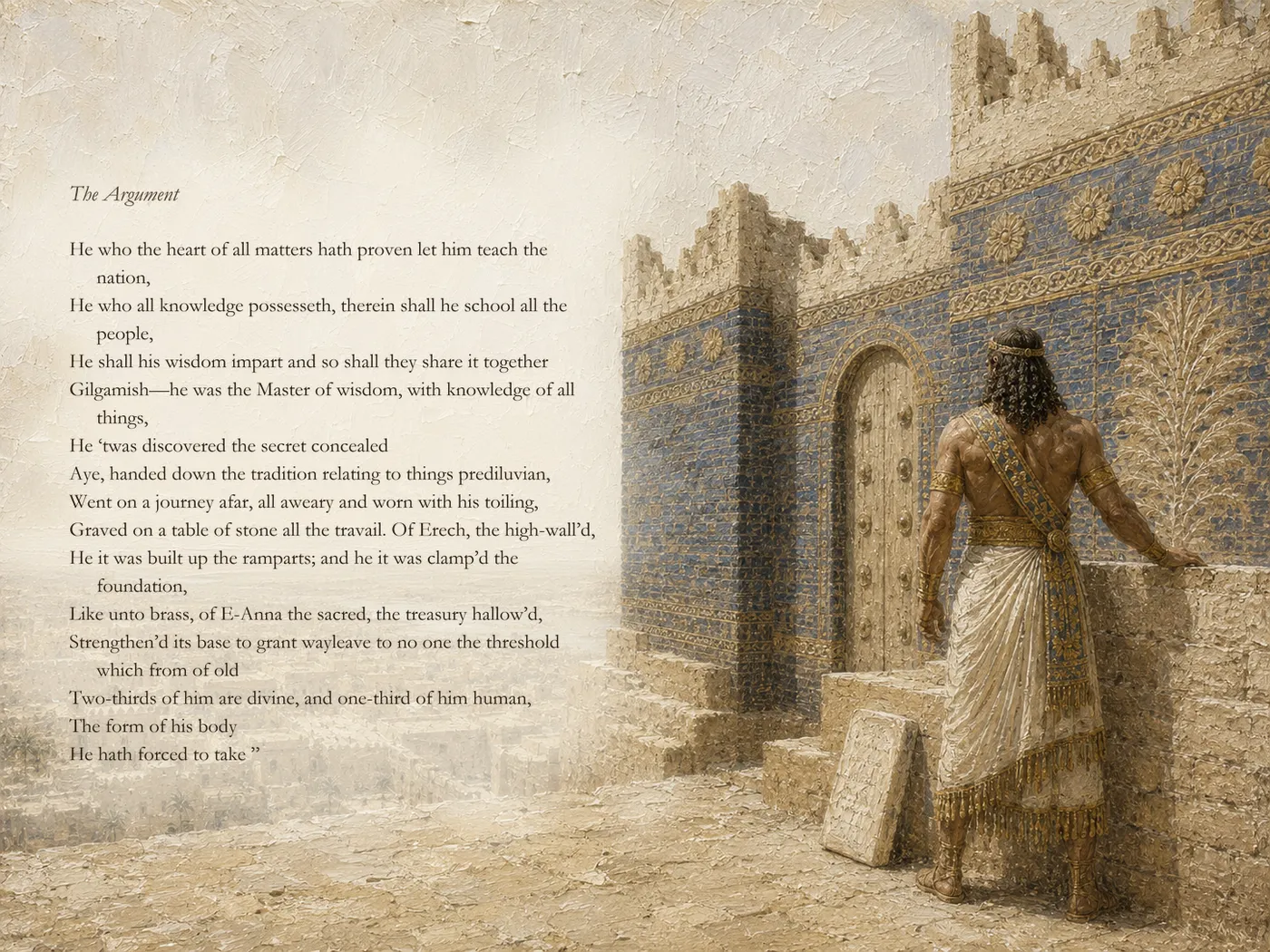
The poem names two things at Uruk. One is the city wall, and the other is E-Anna, the temple precinct of the goddess Inanna, called Ishtar in Akkadian. The prologue gives both to Gilgamesh, in Thompson's translation of 1928:
“He it was built up the ramparts; and he it was clamp’d the foundation,
Like unto brass, of E-Anna the sacred, the treasury hallow’d,”
Both exist. The E-Anna precinct stood at the centre of Uruk for thousands of years. A city wall about nine kilometres, nearly six miles, long enclosed the city, and excavators usually date its main phase to around 2900 BCE. That is somewhat earlier than the usual guess for Gilgamesh, so the wall of the poem is probably older than the king the poem credits with it. No building inscription names him as its builder. The poem ends by inviting the reader to check the brickwork:
“Do thou, Ur-Shanabi, go up and walk on the ramparts of Erech, Look on its base, and take heed of its bricks, if its bricks be not kiln-burnt,”
The evidence
What can archaeology confirm, and what can it not?
It can confirm the setting. Uruk, its walls, its temple precinct and its writing are all in the ground. It can also confirm that the King List keeps some real names. Enmebaragesi of Kish, whom the list gives as the father of Agga, Gilgamesh's rival in a Sumerian poem, appears on inscribed vessel fragments from around 2600 BCE, and he is usually described as the earliest ruler named in an inscription of his own time. That shows the list is not made up. It does not show that Gilgamesh is one of the real names.
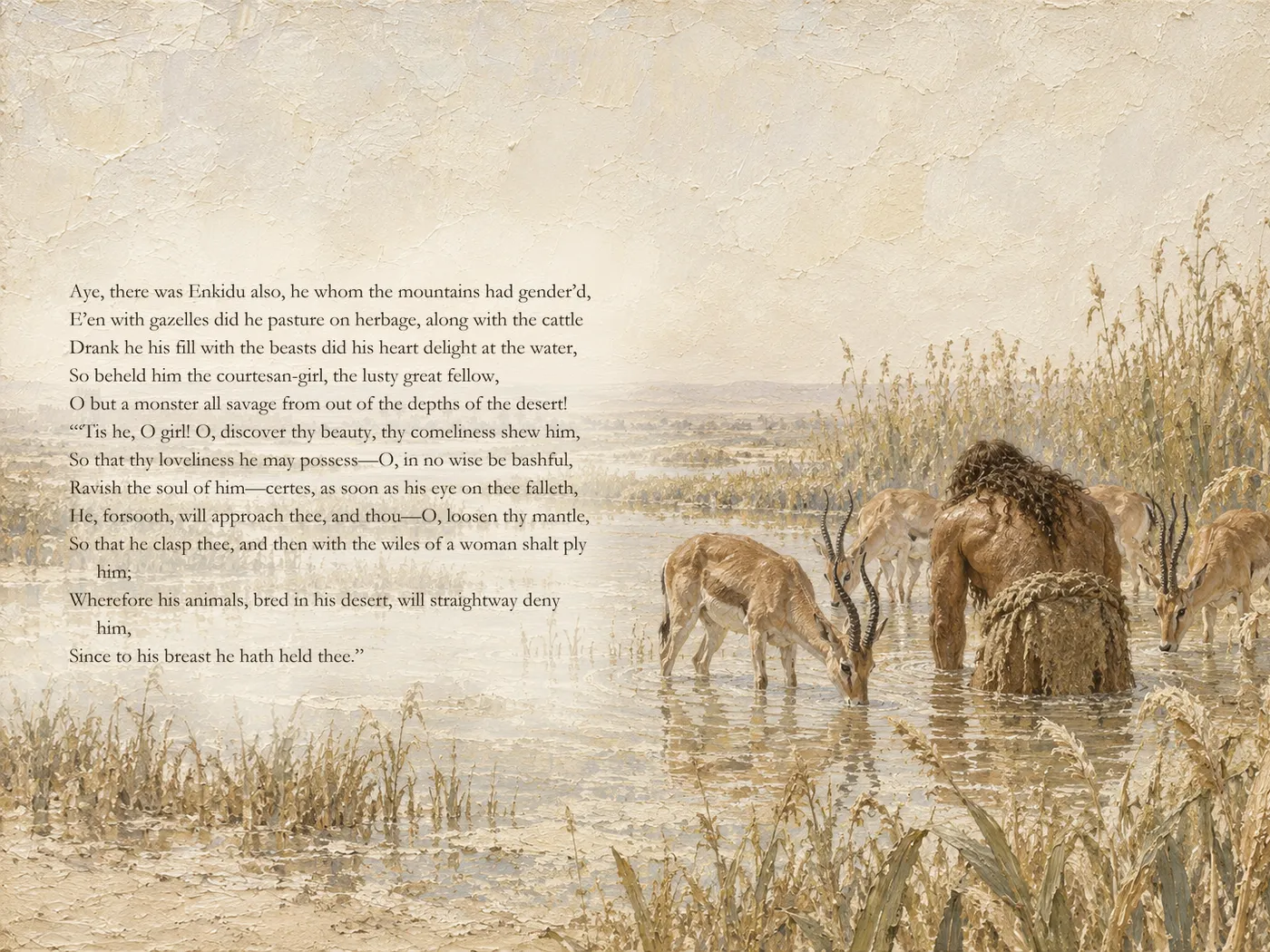
What archaeology cannot do is find the man. No royal inscription of Gilgamesh exists, no palace or tomb carries his name, and nothing in the ground answers to Humbaba or the Bull of Heaven. Enkidu is known only from the poems about Gilgamesh, and so far as scholars know he appears in no king list and no cult record.
The tomb is a separate story. The Sumerian poem The Death of Gilgamesh says that the people of Uruk dammed the Euphrates, buried their king in the riverbed and let the water return. In 2003 a German team reported a magnetic survey at Uruk that showed buried structures in an old river channel, and some press reports called it his tomb. Nothing there has been dug or confirmed, and the claim should be treated as unproven.
How did a king become a god and a hero?
Gilgamesh was being treated as more than a king long before the epic was assembled. Around 2100 BCE King Shulgi of Ur praised himself in hymns as Gilgamesh's brother and friend, and records of the same age list offerings made to Gilgamesh as a god of the dead. The Sumerian poem about his death closes with him as a ruler and judge in the underworld.
The deeds came later. Sumerian poets told separate adventures, a poet or poets of around 1800 BCE joined them into one poem, and the twelve-tablet edition added the flood and the search for life. The result is odd. The epic that bears his name is about a man who fails to become immortal, while the cult made him a god anyway. How the tablets were assembled is told in the article on the twelve tablets.
What does two-thirds god mean in the poem?
It is the poem's own claim, made in its prologue:
“Two-thirds of him are divine, and one-third of him human,”
The words return in Tablet IX, where the wife of a scorpion-man who guards the mountains says of Gilgamesh as he approaches:
“Two parts of him god-like,
Only a third of him human.”
His mother is the goddess Ninsun, whom Thompson spells Nin-sun, and who is called in his text “that choicest cow of the steer-folds”. His father is less settled. Sumerian poems name Lugalbanda, an earlier king of Uruk who became a god, and the King List says a phantom. If one parent is a goddess and the other a man, the sum gives one half, not two-thirds, and no surviving ancient text works it out.
Most readers take the ratio as a poet's way of saying that he is far more than a man and still not a god. The epic uses it to set up its question: he is divine enough to be extraordinary and human enough to die, and the poem is about which of the two wins. Heroes with a divine parent are common in the ancient world. Hesiod's Theogony ends with goddesses who bore children to mortal men; see the Theogony summary.
What the poem does with that divided hero is told in the Epic of Gilgamesh summary, and the best of its lines are in Epic of Gilgamesh quotes. The edition belongs to the Illuminated Classics.
Questions
Was Gilgamesh a real person?
Probably. A king of that name appears in the Sumerian King List as ruler of Uruk, and he was worshipped as a god within several centuries. No inscription from his own lifetime has been found, so it is a strong likelihood and not a proof.
When did Gilgamesh live?
Around 2700 BCE is the usual guess, in the Early Dynastic period. Dates for that age are approximate, and estimates run from about 2800 to 2500 BCE.
Where is Gilgamesh buried?
A Sumerian poem says in the bed of the Euphrates, in a river dammed for the burial. No tomb has been found. A magnetic survey at Uruk in 2003 reported buried structures in an old river channel, but nothing has been excavated or confirmed.
Was Enkidu real?
Probably not. Enkidu appears only in the literary tradition about Gilgamesh, not in the King List or in cult records. In the oldest Sumerian poems he is Gilgamesh's servant, and the epic makes him a friend and an equal.
What does two-thirds god mean?
It is the poem's claim that Gilgamesh is two-thirds divine and one-third human. His mother is the goddess Ninsun, but no ancient text explains the fractions. The poem uses them to set a hero who is more than human against the fact that he must die.
The Inner Circle
Join the Circle
The next book is already taking shape in the dark.
Be the first to know about new releases, exclusive content, hardcover drops, and glimpses behind the veil of ZoderoT's worlds.
No spam. No noise. Only the signal that matters.