The Epic of Gilgamesh
Who Is Enkidu? The Wild Man of the Epic of Gilgamesh
How the gods made Enkidu, how he was tamed, why he became Gilgamesh's friend, and why his death drives the rest of the poem.
Enkidu is the wild man of the Epic of Gilgamesh. The goddess Aruru shapes him from clay in the wilderness so that the tyrant king Gilgamesh will have a rival, and he lives among the animals until a woman from the city teaches him human ways. He wrestles Gilgamesh, becomes his closest friend, and helps him kill Humbaba and the Bull of Heaven. For that the gods condemn him to die, and his death sends Gilgamesh looking for eternal life.
Names here use modern spellings. Thompson wrote Erech and Gilgamish, and those spellings appear only inside the quotations. The whole poem is laid out in The Epic of Gilgamesh: Summary, Tablet by Tablet.
Who made Enkidu, and why?
Gilgamesh begins the poem as a king who takes what he wants. His people cry out to the gods that he leaves no son to his father and no maiden to her mother. Anu, the sky god, turns to Aruru, who made the first of mankind, and tells her to make a match for him, so that the two will fight and Uruk may be left in peace. She washes her hands, forms the idea in her mind, and shapes it from clay on the open plain.
Finger’d some clay, on the desert she moulded it: thus on the desert
Enkidu made she, a warrior, as he were born and begotten,
Enkidu has long hair like the awns of barley and knows nothing of people or land. He grazes with the gazelles and drinks at the water with the herds. In the oldest Sumerian poems about Gilgamesh, Enkidu is the king's servant. The Babylonian poem makes him something else: a warrior to rival Ninurta, the god of war, and an equal for the king.
How was Enkidu tamed?
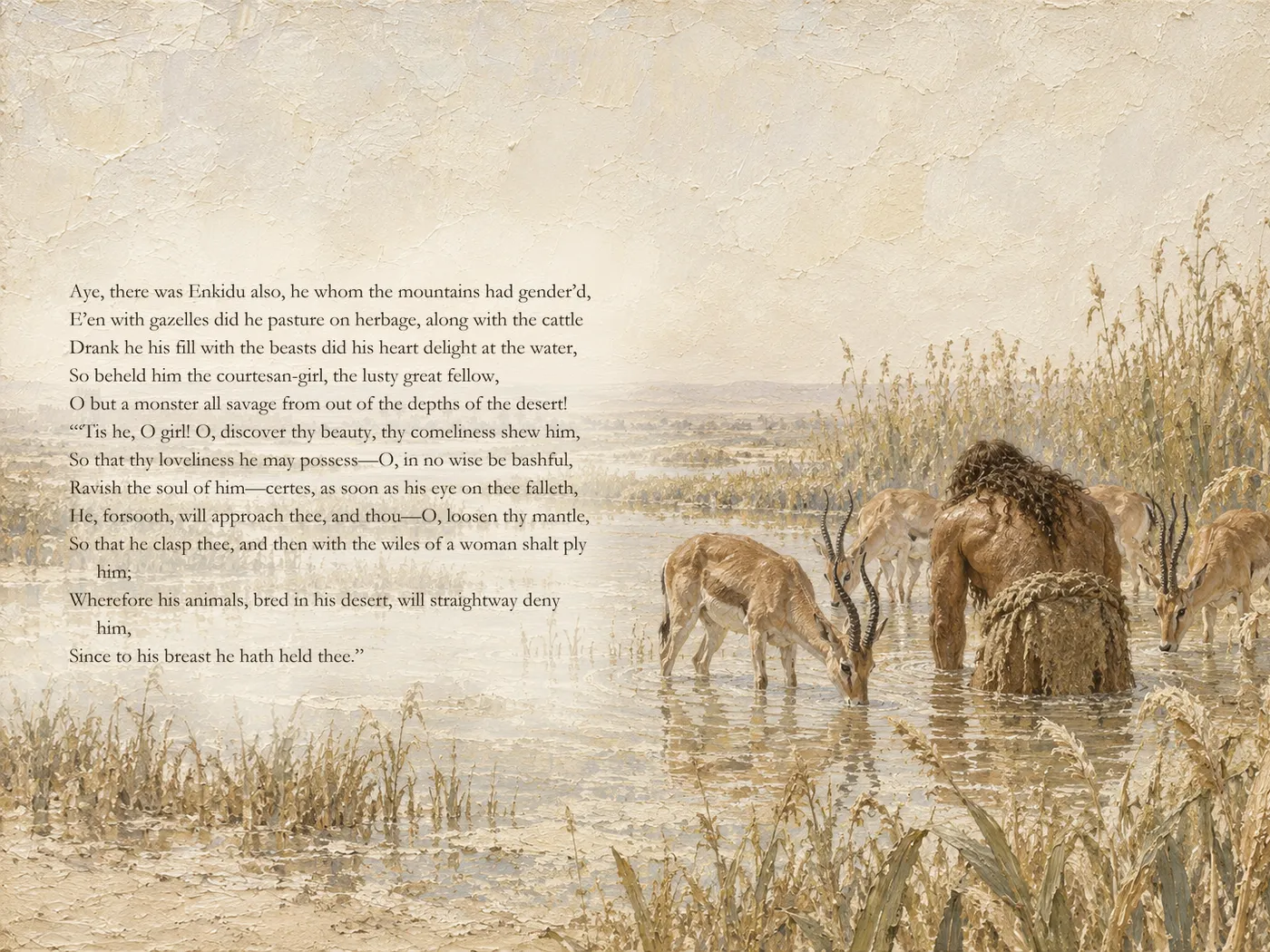
A trapper finds Enkidu filling in his pits and tearing up his snares, and he runs to his father in terror. The father sends him to Gilgamesh, and Gilgamesh gives the order: take a woman from the city to the watering place, and when the wild man sees her the animals will turn from him. Thompson calls her a courtesan and a hetaera and gives her no name. Other translations name her Shamhat.
It works. Enkidu stays with her six days and seven nights, and when he turns back to the herd the gazelles bolt. He has lost his place among them, and gained something Thompson calls wisdom. She brings him to the shepherds and teaches him bread and drink.
Enkidu ate of the bread, aye, ate until he was gorged,
Drank of the mead seven bumpers; his spirits rose, and, exultant,
Glad was his heart, and cheerful his face: himself was he rubbing,
Oil on the hair of his body anointed: and thus became human
Many readers take this as the poem's account of how people left the wild for settled life, and it counts the cost. Enkidu's knees fail him as the gazelles run, and later, dying, he curses the woman for what she did.
How did Enkidu and Gilgamesh become friends?
Gilgamesh dreams of Enkidu twice before they meet. In the first a star falls on his shoulders, too heavy to shift, and the people of Uruk crowd round and kiss its feet. In the second an axe lands in the street, and he holds it to him. His mother Ninsun tells him that both mean the same thing.
This is a stoutheart, a friend, one ready to stand by a comrade,
One whose strength is the greatest, the length and breadth of the country,
Enkidu, for his part, longs for a companion. He comes to Uruk, where the crowd says he is shorter than Gilgamesh and stronger in build. At the door of a chamber where a bridal bed is laid he blocks the king's way, and the two fight until the doorway shatters. The fight ends when Gilgamesh gives way and the two recognise each other.
Gilgamish bent his leg to the ground: so his fury abated,
Aye, and his ardour was quell’d: so soon as was quelled his ardour,
Enkidu then tells Gilgamesh that his mother raised his head above heroes, and that Enlil gave him the kingship over men. In Tablet III they grip each other's hands like brothers.
What did Enkidu do against Humbaba and the Bull of Heaven?
The plan to kill Humbaba is Gilgamesh's. Enkidu, who has roamed the hills, knows the guardian of the Forest of Cedars and tries to talk the king out of it.
Flame in his jaws, and his very breath Death!
When Gilgamesh insists, Enkidu goes with him. At the Gate of the Forest his nerve breaks, and Gilgamesh has to talk him back to his feet. When the winds of the sun god pin Humbaba and the monster begs for mercy, it is Enkidu who says he must not be left alive, and the two cut off his head.
Back in Uruk, Ishtar sends the Bull of Heaven after Gilgamesh refuses to marry her. Enkidu is the one who goes for it.
Enkidu girded his middle; and straightway Enkidu, leaping,
Seized on the Heavenly Bull by his horns, and headlong before him
Cast down the Heavenly Bull his full length,
When Ishtar curses them from the city wall, Enkidu tears a piece from the dead animal and throws it at her. The killing of the Bull makes the pair famous. It also seals Enkidu's fate. The poem's whole shape is in The Twelve Tablets of Gilgamesh Explained.
Death and what follows
Why does Enkidu die?
After the celebration, Enkidu dreams that the great gods meet in council. Humbaba and the Bull are dead, and someone must answer for them. The gods decree that Enkidu shall die and Gilgamesh shall live. The sun god Shamash speaks against it, and Enlil turns on him in anger. Enkidu falls ill with fever, and in his misery he curses the woman who took him out of the wild, wishing her the street for a home and the shadow of a wall for a house. Shamash calls to him from the sky and reminds him what she gave him.
She ‘twas who made thee eat bread, for divinity proper: aye, wine too,
She made thee drink, ‘twas for royalty proper: a generous mantle
Enkidu takes back the curse and blesses her. Then he dreams again, of a dark man with a lion's claws who seizes him and carries him down to the House of Dust, the place from which nobody returns.
Me did he lead to the Dwelling of Darkness, the home of Irkalla,
Unto the Dwelling from which he who entereth cometh forth never!
Aye, by the road on the passage whereof there can be no returning,
The tablets are damaged at the moment of death, and Tablet VIII opens at first light with Gilgamesh beside his friend, who is dying.
Why does Enkidu's death drive the rest of the poem?
Gilgamesh covers Enkidu's face as a bride's is covered and roars like a lioness robbed of her cubs. He will not bury the body for six days and seven nights, and then a fear takes hold of him: Enkidu has turned to dust, and so will he. That fear sets the second half of the poem in motion.
He leaves Uruk in a lion's skin to find Utnapishtim, the one man the gods made immortal. He crosses the Mountains of Mashu and the Waters of Death, and everyone he meets hears the same account of Enkidu.
Gone to the common lot of mankind! And I have bewail’d him
Day and night long: and unto the tomb I have not consign’d him
Siduri and Utnapishtim both tell him that death cannot be bought off. He wins a plant that would make him young again and loses it to a serpent. In Tablet XII, which is probably a later addition, he calls Enkidu's ghost out of the earth for one last conversation. Enkidu at first refuses to describe the world of the dead, then gives way, and the poem closes on his account of how the dead are treated.
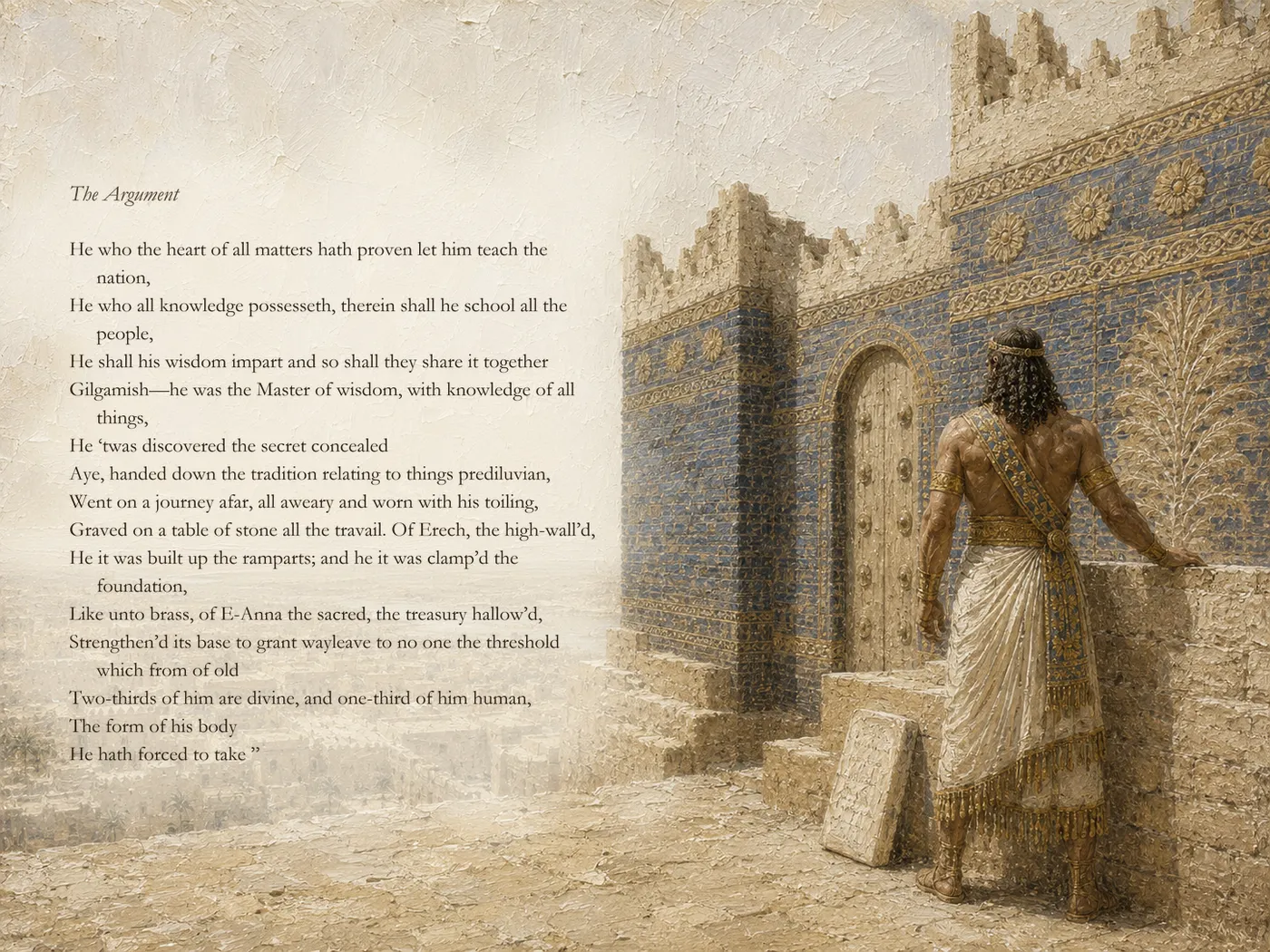
The first half of the poem gives a king who cannot be stopped someone he cannot overpower. The second takes that friend away. Gilgamesh comes home without immortality and shows Urshanabi the wall he built, which will outlast him. What Utnapishtim tells him on the way is in The Gilgamesh Flood Story and Noah.
Enkidu at the water among the gazelles is one of the 100 paintings in The Epic of Gilgamesh Illustrated, Volume II of Ancient Mythology, one of the Illuminated Classics, which follows Hesiod's Theogony. More of the poem's lines are collected in Epic of Gilgamesh Quotes.
Questions
Is Enkidu human or a god?
Neither entirely. The goddess Aruru makes him from clay, so he is a made being, strong as a god, and he lives as an animal until he is taught to eat bread and wear clothes. After that the poem treats him as a man, and he dies as one.
Who is the woman who tames Enkidu?
Thompson calls her a courtesan and a hetaera and does not name her. The Akkadian text calls her Shamhat, and many translations use that name.
Why do the gods kill Enkidu?
As the answer to the killing of Humbaba and the Bull of Heaven. In Enkidu's dream the gods decree that he must die and Gilgamesh may live. The sun god Shamash objects and Enlil answers him in anger. Thompson's text gives no further reason for choosing Enkidu.
Were Gilgamesh and Enkidu lovers?
Scholars disagree. The poem calls Enkidu a friend, a comrade and a brother, and Gilgamesh grieves like a man who has lost half of himself. Some readers find a romantic bond in the language, and others read a friendship between equals. The text allows both readings.
Where can I read the Enkidu story for free?
Thompson's 1928 translation is in the public domain in the United States. The Epic of Gilgamesh Illustrated sets it among 100 paintings and is a free ebook on Payhip.
The Inner Circle
Join the Circle
The next book is already taking shape in the dark.
Be the first to know about new releases, exclusive content, hardcover drops, and glimpses behind the veil of ZoderoT's worlds.
No spam. No noise. Only the signal that matters.