The Epic of Gilgamesh
The Epic of Gilgamesh: Summary, Tablet by Tablet
What happens in each of the twelve tablets, in order, with lines from R. Campbell Thompson's 1928 translation.
What is the Epic of Gilgamesh about?
The Epic of Gilgamesh is a Babylonian poem about Gilgamesh, king of Uruk, who is two-thirds god and one-third human. The gods make a wild man, Enkidu, to check his pride, and the two become friends. Together they kill the forest guardian Humbaba and the Bull of Heaven, and the gods answer by taking Enkidu's life. Gilgamesh, terrified of dying, crosses the world to ask the flood survivor Utnapishtim how to live for ever. He fails, loses a plant that would have made him young again, and walks home to the wall he built.
The standard version was written in Akkadian on twelve clay tablets, and most surviving copies come from the library of the Assyrian king Ashurbanipal at Nineveh, in the seventh century BC. Later Babylonian tradition credits a scholar-priest named Sin-leqi-unninni with shaping it from older Sumerian poems. Whether its hero rests on a real king of Uruk is taken up in Was Gilgamesh a Real King? Names here use modern spellings. Thompson wrote Erech, Gilgamish, Uta-Napishtim and Ur-Shanabi, and those spellings appear only inside the quotations.
Tablet I: The tyrant king and the wild man
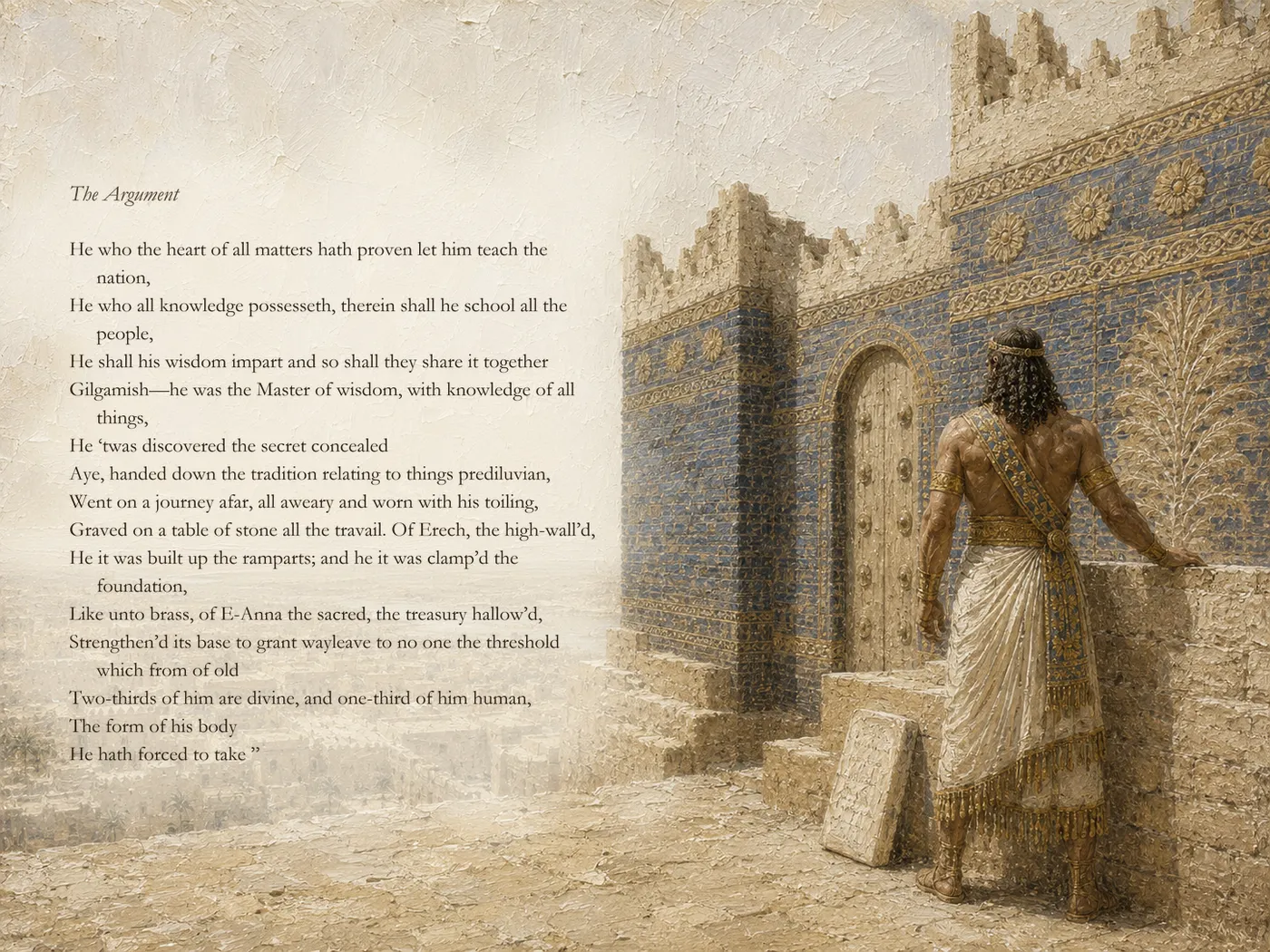
Gilgamesh rules Uruk, and his people complain to the gods that he leaves no son to his father and no maiden to her mother. Anu tells the goddess Aruru to make a rival for him, and she moulds Enkidu from clay on the open plain. He lives among the gazelles until a trapper, on Gilgamesh's orders, brings a woman from the city to draw him away from the herd. Gilgamesh has already dreamed of him twice, as a star and as an axe, and his mother Ninsun says both mean a friend.
Two-thirds of him are divine, and one-third of him human,
Tablet II: The fight at the door
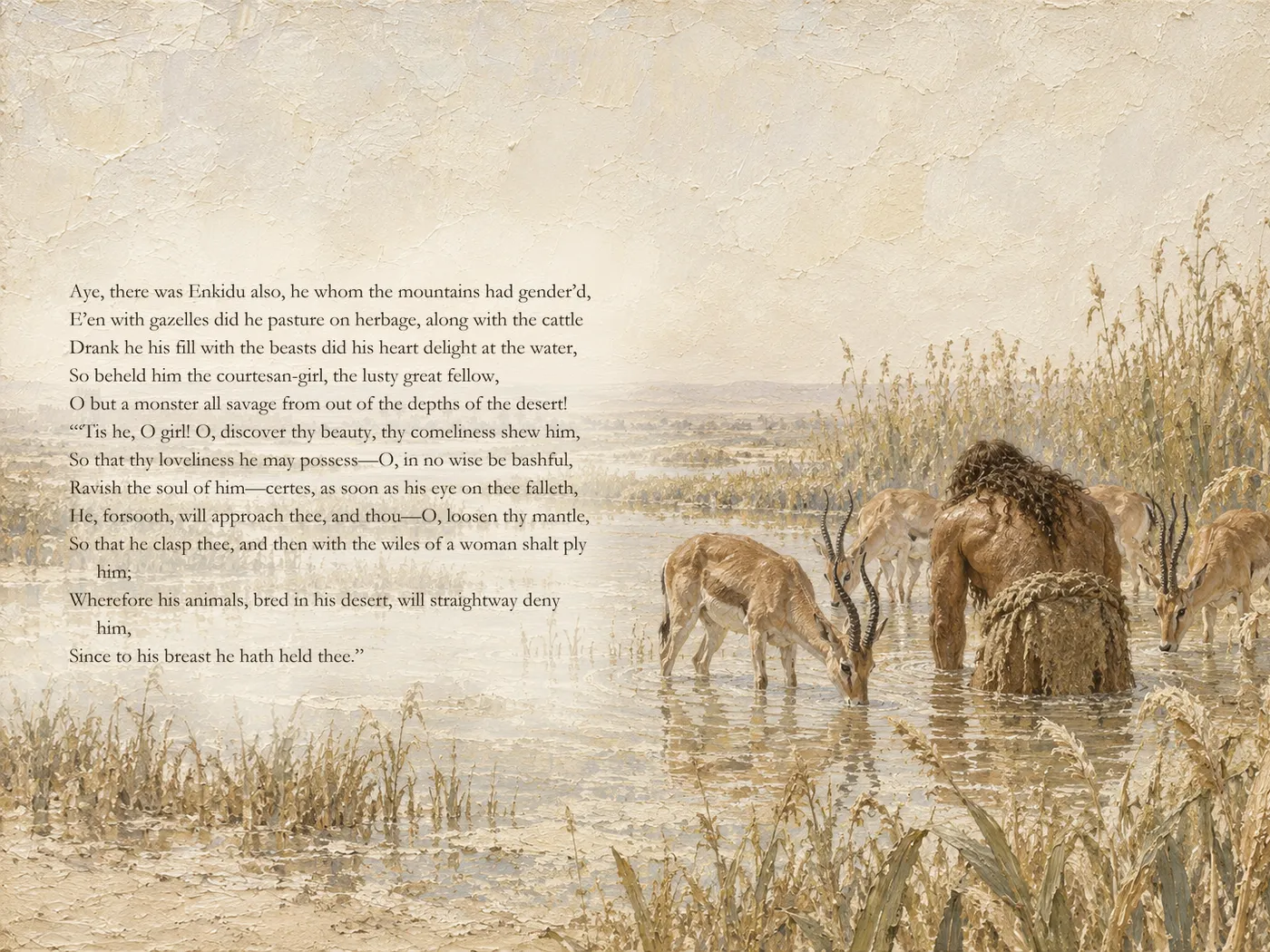
Enkidu spends six days and seven nights with the woman, and the gazelles run from him afterwards. She teaches him to eat bread and drink, and he dresses and drives off the lions that prey on the shepherds. In Uruk he bars the door of a bridal chamber against Gilgamesh, and the two fight like bulls until the threshold splits. Then Gilgamesh gives way, and they are friends.
they grappled and snorted like bulls, and the threshold
Shatter’d: the very wall quiver’d as Gilgamish Enkidu grappled,
Tablet III: The plan to kill Humbaba
Gilgamesh wants to cut the cedars of the Forest of Cedars and kill its guardian, Humbaba, whom Enlil set there as a terror to mortals. Enkidu knows the forest and warns him: Humbaba roars like a whirlwind and his breath is death. Gilgamesh answers that men's days are numbered, so a man should win a name that lasts. Weapons are cast, the Elders plead, and the two set out. Enkidu has his own page at Who Is Enkidu?
I, forsooth, if I should fall, my name will have stablish’d for ever
Gilgamish ‘twas, who fought with Humbaba, the Fierce!
Tablet IV: The gate of the forest
At the Gate of the Forest, Enkidu admires the cedar timber and speaks to the gate as though it could hear. Then his courage fails, and he lies sick and begs Gilgamesh to turn back. Gilgamesh tells him to forget death, and the two arrive together at the edge of the trees.
“Nay, but, my friend, let us no wise go down to the depths of the Forest,
For ‘tis my hands have grown weak, and my arms are stricken with palsy.”
Tablet V: The fight with Humbaba
The heroes look at Humbaba's path and the cedar mountain, the home of the gods. Gilgamesh dreams badly, and Enkidu tells him to put his fear aside. The clay is broken at the fight itself, and Thompson fills the gap from a Hittite telling. The sun god Shamash sends eight winds that pin Humbaba where he stands. He begs for mercy, Enkidu says he must not be left alive, and they cut off his head.
Chill wind, and whirlwind, a wind of all evil: ‘twas eight winds he raiséd,
Seizing Humbaba before and behind, so that nor to go forwards,
Nor to go back was he able: and then Humbaba surrender’d
Tablet VI: Ishtar and the Bull of Heaven
Washed and dressed, Gilgamesh catches the eye of Ishtar, goddess of love, who offers marriage, a golden chariot and a rich kingdom. He refuses and lists the lovers she ruined, among them a bird whose wing she broke and a shepherd she turned into a jackal. Ishtar makes her father Anu give her the Bull of Heaven. It kills hundreds in Uruk until Enkidu seizes it by the horns and the heroes kill it. Ishtar curses them from the city wall, and Enkidu throws a piece of the dead animal at her.
Thou’rt but a ruin which giveth no shelter to man from the weather,
Thou’rt but a back door not giving resistance to blast or to windstorm,
The second half of the poem
Tablet VII: The gods condemn Enkidu
In a dream Enkidu sees the great gods in council decree that he shall die and Gilgamesh shall live. Shamash speaks against it, and Enlil turns on him in anger. Fever takes Enkidu, and he curses the woman who brought him to Uruk, until Shamash reminds him of everything she gave him. He takes the curse back and blesses her. A second dream drags him down to the House of Dust, where the dead wear feathers like birds and eat dust.
“Why, O my friend, do the great gods now take counsel together?”
Tablet VIII: The lament
At first light Gilgamesh speaks to his dying friend, then cries out before the Elders that he weeps like a woman and his weapons hang slack. When Enkidu does not stir, he covers his face as a bride's is covered and tears his hair. He sets out honey and cream as offerings for the dead.
Then he veil’d his friend like a bride
Lifted his voice like a lion
Roar’d like a lioness robb’d of her whelps.
Tablet IX: The road to the end of the world
In fear of death, Gilgamesh decides to find Utnapishtim, who survived the flood and was made immortal. At the Mountains of Mashu, scorpion-men guard the gate of the sun, and he falls to the ground in terror. They let him pass, and he walks the Road of the Sun through darkness for twelve double hours, until he comes out beside the Tree of the Gods.
Sorrow hath enter’d my heart; I fear death as I range o’er the desert,
Tablet X: Siduri, the boatman and the Waters of Death
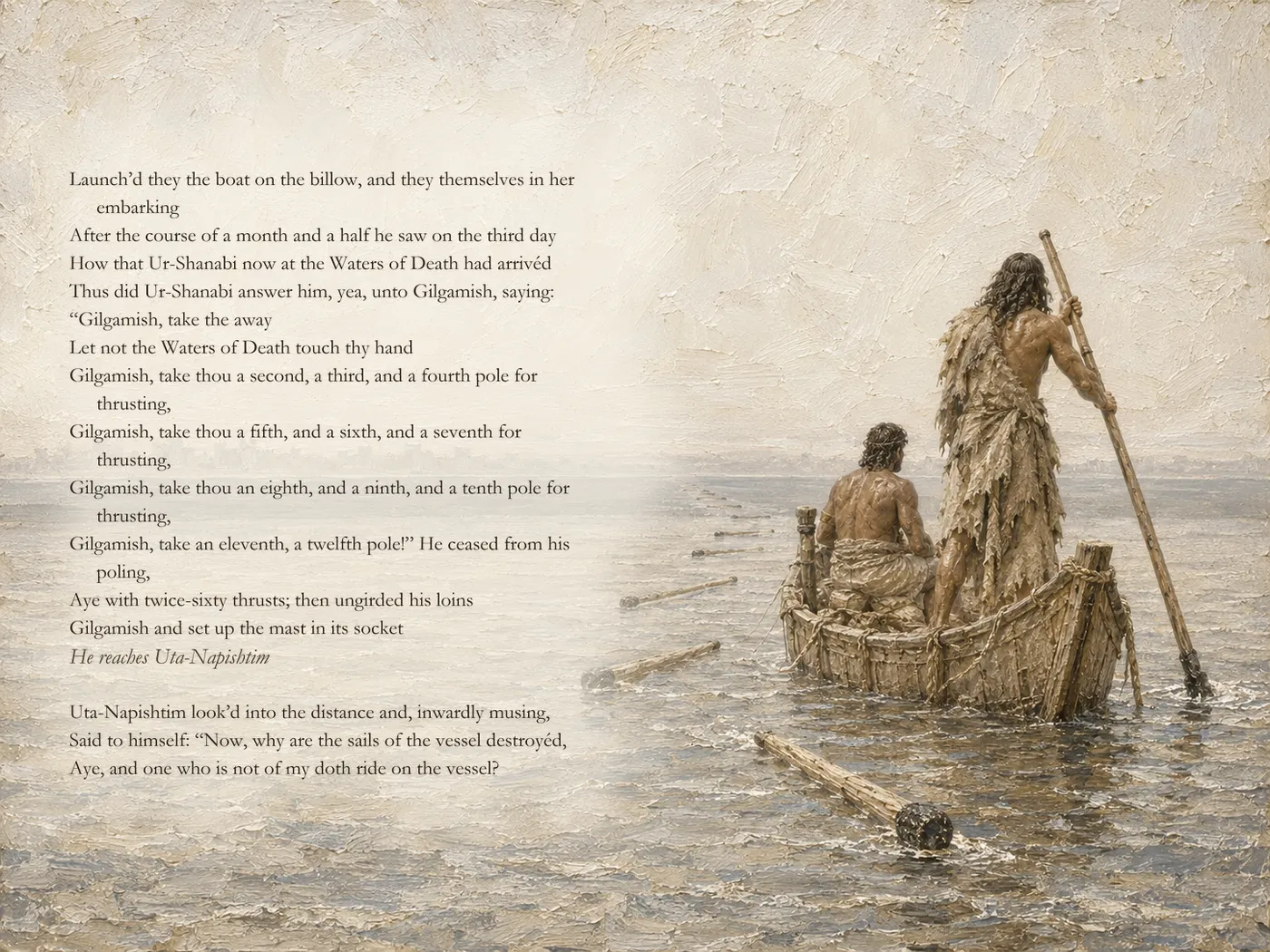
At the edge of the sea the wine-maker Siduri bars her door against the stranger in animal pelts. Gilgamesh tells her about Enkidu, and she answers that the gods gave death to men and kept life for themselves, so he should eat, bathe and love the child who holds his hand. She names the boatman Urshanabi, whose sails he wrecks. He cuts punt poles in the forest, and the two cross the Waters of Death.
“Gilgamish, why runnest thou, inasmuch as the life which thou seekest,
Thou canst not find? For the gods, in their first creation of mortals,
Death allotted to man, but life they retain’d in their keeping
Tablet XI: The flood, the test and the plant
Gilgamesh sees that Utnapishtim looks like himself and asks how he came to live for ever. Utnapishtim tells how Ea warned him of the flood and how he built a ship and rode out the storm, a story compared with Noah's in The Gilgamesh Flood Story and Noah. Then he sets a test: stay awake six days and seven nights. Gilgamesh sleeps at once, and Utnapishtim's wife bakes a loaf for each day. Sent home, Gilgamesh learns of a thorny plant on the sea floor that makes an old man young. He ties stones to his feet, dives and takes it, but on the way back a serpent steals it while he bathes. In Uruk he shows Urshanabi the ramparts.
But here was a serpent who snuff’d the plant’s fragrance,
Darted he up from the water and snatch’d the plant, uttering malison
As he drew back.
Tablet XII: The ghost of Enkidu
The last tablet does not follow from the one before. Scholars think it is a later addition, a rendering of part of an older Sumerian poem in which Enkidu is still alive at the start. Gilgamesh asks how to bring Enkidu's spirit back, is told the rules for approaching the dead, and breaks every one. Enlil and the Moon god give no answer, and Ea tells Nergal to open a hole in the earth. Enkidu rises like a wind and describes how the dead fare: the man killed in battle is tended by his parents and wife, and the ghost with nobody to tend it eats scraps thrown into the street.
Lees of cup, and broken bread
Thrown into the street he eateth.”
Who are the main characters in the Epic of Gilgamesh?
- Gilgamesh, king of Uruk, two-thirds god and one-third human, builder of its wall.
- Enkidu, the wild man made from clay, his equal and friend.
- Humbaba, guardian of the Forest of Cedars, set there by Enlil.
- Ishtar, goddess of love, who sends the Bull of Heaven against Uruk.
- Ninsun, Gilgamesh's divine mother, who reads his dreams.
- Shamash, the sun god, who helps the heroes and speaks up for Enkidu.
- Anu, Enlil and Ea, great gods: Anu is the sky god, Enlil the warrior god who sends the flood, and Ea the wise god who warns Utnapishtim.
- The woman who tames Enkidu, called a courtesan by Thompson. Other translations name her Shamhat.
- Siduri, the wine-maker at the edge of the sea.
- Urshanabi, the boatman of the Waters of Death.
- Utnapishtim, the flood survivor whom the gods made immortal.
What are the main themes of the Epic of Gilgamesh?
Death is the subject. Gilgamesh begins by hoping that fame will keep his name alive, and he ends by trying to escape dying altogether. Siduri and Utnapishtim both tell him it cannot be done.
Friendship comes next. A king who cannot be stopped is given someone he cannot overpower, and grief for that one man sets the second half in motion.
The city and the wilderness pull against each other. Enkidu becomes a man by eating bread and putting on clothes, and the poem leaves open whether that was a gain. Tablet XI ends with Gilgamesh showing off the kiln-fired brick walls of Uruk, work that other people will go on using after he is dead.
Which translation do the quotations come from?
Every quotation here is from R. Campbell Thompson's The Epic of Gilgamish, published in London by Luzac and Company in 1928. Thompson worked from the tablets known then, so his text lacks later finds, such as a tablet acquired in 2011 that restored lines of Tablet V. His English is archaic verse. The text in The Epic of Gilgamesh Illustrated is an edited reading text: Thompson's brackets are resolved into the line, and his notes on damage to the tablets are replaced by short bridges, which this page also draws on. Newer translations by Andrew George, Stephen Mitchell, N. K. Sandars and Maureen Gallery Kovacs are still under copyright and are not quoted. The book is Volume II of Ancient Mythology, one of the Illuminated Classics, after Hesiod's Theogony. Lines worth keeping are gathered in Epic of Gilgamesh Quotes, and the poem's structure in The Twelve Tablets of Gilgamesh Explained.
Questions
How many tablets are in the Epic of Gilgamesh?
Twelve in the standard Babylonian version. Tablets I to XI make one connected story, and Tablet XII, about Enkidu's ghost, looks like a later addition.
Who wrote the Epic of Gilgamesh?
No one knows. It grew out of older Sumerian poems and an earlier Babylonian version, and the standard version was probably assembled in the late second millennium BC. Later Babylonian tradition credits a scholar-priest named Sin-leqi-unninni.
Is the Epic of Gilgamesh complete?
No. The clay tablets are broken, and every translation has gaps. New pieces still turn up: a tablet acquired in 2011 restored lines of Tablet V.
How does the Epic of Gilgamesh end?
Gilgamesh fails to win eternal life and loses the plant of youth to a serpent. He returns to Uruk and shows the boatman Urshanabi the city wall. Tablet XII adds a last scene in which the ghost of Enkidu describes the world of the dead.
Can I read the Epic of Gilgamesh for free?
Yes. Thompson's 1928 translation is in the public domain in the United States, and The Epic of Gilgamesh Illustrated, which sets it among 100 paintings, is a free ebook on Payhip.
The Inner Circle
Join the Circle
The next book is already taking shape in the dark.
Be the first to know about new releases, exclusive content, hardcover drops, and glimpses behind the veil of ZoderoT's worlds.
No spam. No noise. Only the signal that matters.