The Epic of Gilgamesh
Epic of Gilgamesh Quotes: 25 Lines, With Tablet and Meaning
Twenty-five lines from the poem, copied exactly from R. Campbell Thompson's 1928 translation, each with its tablet and a plain note on what is happening.
These twenty-five lines come from R. Campbell Thompson's 1928 translation, printed in full in The Epic of Gilgamesh Illustrated. They are grouped by theme and run in story order. Each is copied exactly, with its tablet number and a note on where it falls in the plot.
Thompson spelled the names his own way: Gilgamish for Gilgamesh, Erech for Uruk, Uta-Napishtim for Utnapishtim, Ur-Shanabi for Urshanabi. His spellings stay inside the quotations, and the rest of the page uses the modern forms. The lines come from the edition's reading text, which prints Thompson without his editorial brackets, so a line sometimes stops where the clay is broken.
Newer translations, by Andrew George, N. K. Sandars, Stephen Mitchell and Maureen Gallery Kovacs among others, are still in copyright, so none of their wording appears here. For the plot in order, see the Epic of Gilgamesh summary.
Epic of Gilgamesh quotes about friendship
The gods make Enkidu as a match for the king, to keep Gilgamesh busy and give Uruk some peace. He becomes the one person Gilgamesh loves. More on him in who Enkidu is.
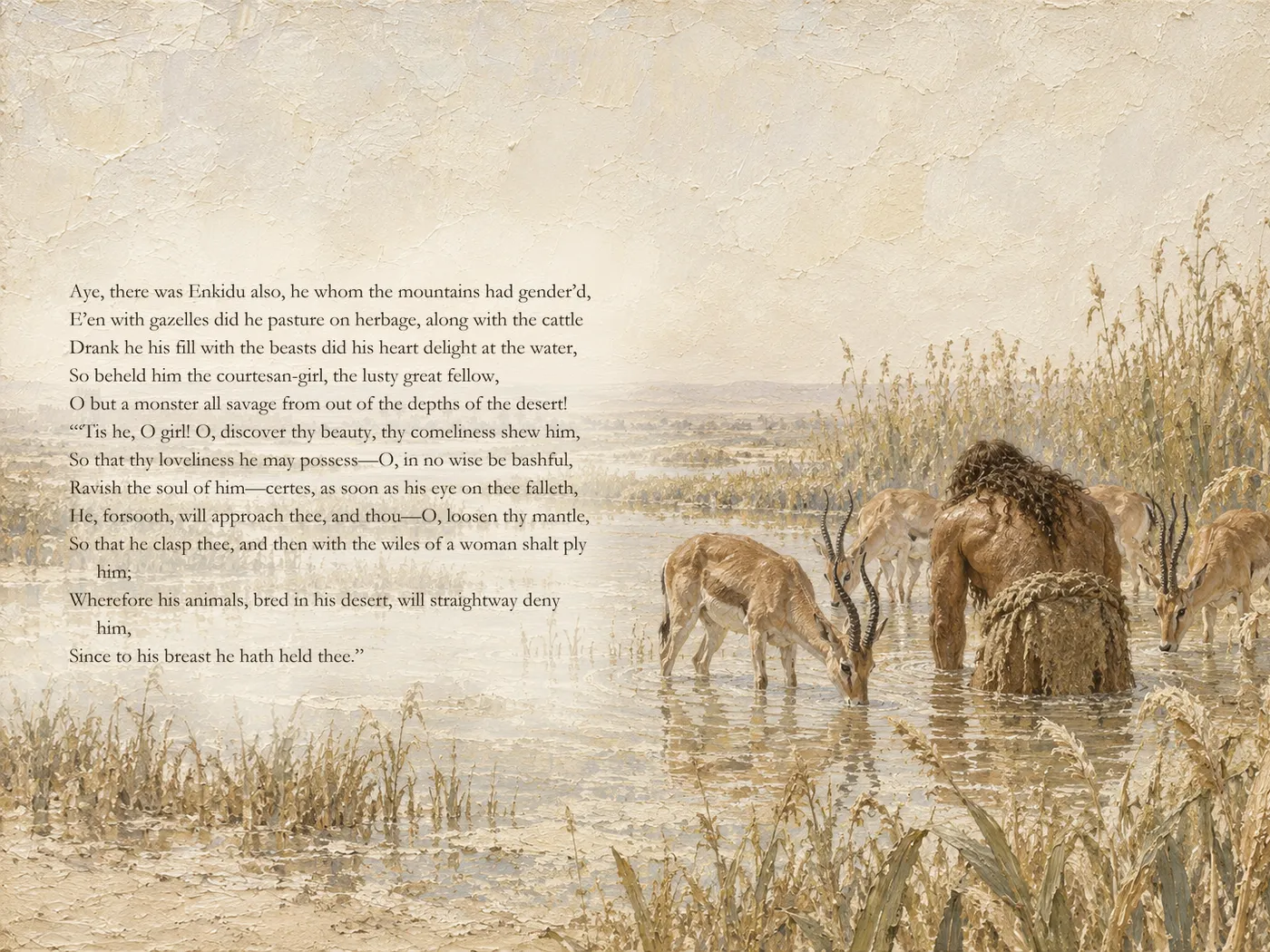
“Now, since thou to thy breast didst hold him the way of a woman,
This is a sign that thou art the one he will never abandon:”
Before Enkidu arrives, Gilgamesh dreams of a heavy shape he cannot shake off. His mother Ninsun, a goddess, reads it: a friend is coming, and he will not leave him.
“Gilgamish bent his leg to the ground: so his fury abated,
Aye, and his ardour was quell’d: so soon as was quelled his ardour,”
Enkidu blocks a doorway Gilgamesh is about to enter, and the two fight until the threshold breaks. Gilgamesh goes down on one knee and the anger leaves him.
“Cautious and careful, by leading the way hath his own body guarded,
He ‘tis will safeguard a comrade.”
Enkidu lies sick with dread for twelve days at the edge of the Cedar Forest. Gilgamesh tells him to forget death: the careful man who leads the way protects his friend.
“‘Tis that I weep for my comrade Enkidu, bitterly crying
Like to a wailing woman: my grip is slack’d on the curtleaxe”
Enkidu has died of fever. Gilgamesh calls the elders of Uruk and says he weeps like a woman, with no strength left in the hand that held his axe.
“Then he veil’d his friend like a bride
Lifted his voice like a lion
Roar’d like a lioness robb’d of her whelps. In front of his comrade”
The chest no longer beats. Gilgamesh veils the face as for a bride, roars, and paces over the body tearing out his hair.
Epic of Gilgamesh quotes about death and the fear of dying
After Enkidu dies, death is nearly the only subject. These lines run from a boast about fame to the scraps the forgotten dead eat.
“I, forsooth, if I should fall, my name will have stablish’d for ever
Gilgamish ‘twas, who fought with Humbaba, the Fierce!”
Before the fight with Humbaba, Enkidu is afraid. Gilgamesh answers that a man who falls in a great deed leaves a name, the only afterlife he can imagine yet.
“Unto the Dwelling from which he who entereth cometh forth never!
Aye, by the road on the passage whereof there can be no returning,”
Dying, Enkidu dreams that a dark figure drags him down to the house of Irkalla, the underworld. No one leaves it.
“Wear they a garment of feathers: and, sitting there in the darkness,
Never the light will they see.”
The dream goes on. The dead eat dust and mud, wear feathers like birds and sit in the dark.
“Sorrow hath enter’d my heart; I fear death as I range o’er the desert,”
Enkidu is buried. Gilgamesh, who has seen what waits for him, leaves Uruk to find Utnapishtim, the one human the gods made immortal.
“Lay my head in the bowels of earth, and throughout the years slumber
Ever and aye? Let mine eyes see the Sun and be sated with brightness,”
Shamash tells him that the life he seeks he will not find. Gilgamesh answers that he will sleep in the earth long enough, and for now he wants the sun.
“‘Greybeard-who-turneth-to-man-in-his-prime’ is its name and I’ll eat it
I myself, that again I may come to my youthful condition.”
Utnapishtim tells him of a thorny plant on the sea floor. Gilgamesh dives for it and brings it up, but a serpent smells it while he bathes and takes it.
“Lees of cup, and broken bread
Thrown into the street he eateth.”
In Tablet XII Enkidu's spirit is called up from the earth and says how the dead fare. This is the man whose ghost has no one to tend it. The poem ends on this image, and the twelve tablets are explained in their own article.
The lines themselves
Epic of Gilgamesh quotes about kingship and the walls of Uruk
The poem opens on a king and closes on his city, with a tyrant, a hero and a mourner in between. Whether such a king lived is taken up in Was Gilgamesh a real king?.
“He it was built up the ramparts; and he it was clamp’d the foundation,
Like unto brass, of E-Anna the sacred, the treasury hallow’d,”
The prologue credits Gilgamesh with the ramparts of Uruk and the foundation of E-Anna, the temple of the goddess Ishtar. Both were real, and their ruins have been excavated in southern Iraq.
“Two-thirds of him are divine, and one-third of him human,”
The prologue's best-known line. The poem never works out the sum, and what it may mean is discussed in the history article.
“Gilgamish leaveth no son to his father, his arrogance swelling
Each day and night; aye, he is the shepherd of Erech, the high-wall’d,”
The people of Uruk complain to the gods. Shepherd is the old word for a king, and here it is an accusation. The gods answer by having Enkidu made.
“Nin-sun exalted thy head above heroes, and Enlil hath dower’d
Thee with the kingship o’er men.”
After the fight Enkidu tells Gilgamesh that his mother Ninsun raised him above other heroes and that the great god Enlil gave him kingship. A king rules because a god chose him.
“Do thou, Ur-Shanabi, go up and walk on the ramparts of Erech, Look on its base, and take heed of its bricks, if its bricks be not kiln-burnt,”
Back home with nothing, Gilgamesh sends the boatman Urshanabi to walk the walls and check the bricks. In the standard text this closes Tablet XI and echoes the opening praise of the walls.
Epic of Gilgamesh quotes about the flood
Tablet XI holds the flood Utnapishtim describes to Gilgamesh. Its likeness to Noah's flood caused a sensation when George Smith announced it in 1872, and the two are compared in Gilgamesh and the flood.
“Life do thou seek, and thy hoard disregard, and save life; every creature
Make to embark in the vessel. The vessel, which thou art to fashion,”
Ea, one of the gods who agreed to the flood, betrays the plan by saying it aloud to a reed hut with Utnapishtim on the other side of the wall.
“Nor could a brother distinguish his brother; from heaven were mortals
Not to be spied.”
When the storm breaks the world goes dark. No brother can pick out his brother, and from heaven the people can no longer be seen.
“Cow‘ring like curs were the gods while like to a woman in travail
Ishtar did cry, she shrieking aloud, e’en the sweet-spoken Lady”
The gods who sent the flood are terrified by it. They flee to the highest heaven and crouch like dogs, and Ishtar cries out in regret for her vote in the assembly.
“Six days, a se’nnight the hurricane, deluge, and tempest continued
Sweeping the land: when the seventh day came, were quelléd the warfare,”
The storm lasts about a week. The boat then grounds on Mount Nisir, and Utnapishtim sends out a dove, a swallow and a raven.
“Blessing us; ‘Uta-Napishtim hath hitherto only been mortal,
Now, indeed, Uta-Napishtim and also his wife shall be equal
Like to us gods;”
Enlil, who wanted every human dead, ends by blessing the survivors: Utnapishtim and his wife become like gods. Utnapishtim then asks Gilgamesh who will call the gods together for him.
Siduri's advice to Gilgamesh
Siduri keeps a wine shop at the edge of the world. Gilgamesh arrives in animal skins, grieving and afraid, and she bars her door. Then she gives the most quoted advice in the poem.
It has a history. Thompson's notes show that he fills this part of Tablet X from an Old Babylonian tablet in Berlin, because the Nineveh text is badly damaged here. The older version is the one people quote.
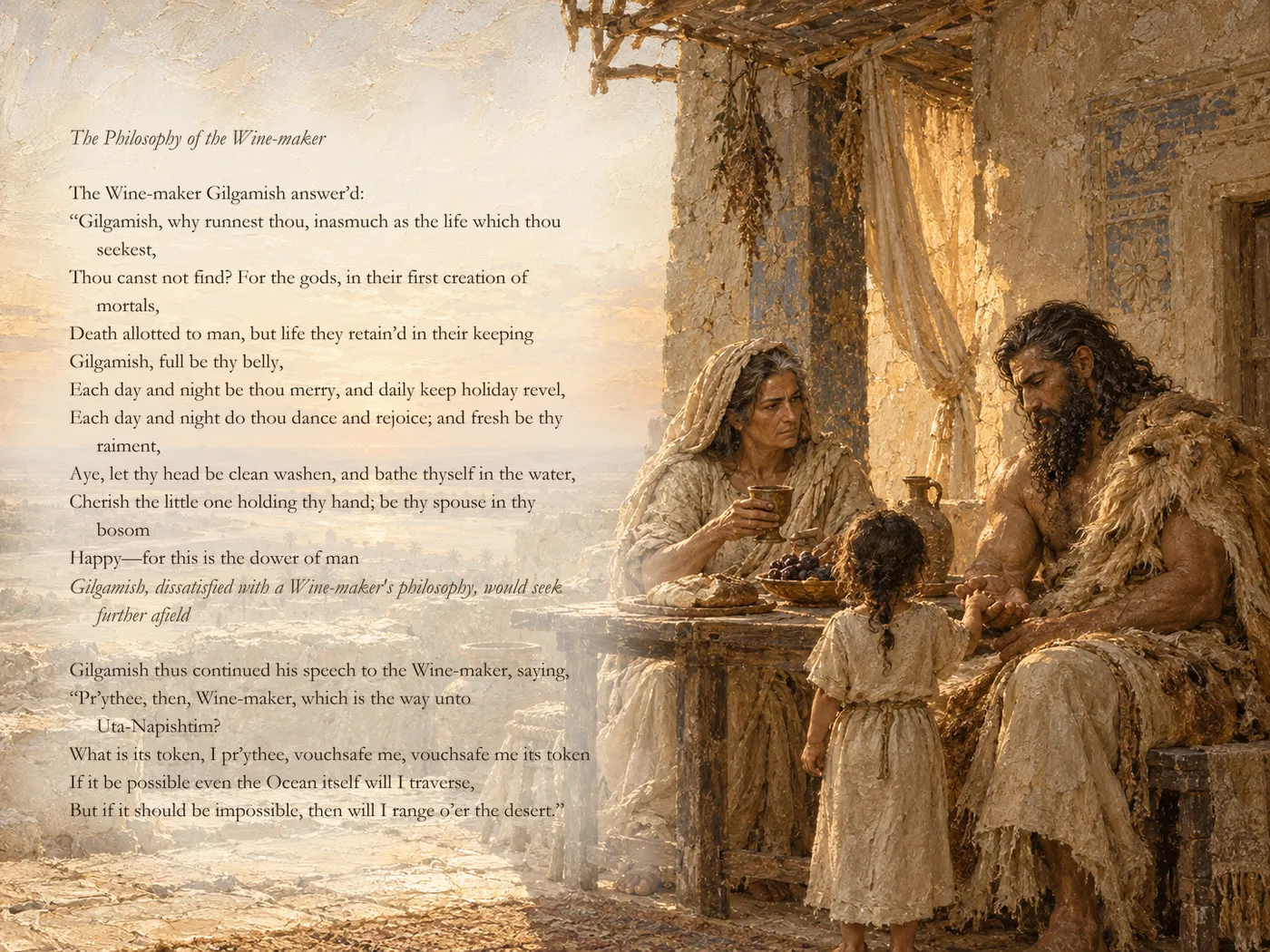
“Gilgamish, why runnest thou, inasmuch as the life which thou seekest,
Thou canst not find? For the gods, in their first creation of mortals,
Death allotted to man, but life they retain’d in their keeping”
Siduri begins with what cannot be had. The gods gave death to people and kept life for themselves.
“Gilgamish, full be thy belly,
Each day and night be thou merry, and daily keep holiday revel,
Each day and night do thou dance and rejoice; and fresh be thy raiment,”
Then what can be had: feasting, dancing, clean clothes, a bath. The speech ends with the child who holds his hand and the wife in his arms, “for this is the dower of man”. Gilgamesh asks for the road to Utnapishtim.
“Death, aye, and Life they determine; of Death is the day not revealéd.”
At the end of the tablet Utnapishtim gives Gilgamesh the same lesson. The great gods and Mammetum, maker of destiny, settle every fate, and the day of death stays hidden.
The edition is Volume II of the Ancient Mythology line, after Hesiod's Theogony (Hesiod's Theogony summary). Both belong to the Illuminated Classics.
Questions
What is the most famous quote from the Epic of Gilgamesh?
Siduri's speech in Tablet X is among the most quoted: the life you seek you will not find, because the gods kept life for themselves, so enjoy the days you have. It is in the Siduri section above.
Which translation do these quotes come from?
R. Campbell Thompson's 1928 translation, the text printed in The Epic of Gilgamesh Illustrated. It is in the public domain in the United States. Newer translations are still under copyright.
Why do the names look different from other versions?
Thompson used the spellings of his day: Gilgamish, Erech, Uta-Napishtim and Ur-Shanabi. Modern writers say Gilgamesh, Uruk, Utnapishtim and Urshanabi.
Where does Siduri's advice come from?
In Thompson's translation it comes from an Old Babylonian tablet in Berlin, used because the Nineveh text of that passage is badly damaged. The Old Babylonian version is roughly a thousand years older than the Nineveh tablets.
Is two-thirds god in the poem?
Yes. Tablet I says that two-thirds of him are divine and one-third human, and the wife of the scorpion-man says it again in Tablet IX. The poem never explains the sum.
The Inner Circle
Join the Circle
The next book is already taking shape in the dark.
Be the first to know about new releases, exclusive content, hardcover drops, and glimpses behind the veil of ZoderoT's worlds.
No spam. No noise. Only the signal that matters.