The Epic of Gilgamesh
The Twelve Tablets of Gilgamesh, Explained
What the tablets are, who put them in order, where they were dug up, and what each of the twelve contains.
The Epic of Gilgamesh, as most readers meet it, is written on twelve clay tablets. They make up the Standard Babylonian version, a poem in Akkadian that tradition credits to a scholar named Sin-leqi-unninni, and most surviving copies come from the library of the Assyrian king Ashurbanipal at Nineveh. Eleven tablets tell one story. The twelfth tells another.
R. Campbell Thompson's 1928 translation, printed in full in The Epic of Gilgamesh Illustrated, follows this order, and the tablet numbers below are his. Dates are approximate.
What is a clay tablet?
A tablet is a flat cushion of clay that a scribe could hold in one hand. He pressed wedge-shaped signs into the wet surface with a cut reed, a script called cuneiform, and then dried or baked the clay. A long poem ran over a series of tablets, each one working like a chapter.
Scribes named a work by its opening words. The twelve-tablet poem began Sha naqba imuru, roughly “He who saw the abyss”, and an older version began Shutur eli sharri, roughly “Greater than all other kings”.
Who put the twelve tablets together?
Nobody knows who first told the story, because it grew over centuries from older poems. The twelve-tablet edition is credited to Sin-leqi-unninni, a name known from a later list of scholars from Uruk. He was an exorcist-priest, placed between about 1300 and 1000 BCE, though the date is uncertain.
He seems to have collected, edited and reshaped older material rather than made the poem from nothing. The copies we have are younger, mostly from the seventh century BCE.
Where were the Gilgamesh tablets found?
Most come from Nineveh, on the Tigris opposite modern Mosul in northern Iraq. Ashurbanipal, who ruled Assyria in the seventh century BCE, gathered texts from across Mesopotamia for his palace libraries. When Nineveh was sacked in 612 BCE the palaces burned, and the fire baked many tablets hard enough to last.
British excavators reached them in the 1840s and 1850s: Austen Henry Layard from 1847, then Hormuzd Rassam, who had worked with him. The tablets went to London in crates as thousands of broken pieces.
The reading began with George Smith, a British Museum assistant who sorted the fragments. In 1872 he recognised among them an account of a great flood, with a boat landing on a mountain and birds sent out to find land. He announced it in December. A newspaper then paid for him to go to Nineveh, where in 1873 he found a missing piece within a week.
Copies have also turned up at Babylon, Uruk and Sultantepe in Turkey, so the poem was copied widely.
What is on each of the twelve tablets?
The summaries follow Thompson's division. Modern editions agree with it closely, though a few episodes sit on a different tablet.
Tablet I: the tyrant and the wild man
The poem praises Gilgamesh as the builder of the walls of Uruk, two-thirds god and one-third human. His people cry out against his rule, and the gods have the goddess Aruru shape Enkidu from clay. Enkidu lives among the gazelles until a hunter brings a courtesan from the city to him. After six days and seven nights he is no longer wild.
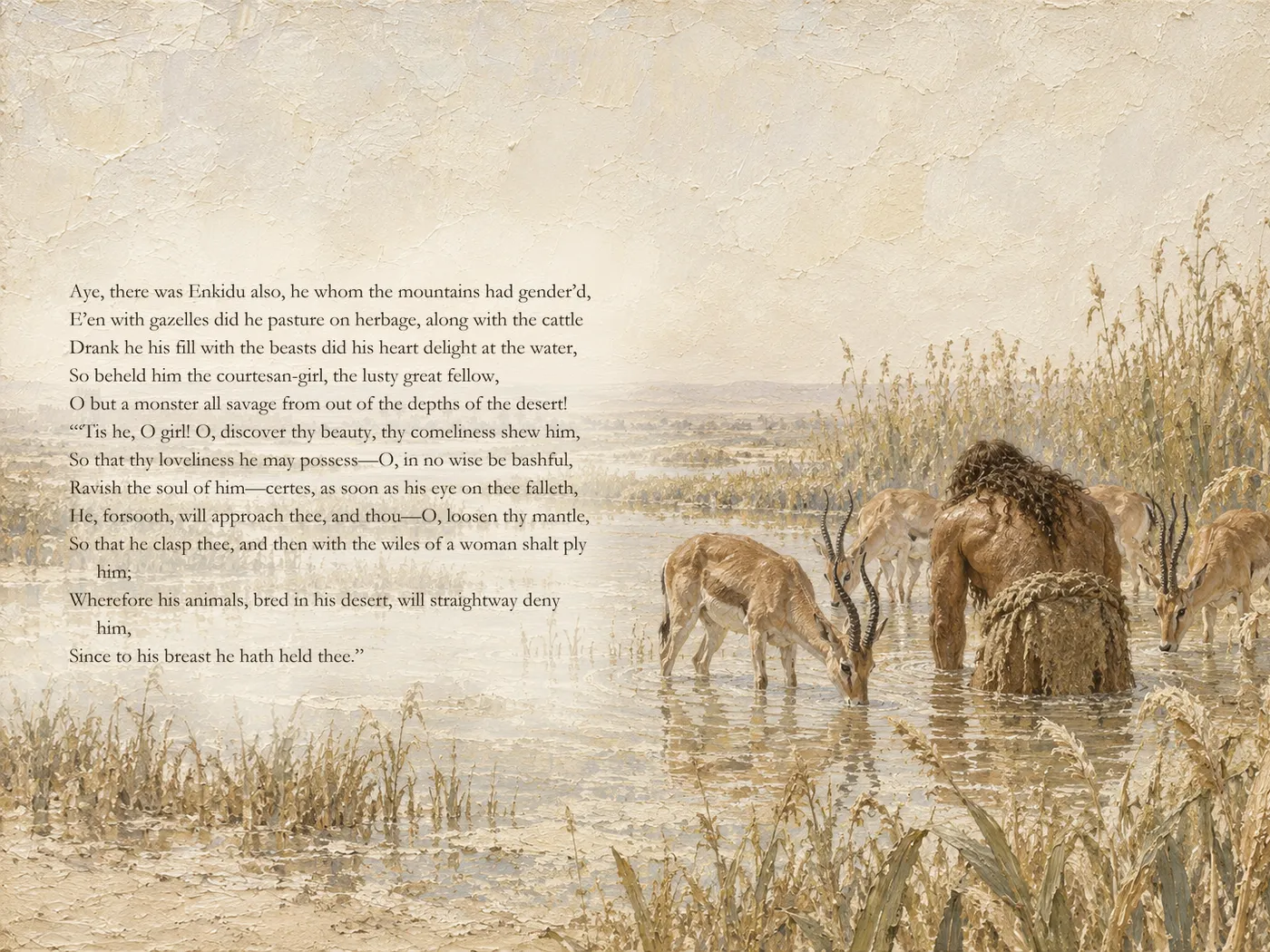
Tablet II: the fight in the doorway
The woman teaches Enkidu to eat bread and drink beer, and he kills the lions that trouble the shepherds. In Uruk he blocks the doorway Gilgamesh is about to enter. They fight until the threshold shatters, and the fight ends in friendship.
Tablet III: the Cedar Forest
Gilgamesh decides to kill Humbaba, the guardian of the Cedar Forest. Enkidu and the elders of Uruk try to talk him out of it. Weapons are cast, and his mother Ninsun prays to the sun god Shamash to protect him.
Tablet IV: the gate of the forest
At the gate of the forest Enkidu speaks to the great door as if it could hear him. Then he falls ill with dread and lies sick for twelve days, until Gilgamesh talks him on.
Tablet V: the fight with Humbaba
In the forest, which Thompson calls the home of the gods, Gilgamesh has dreams that Enkidu reads as good omens. The fight itself is lost from the Assyrian tablets, and Thompson fills the gap from a Hittite translation: Shamash sends winds that pin Humbaba, who begs for mercy, and Enkidu says he must die.
Tablet VI: Ishtar and the Bull of Heaven
Ishtar offers to marry the hero, and he refuses, listing the lovers she has ruined. She demands the Bull of Heaven from her father Anu, and it comes down on Uruk. Gilgamesh and Enkidu kill it, and Enkidu throws a piece of it at her.
The second half of the poem
Tablet VII: the death of Enkidu
Enkidu dreams that the gods have judged that one of the two must die for killing Humbaba and the Bull, and they choose him. He falls ill and curses the woman who brought him to Uruk, then takes the curse back when Shamash reminds him what she gave him. A last dream shows him the house of dust.
Tablet VIII: the mourning
Enkidu dies. Gilgamesh calls the elders of Uruk to hear his grief, goes over everything the two did together, and veils the body as for a bride. Then he lays out offerings for the dead.
Tablet IX: the search for life
Afraid of dying, Gilgamesh leaves Uruk to find Utnapishtim, the one human the gods made immortal. Scorpion-men guard the mountains of Mashu, where the sun passes. He walks twelve double hours in darkness through the mountain and comes out into a garden of jewelled trees, where Shamash tells him the life he seeks he will not find.
Tablet X: Siduri, the boatman and the Waters of Death
Siduri, who keeps a wine shop, bars her door, then hears his story and tells him to enjoy the life he has. Gilgamesh asks for the road instead. He quarrels with the boatman Urshanabi, cuts new poles in the forest, and the two cross the Waters of Death to Utnapishtim.
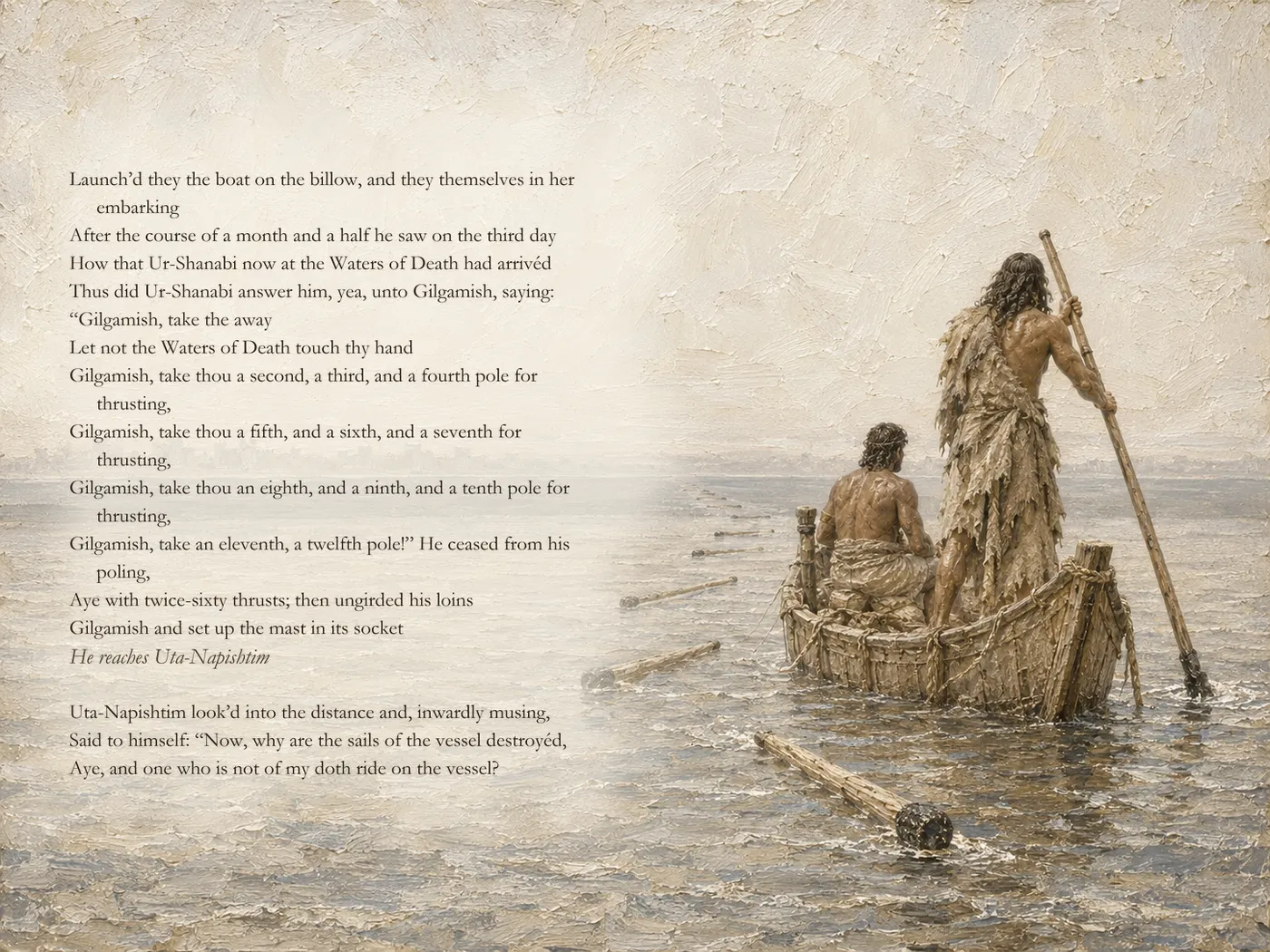
Tablet XI: the flood and the plant
Utnapishtim tells how Ea warned him of the flood, how he built a boat and lived, and how the gods relented. He tests Gilgamesh with a week without sleep, and Gilgamesh falls asleep at once. Utnapishtim names a plant that restores youth. Gilgamesh gets it, loses it to a serpent, and returns to Uruk and its walls. The flood is compared with Noah's in its own article.
Tablet XII: the voice from the earth
Grieving again, Gilgamesh asks how the dead can be reached. Ea orders the underworld god Nergal to open a hole in the earth, and the spirit of Enkidu rises like a wind. Gilgamesh asks what he has seen. Enkidu says he would weep to hear it, then tells him how the dead fare.
Why does Tablet XII not fit the story?
Tablet XI ends with Gilgamesh home in Uruk, looking at his walls, in lines that echo the start of the poem. That is a finished poem. Tablet XII begins again with Gilgamesh grieving, and it contradicts what came before.
Most of it is a close translation into Akkadian of the second half of an older Sumerian poem about Gilgamesh, Enkidu and the underworld. In the Sumerian poem Enkidu is Gilgamesh's servant and still alive when the story starts: he goes down into the underworld to fetch something Gilgamesh dropped and cannot come back. In Tablets VII and VIII of the epic he has already died of illness, so the two accounts cannot both be true.
Scholars disagree about why the editor kept it. Some call it an appendix, added to complete a set of twelve or to save good text. Others read it as a last word: the dead can be reached for a moment and will not help the living. Many modern readers stop at Tablet XI.
What came before the twelve tablets?
The oldest Gilgamesh texts are separate Sumerian poems, composed probably in the late third millennium BCE and known from copies made in the scribal schools of the early second millennium BCE. There are five, among them Gilgamesh and Huwawa (Huwawa is Humbaba under an older name), Gilgamesh and the Bull of Heaven, and The Death of Gilgamesh. In them Enkidu is a servant, and none contains the flood story.
Around 1800 BCE a poet or poets wove several of these stories into one Akkadian poem, the Old Babylonian version, which makes the two heroes friends and contains the meeting with Siduri. Thompson used it where the later text was broken: his notes mention tablets from Yale and Berlin, and Siduri's speech in his Tablet X comes from the Berlin tablet. The twelve-tablet poem reworked it and added the flood, borrowed from an older poem called Atrahasis.
Thompson used a Hittite translation, found at the Hittite capital, now Boghazkoy in Turkey, to restore the fight with Humbaba.
How much of the Epic of Gilgamesh has survived?
There is no complete copy. Every tablet has damaged lines, Tablet XI, the flood, is the best preserved, and some passages survive only in part. The story can still be followed as one piece, but every translation has gaps and either marks them or fills them from other versions, as Thompson did.
The text has kept growing since 1928. Tablets from Sultantepe, dug in the 1950s, added lines. In 2011 the Sulaymaniyah Museum in Iraq bought a tablet that restores part of Tablet V, the Humbaba episode, published in 2015. The illustrated edition keeps his text as it stood in 1928 and adds short editorial bridges where the clay is broken.
The edition is Volume II of the Ancient Mythology line within the Illuminated Classics, after Hesiod's Theogony (Hesiod's Theogony summary). Some of the best lines of the twelve tablets are in Epic of Gilgamesh quotes.
Questions
How many tablets are there in the Epic of Gilgamesh?
Twelve in the Standard Babylonian version, the form most readers know. Eleven tablets tell one story and the twelfth is a separate piece added at the end. The older Old Babylonian version was shorter.
Who wrote the Epic of Gilgamesh?
No single person. Sumerian poets composed the first Gilgamesh poems in the late third millennium BCE, and unknown poets later wove them into one Akkadian poem. The twelve-tablet edition is credited to Sin-leqi-unninni, who lived probably between about 1300 and 1000 BCE.
Where are the Gilgamesh tablets now?
Most of the Nineveh tablets are in the British Museum in London. Thompson's notes name Old Babylonian tablets at Yale and in Berlin, and the tablet bought in 2011 is in the Sulaymaniyah Museum in Iraq.
Is Tablet XII part of the original epic?
It is part of the twelve-tablet edition but not of the story. Most of it translates an older Sumerian poem in which Enkidu is still alive, so it contradicts his death in Tablets VII and VIII.
What is the oldest part of the Gilgamesh story?
The five Sumerian poems about Gilgamesh, composed in the late third millennium BCE and known from copies made around 1800 BCE. None of them contains the flood story or the search for Utnapishtim.
The Inner Circle
Join the Circle
The next book is already taking shape in the dark.
Be the first to know about new releases, exclusive content, hardcover drops, and glimpses behind the veil of ZoderoT's worlds.
No spam. No noise. Only the signal that matters.