Theogony
Chaos, Gaia, Tartarus and Eros: The First Gods in Hesiod
What the Theogony says came first, what Chaos means in Hesiod, and how the first beings lead to Uranus and the Titans.
In Hesiod's Theogony the first beings are Chaos, Gaia (Earth), Tartarus and Eros, in that order. Chaos comes first and has no parents. Gaia, the deep place called Tartarus and Eros, the power of desire, follow. Almost every other god in the poem descends from Chaos or from Gaia. Chaos is a gap in Hesiod, an open space, and the sense of disorder came later.
Who were the first gods in Greek mythology?
At the end of his opening hymn Hesiod asks the Muses to tell him which of the gods first came to be. The answer takes seven lines, in Hugh G. Evelyn-White's translation:
“Verily at the first Chaos came to be, but next wide-bosomed Earth, the ever-sure foundations of all the deathless ones who hold the peaks of snowy Olympus, and dim Tartarus in the depth of the wide-pathed Earth, and Eros (Love), fairest among the deathless gods, who unnerves the limbs and overcomes the mind and wise counsels of all gods and all men within them.”
Hesiod does not say who made any of the four. Chaos is first. Gaia comes next, the broad-breasted floor of the world and the “ever-sure foundations” of the gods who live on Olympus. Tartarus lies beneath her, deep in the earth. Eros is the fourth.
What does Chaos mean in the Theogony?
The Greek word comes from a root meaning to gape or yawn, and Hesiod uses a related word, chasma, for the great gulf of Tartarus:
“It is a great gulf, and if once a man were within the gates, he would not reach the floor until a whole year had reached its end, but cruel blast upon blast would carry him this way and that.”
Chaos is first of all room: an opening in which the earth, the sky and the dark can appear. Aristotle read it that way more than three centuries later, in the fourth book of his Physics. Something must exist first, he argued, to hold everything that comes after.
The sense of shapeless disorder is later. The Roman poet Ovid opens his Metamorphoses with a rough heap of mixed things and calls it Chaos, and that is the picture English kept.
Hesiod gives Chaos no body, no voice and no will. It has two children, Erebus and Night. It comes back twice in the poem, both times as a place. When Zeus fights the Titans, “Astounding heat seized Chaos” (line 700). Later Hesiod says the Titans live “beyond gloomy Chaos” (lines 813-814).
Who is Eros in Hesiod?
Hesiod's Eros is an old power, one of the first four beings, and he has no mother. He is the fairest of the immortals, and he loosens the limbs and overpowers the mind of every god and every man.
He has no children and no scene of his own. A reader can see him at work behind the pairings that follow: Night with Erebus, Earth with Heaven, Rhea with Cronos. When Aphrodite rises from the sea foam, Eros walks beside her: “And with her went Eros, and comely Desire followed her at her birth” (lines 201-202). Later poets made him her son. In the Theogony he is older than she is.
What is Tartarus in the Theogony?
Tartarus is the deepest place in Hesiod's world. At line 119 it lies “in the depth of the wide-pathed Earth”. Later the poem measures it: as far below the earth as the sky is above it, so far that a bronze anvil falling for nine days and nights from the earth would reach it on the tenth (lines 720-725). Zeus chains the Titans there, a war told in the Titanomachy, and later throws the monster Typhoeus into it (line 868).
Tartarus is also a father. Gaia bears Typhoeus to him (lines 820-822), the only child the poem gives him. Hesiod gives Tartarus no face and no speech. It is a place that can father a child.
Night and Erebus
Who are Night and Erebus?
Chaos has two children, Erebus and black Night. Erebus is darkness. Later in the poem the name also belongs to a place under the earth, where Zeus sends Menoetius, a son of Iapetus (line 515). Night and Erebus have children of their own.
“From Chaos came forth Erebus and black Night; but of Night were born Aether and Day, whom she conceived and bare from union in love with Erebus.”
Light comes out of the dark. Hesiod's Day is the daughter of Night.
Night then bears a second family with no partner at all.
“And again the goddess murky Night, though she lay with none, bare Blame and painful Woe, and the Hesperides who guard the rich, golden apples and the trees bearing fruit beyond glorious Ocean.”
The list is long. Doom, black Fate, Death, Sleep and the tribe of Dreams come first (lines 211-212). After the Hesperides come the three Fates, Nemesis, Deceit, Friendship, hateful Age and Strife (lines 217-225). Strife in turn bears Toil, Forgetfulness, Famine, Sorrows, Battles, Murders, Quarrels, Lying Words, Lawlessness, Ruin and Oath (lines 226-232). Read in order, the family of Night is a catalogue of what people dread and endure, with Sleep and Dreams among them as the mercies.
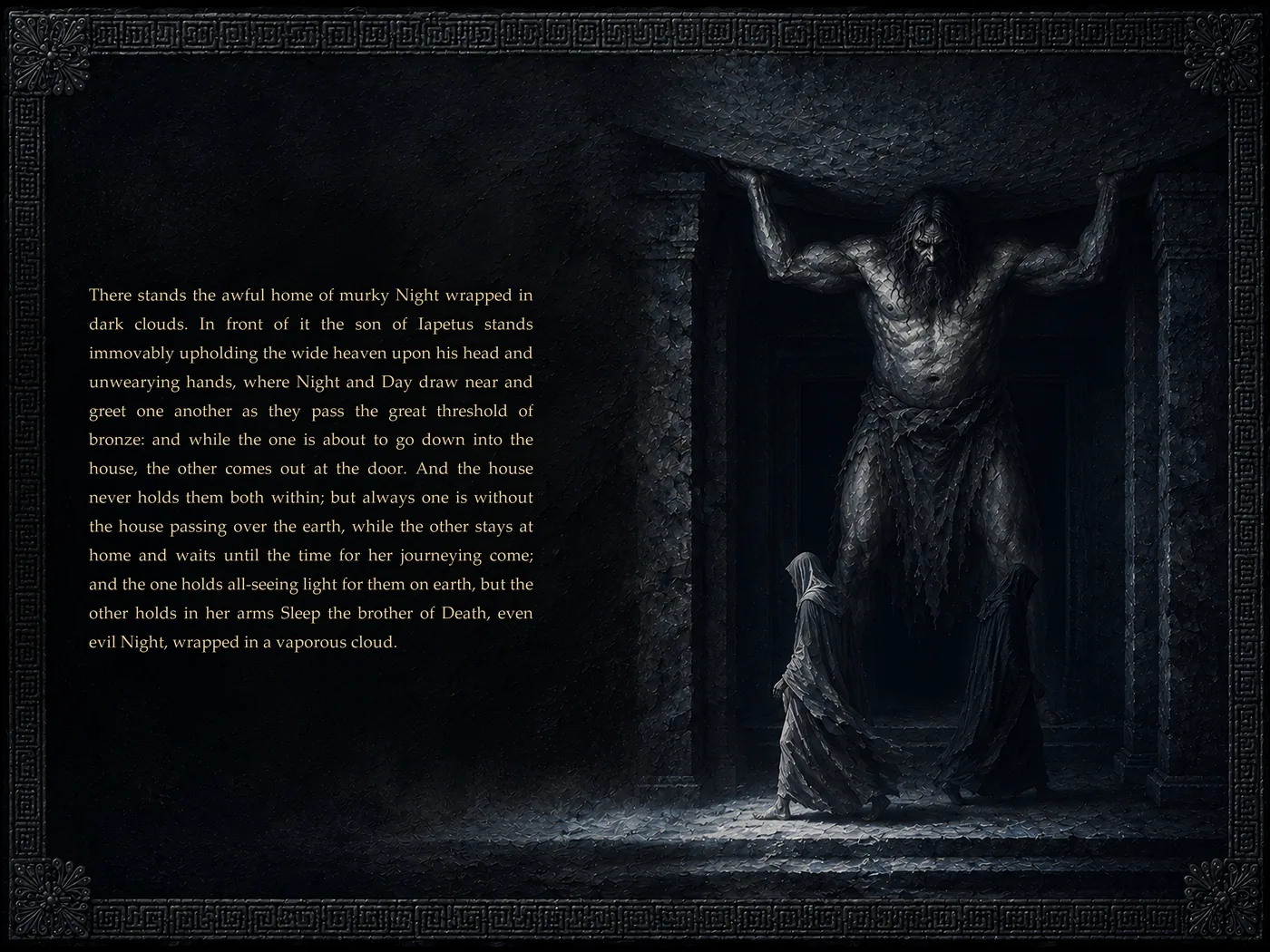
Hesiod puts the house of Night at the edge of the world. Atlas holds up the sky in front of it, and Night and Day pass each other at a bronze threshold, one going in as the other comes out (lines 744-757). The painted opening below shows that scene.
How do the first beings lead to Uranus and the Titans?
Gaia carries the next steps alone. She bears Heaven without a partner, and Hesiod says why.
“And Earth first bare starry Heaven, equal to herself, to cover her on every side, and to be an ever-sure abiding-place for the blessed gods.”
Then she bears the long Hills, home of the nymphs, and the barren sea, Pontus, again with no partner (lines 129-132). Only after that does she lie with Heaven. Their children are the twelve Titans, the Cyclopes and the Hundred-Handers (lines 133-153). The first group has its own article, the twelve Titans.
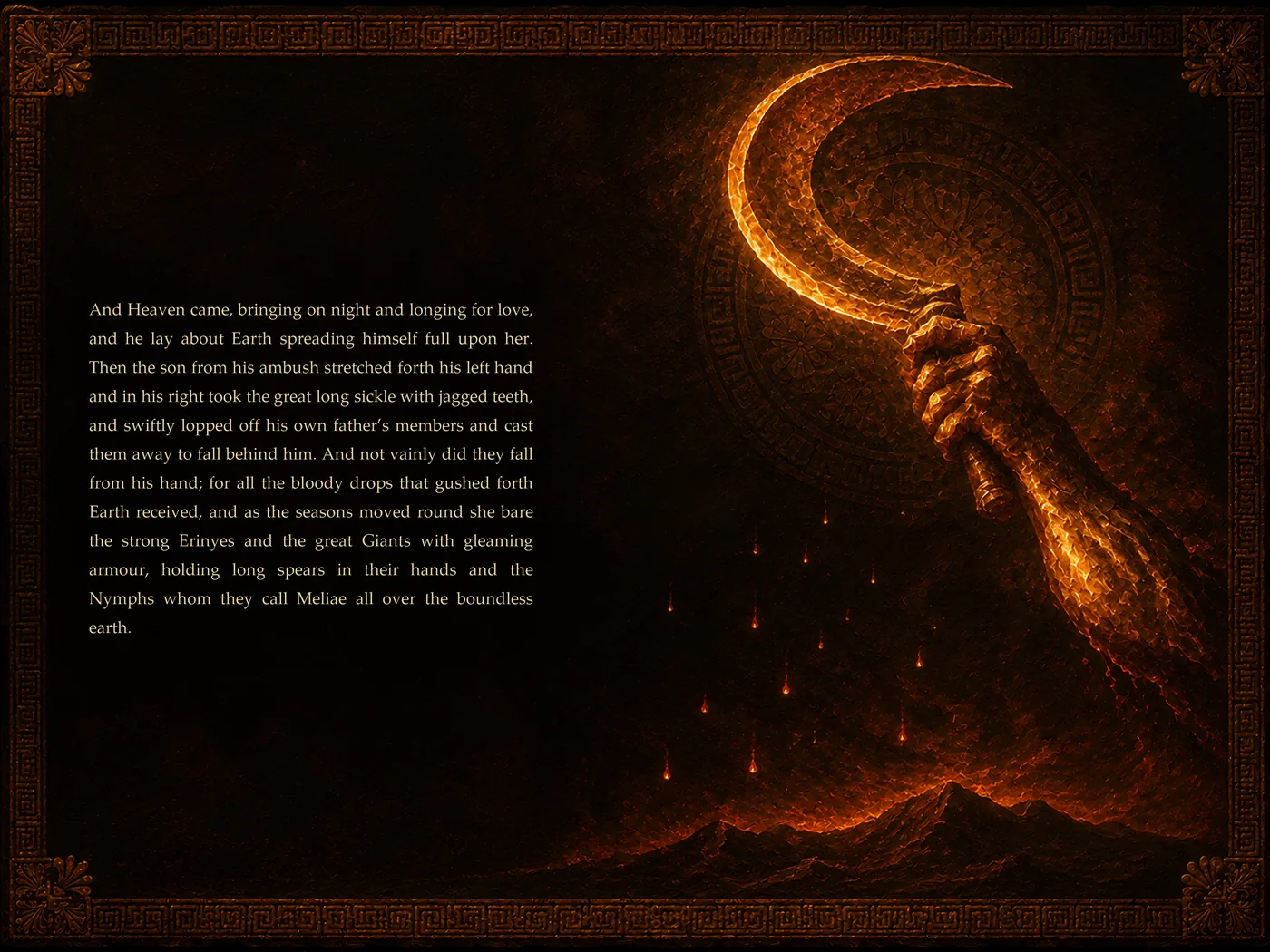
Heaven hides his most terrible children, the Hundred-Handers, inside the earth as each is born (lines 154-160). Gaia makes a flint sickle, and Cronos, the youngest Titan, cuts his father down (lines 173-182). The first line of rulers ends there and the Titans begin. The whole sequence is in the Theogony summary, and every birth is in the family tree.
Do other ancient poets name a different first god?
They do. In the Iliad, book 14, Homer calls Oceanus the origin of the gods, with his wife Tethys. Aristophanes, in his comedy The Birds, lists Chaos, Night, Erebus and Tartarus first, and has Night lay an egg from which Eros hatches. Hesiod's order is the earliest full account that survives.
Questions
Who came first in Greek mythology?
In Hesiod's Theogony, Chaos comes first. Gaia (Earth), Tartarus and Eros follow. Other ancient poets answer differently: Homer calls Oceanus the origin of the gods.
Is Chaos a god?
Hesiod lists Chaos among the first beings but gives it no body, no speech and no story. It is a gap that comes to be, and its only children are Erebus and Night.
Is Eros the son of Aphrodite?
Later poets made him her son. In Hesiod he is older than she is, one of the first four beings, and he walks beside her when she rises from the sea foam.
Who are the children of Chaos?
Erebus and Night. Night and Erebus then have two children, Aether, the bright upper air, and Day.
Where does Tartarus come from?
Tartarus is one of the four first beings, a deep place within the earth. It is also a father: Typhoeus is born to Gaia from the love of Tartarus.
The poem runs from Chaos to the reign of Zeus, and the story of Prometheus is one of its sharpest quarrels. Theogony Illustrated is part of the Illuminated Classics. For an older poem from Mesopotamia, see the Epic of Gilgamesh summary.
The Inner Circle
Join the Circle
The next book is already taking shape in the dark.
Be the first to know about new releases, exclusive content, hardcover drops, and glimpses behind the veil of ZoderoT's worlds.
No spam. No noise. Only the signal that matters.