Theogony
The Titanomachy: The Ten-Year War of the Titans and the Gods
How Hesiod tells it: Cronos swallows his children, Zeus comes back for the throne, and the world burns for ten years.
The Titanomachy was the ten-year war between the older gods, the Titans under Cronos, and the younger gods under Zeus. The Titans held Mount Othrys and the gods held Olympus. Zeus won with the help of the Hundred-Handers, whom he freed from beneath the earth, and with the thunderbolt the Cyclopes made for him. The defeated Titans were chained in Tartarus. Hesiod tells it in the Theogony, lines 617-735. The word Titanomachy is Greek for the battle of the Titans, and Hesiod himself does not use it.
Why did the Titans and the gods go to war?
The cause is a succession. Cronos had taken the throne by cutting down his father, Heaven, and he had learned from Heaven and Gaia that his own son would overcome him.
“For he learned from Earth and starry Heaven that he was destined to be overcome by his own son, strong though he was, through the contriving of great Zeus.”
So he swallowed each of Rhea's children as it was born: Hestia, Demeter, Hera, Hades and Poseidon. When Zeus was due, Rhea asked her parents for a plan. Gaia took the baby to Crete and hid him in a cave on Mount Aegeum, and Cronos was given a stone wrapped in swaddling clothes. He thrust it down into his belly, and Hesiod comments on his mistake.
“he knew not in his heart that in place of the stone his son was left behind, unconquered and untroubled, and that he was soon to overcome him by force and might and drive him from his honours, himself to reign over the deathless gods.”
When Zeus was grown, Gaia's advice tricked Cronos into bringing up his children again, the stone first. Zeus set the stone in the ground at Pytho, below Parnassus, as a sign for mortals. Hesiod credits Gaia for this. Apollodorus, a handbook of myth from Roman times, says instead that Metis gave Cronos a drug that made him vomit. Zeus then freed his father's brothers from their bonds, and they gave him thunder, lightning and the thunderbolt (lines 492-506).
Hesiod does not describe the first blow of the war. The fighting enters his poem at line 617, already deadlocked, and he names the stake in a single word, honours, in the passage quoted at the end of this page.
How long did the Titanomachy last?
Ten years. The Titans fought from high Mount Othrys and the gods born of Cronos from Olympus, and Hesiod says they fought on “for ten full years” while “the issue of the war hung evenly balanced” (lines 629-638).
The deadlock broke on Gaia's advice. She told the gods that victory would be theirs if they brought up the three Hundred-Handers, Cottus, Briareos and Gyes, whom their father Heaven had bound and buried beneath the earth out of jealousy of their size (lines 617-628). Zeus fed them nectar and ambrosia until their spirits revived, and then he asked for their help.
“But do you show your great might and unconquerable strength, and face the Titans in bitter strife; for remember our friendly kindness, and from what sufferings you are come back to the light from your cruel bondage under misty gloom through our counsels.”
Who helped Zeus win the war?
The Hundred-Handers were the first. Cottus answered for them and agreed at once, saying they had come back from the gloom through Zeus's devising.
The Cyclopes were the second. Gaia's one-eyed sons Brontes, Steropes and Arges had made the thunderbolt for Zeus (line 141), and he freed them from their bonds (lines 501-506). Apollodorus adds that the Cyclopes also gave Poseidon his trident and Hades a helmet.
Styx, a daughter of Oceanus, was the third. She came first to Olympus with her children Emulation, Victory, Strength and Force, after Zeus called the gods together and promised an honour for every god who fought for him. He promised more: “he who was without office and rights under Cronos, should be raised to both office and rights as is just” (lines 392-396). Zeus kept his word and made her water the great oath of the gods (lines 397-403).
The end of the war
How did the Titanomachy end?
Zeus stopped holding back. He came down from Olympus hurling lightning, and the whole world caught fire.
“Then Zeus no longer held back his might; but straight his heart was filled with fury and he showed forth all his strength. From Heaven and from Olympus he came forthwith, hurling his lightning: the bolts flew thick and fast from his strong hand together with thunder and lightning, whirling an awesome flame. The life-giving earth crashed around in burning, and the vast wood crackled loud with fire all about.”
The heat reached Chaos itself, and the Titans' eyes were blinded by the glare of the thunderbolts. Then the Hundred-Handers went in at the front of the line.
“And amongst the foremost Cottus and Briareos and Gyes insatiate for war raised fierce fighting: three hundred rocks, one upon another, they launched from their strong hands and overshadowed the Titans with their missiles, and buried them beneath the wide-pathed earth, and bound them in bitter chains when they had conquered them by their strength for all their great spirit, as far beneath the earth to Tartarus.”
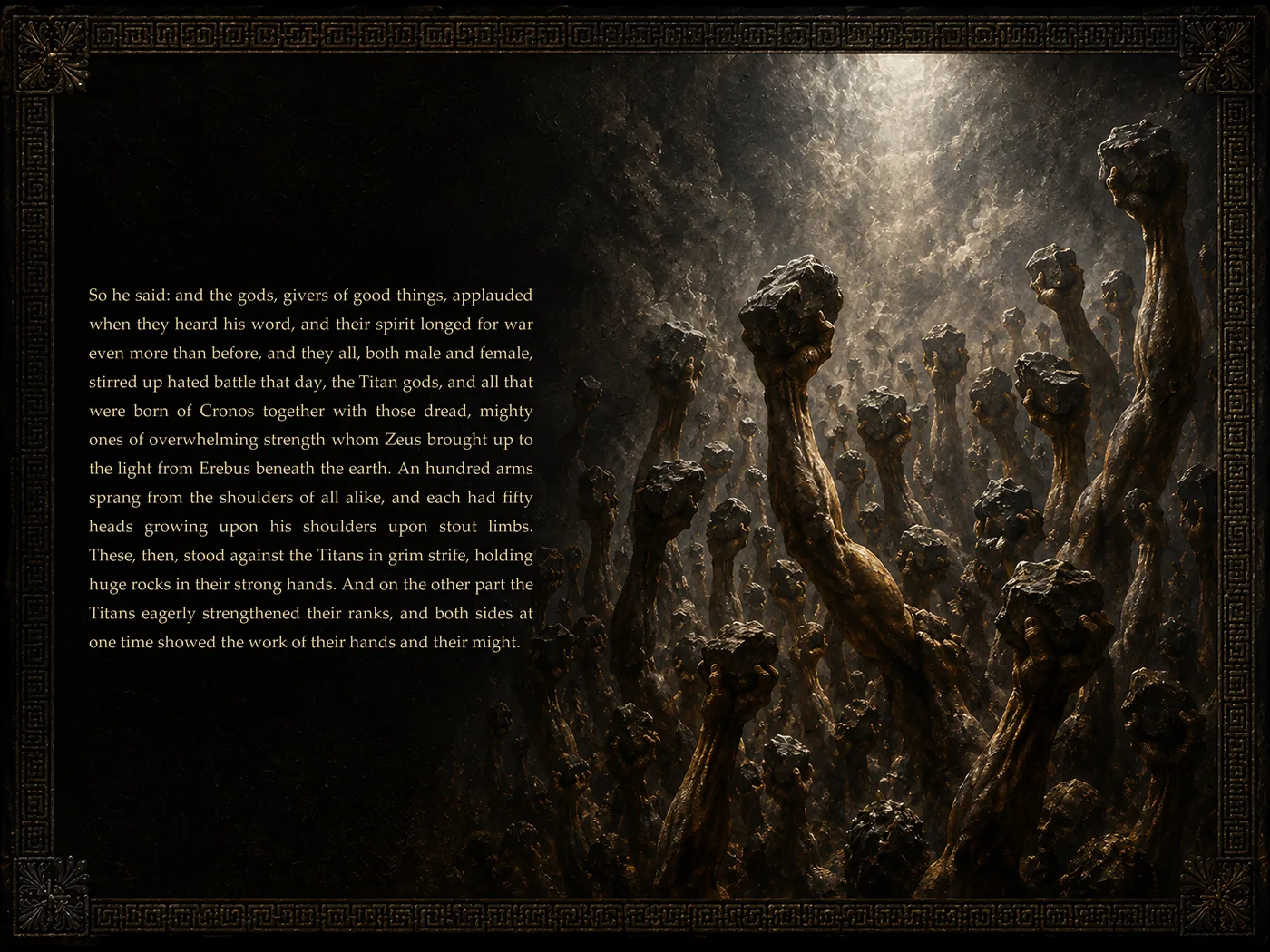
Hesiod then measures the prison. It lies as far below the earth as the sky is above it.
“For a brazen anvil falling down from heaven nine nights and days would reach the earth upon the tenth: and again, a brazen anvil falling from earth nine nights and days would reach Tartarus upon the tenth.”
A fence of bronze runs round the place, with night poured around it in three layers. Poseidon fixed the bronze gates, and the Hundred-Handers live there as the trusty warders of Zeus (lines 726-735). Homer knows the same prison. In the Iliad, book 8, Zeus threatens to throw any god who defies him down to Tartarus, and Cronos and Iapetus are said to sit at the bottom of the world.
What came after the Titanomachy?
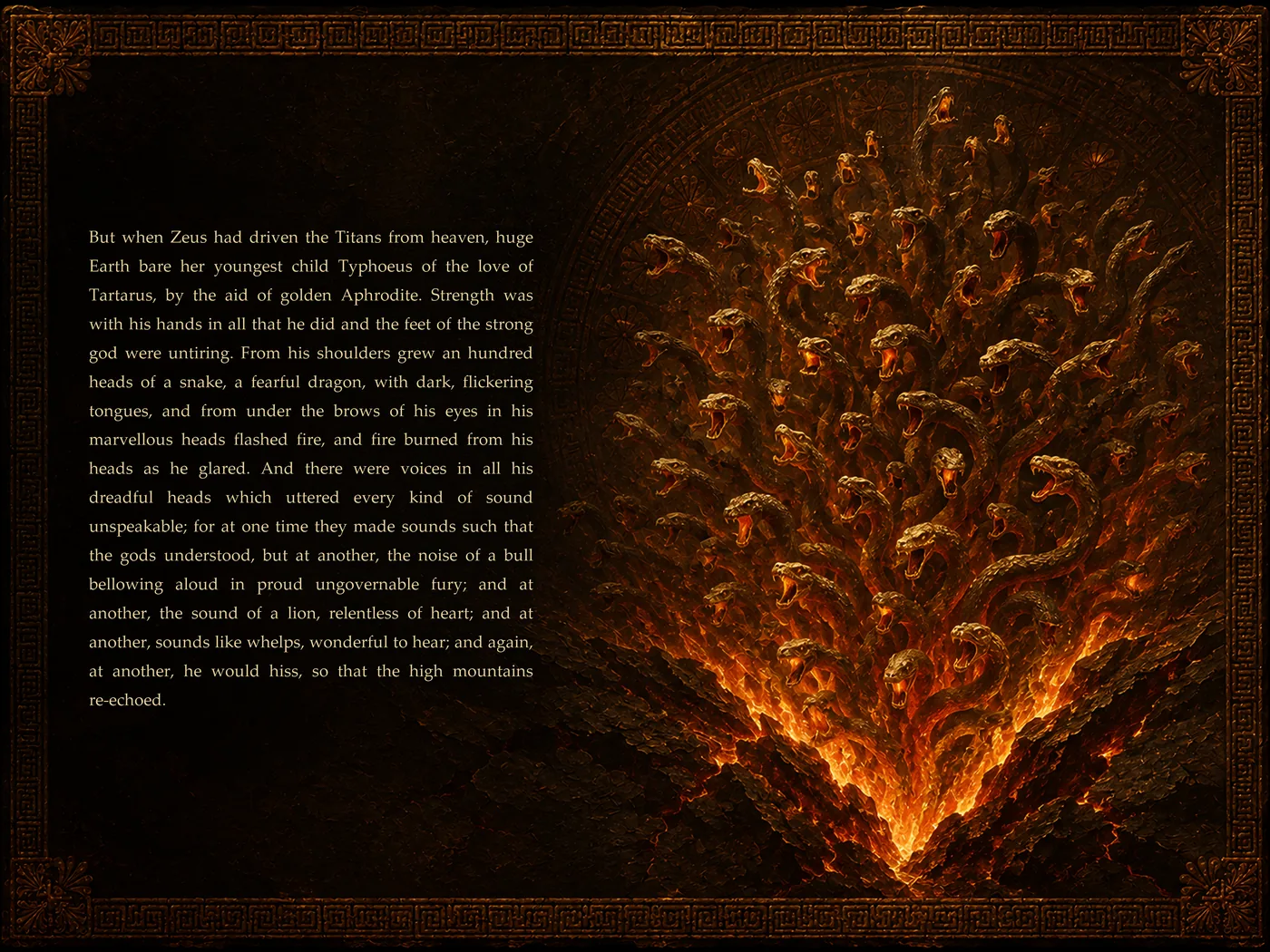
One more enemy. When Zeus had driven the Titans from heaven, Gaia and Tartarus had a last child, Typhoeus (lines 820-822). He had a hundred snake heads with fire in their eyes, and voices that could speak so that the gods understood, bellow like a bull, roar like a lion or hiss. Hesiod says plainly what was at stake.
“And truly a thing past help would have happened on that day, and he would have come to reign over mortals and immortals, had not the father of men and gods been quick to perceive it.”
Zeus thundered, the earth and the sea boiled, and even Hades trembled below. He leaped from Olympus, burned every one of the monster's heads, and in anger threw him into Tartarus (lines 853-868). Hesiod gives no reason why Gaia bore this last child. Apollodorus supplies one: she was angry at the fate of the Giants.
How did Zeus divide the honours after the war?
The gods asked him to be their king, and Hesiod ends the war with his statement of what it was fought for.
“But when the blessed gods had finished their toil, and settled by force their struggle for honours with the Titans, they pressed far-seeing Olympian Zeus to reign and to rule over them, by Earth’s prompting. So he divided their dignities amongst them.”
Hesiod does not list the shares. Homer does, in the Iliad, book 15: the three brothers drew lots, and Zeus took the sky, Poseidon the sea and Hades the world below, with earth and Olympus left to all. In the Theogony the honours go out one at a time through the rest of the poem, to Hecate, to Styx and to the children of Zeus and his wives.
The next thing Zeus does is swallow his first wife, Metis, because Gaia and Heaven told him that a son of hers would be king of the gods. Hesiod gives the motive: so that “no other should hold royal sway over the eternal gods in place of Zeus” (lines 892-893). Cronos was warned of a son and swallowed his children. Zeus, warned of the same, swallows the mother. The story of the succession ends there.
Questions
How long did the Titanomachy last?
Ten years. Hesiod says the two sides fought for ten full years with neither able to end it, until the Hundred-Handers joined Zeus.
Who won the Titanomachy?
Zeus and the gods born of Cronos. The Hundred-Handers' barrage of rocks decided it, and the defeated Titans were chained in Tartarus.
Who were the Hundred-Handers?
Cottus, Briareos and Gyes, three sons of Gaia and Uranus with a hundred arms and fifty heads each. After the war they stayed on as guards of the Titans.
What is the difference between the Titanomachy and the Gigantomachy?
They are two wars. The Titanomachy is the gods against the Titans. The Gigantomachy is the gods against the Giants, who were born from the blood of Uranus. Hesiod tells the first and only names the Giants' birth, and the second comes from later writers such as Apollodorus.
What happened to Cronos after the war?
Hesiod places him among the Titans below Tartarus. Homer, in the Iliad, also has Cronos and Iapetus sitting far beneath the earth.
The Titans have their own article, the twelve Titans, and the world they were born into is in the first gods of Hesiod. For the whole poem in order, read the Theogony summary or the family tree. Prometheus, a son of the Titan Iapetus, takes on Zeus in the story of the stolen fire. Theogony Illustrated is one of the Illuminated Classics, and a still older story of kings and gods is told in the Epic of Gilgamesh summary.
The Inner Circle
Join the Circle
The next book is already taking shape in the dark.
Be the first to know about new releases, exclusive content, hardcover drops, and glimpses behind the veil of ZoderoT's worlds.
No spam. No noise. Only the signal that matters.