Theogony
The Twelve Titans of Greek Mythology
Six sons and six daughters of Gaia and Uranus, in the order Hesiod gives them, with their marriages, their children and what became of them.
The twelve Titans are the children of Gaia (Earth) and Uranus (Heaven), the first family of gods to rule the world. The six sons are Oceanus, Coeus, Crius, Hyperion, Iapetus and Cronos. The six daughters are Theia, Rhea, Themis, Mnemosyne, Phoebe and Tethys. Hesiod gives all twelve names in one passage of the Theogony, lines 133-138, and never states the number: it comes from counting. Cronos, the youngest, maimed his father and took the throne, and was in turn overthrown by his own son Zeus.
Who are the Titans in Hesiod's Theogony?
Gaia bears Heaven, the Hills and the sea, Pontus, on her own. Then she lies with Heaven and bears the twelve. Hesiod lists them in Hugh G. Evelyn-White's translation of 1914, where Earth, Heaven and Ocean appear under their English names.
“But afterwards she lay with Heaven and bare deep-swirling Oceanus, Coeus and Crius and Hyperion and Iapetus, Theia and Rhea, Themis and Mnemosyne and gold-crowned Phoebe and lovely Tethys.”
Cronos gets a line to himself: he is the “youngest and most terrible of her children”, and he hated his father (lines 137-138). Heaven gave the whole family its name, and Hesiod passes on his reason.
“But these sons whom he begot himself great Heaven used to call Titans (Strainers) in reproach, for he said that they strained and did presumptuously a fearful deed, and that vengeance for it would come afterwards.”
Evelyn-White translates the word as Strainers, from a Greek verb meaning to stretch. The deed Heaven means is the attack on himself, told in the lines just before. The vengeance he promises comes: Cronos is overthrown in his turn, and the Titans end in chains.
These twelve are the first generation only. Their children, Prometheus, Atlas, Helius and Selene among them, are not on Hesiod's list, although later writers often call them Titans too. Every family in order is set out in the Greek gods family tree.
Who are the six male Titans?
Oceanus
Oceanus is the river that rings the world, and his wife is his sister Tethys. He has no story of his own in the Theogony. Hesiod never says whether he fought against Zeus. His daughter Styx was the first to come to Olympus when Zeus called the gods there, and her water became the oath the gods swear by (lines 383-403).
Coeus
Coeus marries Phoebe, and their daughters are Leto and Asteria (lines 404-411). Leto, whom Hesiod calls “gentlest in all Olympus”, bears Apollo and Artemis to Zeus. Asteria is the mother of Hecate. The poem never says what became of Coeus himself.
Crius
Crius marries Eurybia, a daughter of Pontus and Gaia, and fathers Astraeus, Pallas and Perses (lines 375-377). Astraeus and Dawn have the winds Zephyrus, Boreas and Notus. Pallas marries Styx, and their four children, Emulation, Victory, Strength and Force, live at Zeus's side ever after (lines 383-388). Crius himself never acts. His sons do.
Hyperion
Hyperion marries Theia, and their children are the lights of the sky: Helius the Sun, Selene the Moon and Eos, the Dawn, who shines on everything on earth and on the gods (lines 371-374). Hyperion is a name in a list and a father in one sentence.
Iapetus
Iapetus marries Clymene, a daughter of Oceanus, and has four sons: Atlas, Menoetius, Prometheus and Epimetheus (lines 507-511). They are the best-known family of the Titan generation, and each of them ends badly.
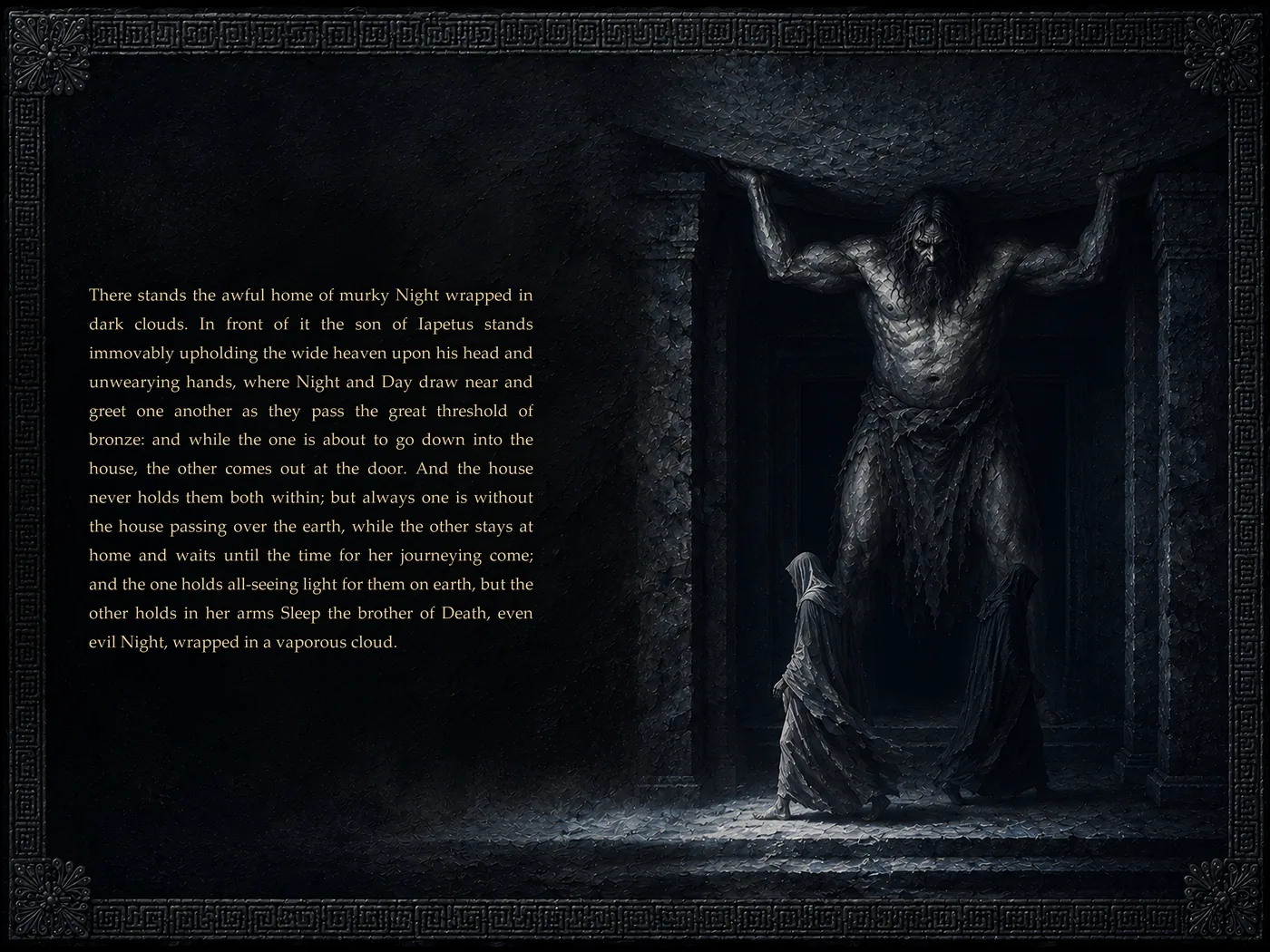
“But Menoetius was outrageous, and far-seeing Zeus struck him with a lurid thunderbolt and sent him down to Erebus because of his mad presumption and exceeding pride. And Atlas through hard constraint upholds the wide heaven with unwearying head and arms, standing at the borders of the earth before the clear-voiced Hesperides; for this lot wise Zeus assigned to him.”
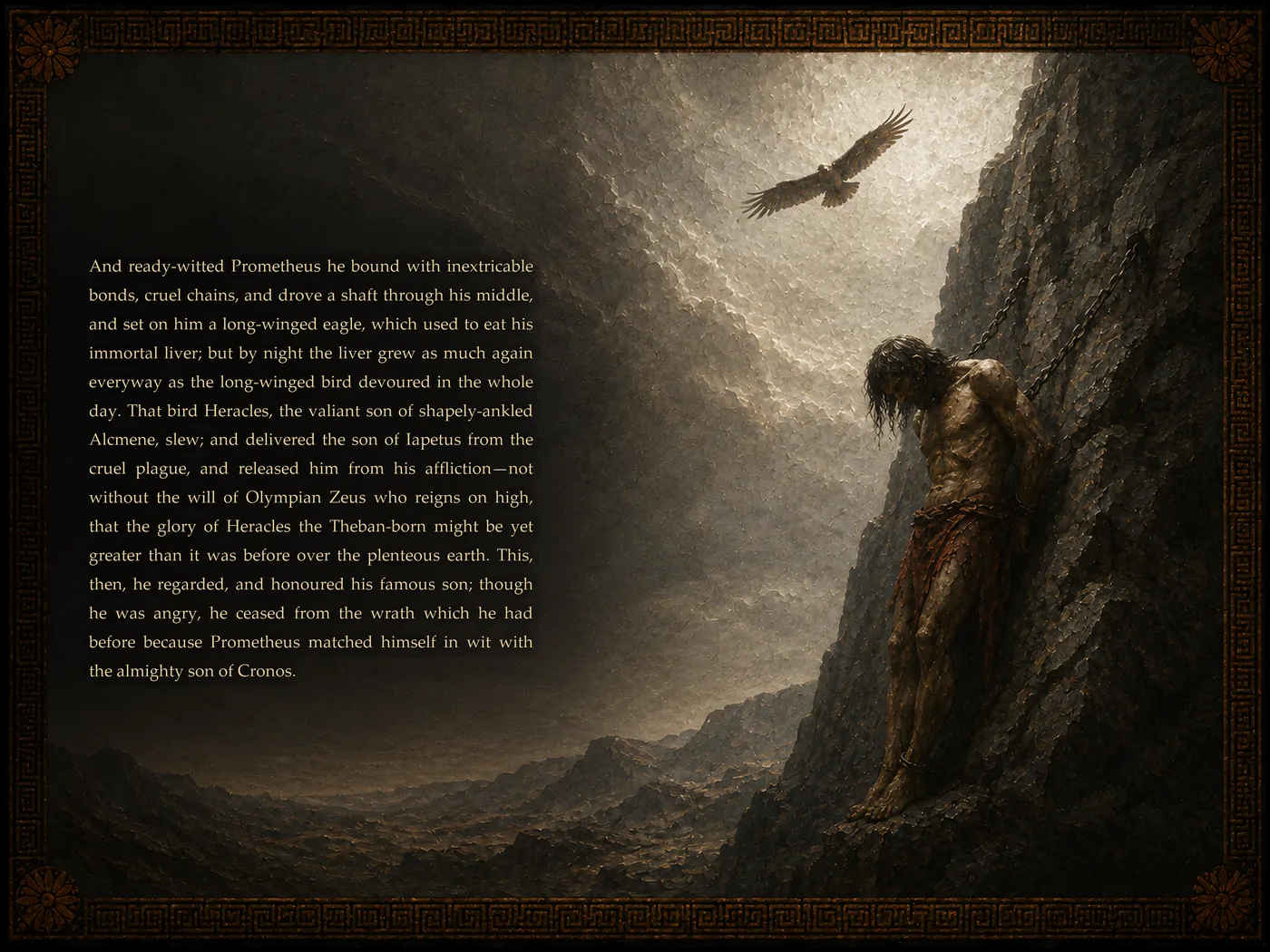
Prometheus is bound in chains and eaten by an eagle, as told in the Prometheus myth, and Epimetheus is the one who first accepts the woman Zeus has fashioned (lines 511-514).
Cronos
Cronos is the youngest and the one who matters. Heaven hid his most terrible children, the Hundred-Handers, inside Gaia as each was born, and Gaia made a sickle of grey flint and asked her sons to punish him. Fear silenced all of them except Cronos, who lay in ambush and cut off his father's members (lines 154-206). From the blood came the Erinyes, the Giants and the Meliae, and from the sea foam came Aphrodite.
Rhea then bore him six children, and he swallowed each one because he had learned that a son would overthrow him (lines 453-465). Zeus escaped, and what follows is told in the Theogony summary and in the Titanomachy.
The six daughters
Who are the six female Titans?
Theia
Theia is the wife of Hyperion and the mother of the Sun, the Moon and the Dawn. Hesiod names her in the list and again in the line that gives her children (lines 371-374), and nowhere else.
Rhea
Rhea is the wife of Cronos and the mother of Hestia, Demeter, Hera, Hades, Poseidon and Zeus (lines 453-458). When she was about to bear Zeus she asked her own parents for a plan. They sent her to Crete, where Gaia hid the baby in a cave, and Rhea gave Cronos a stone wrapped in swaddling clothes to swallow in his place (lines 468-491). Rhea is the Titan who outwits Cronos.
Themis
Themis is the second wife of Zeus. She bears the Hours and the Fates.
“Next he married bright Themis who bare the Horae (Hours), and Eunomia (Order), Dike (Justice), and blooming Eirene (Peace), who mind the works of mortal men, and the Moerae (Fates) to whom wise Zeus gave the greatest honour, Clotho, and Lachesis, and Atropos who give mortal men evil and good to have.”
Hesiod gives the Fates a second mother elsewhere, Night (lines 217-222), so in his poem they have two.
Mnemosyne
Mnemosyne is Memory. Zeus came to her bed for nine nights in Pieria, and a year later she bore the nine Muses (lines 53-62 and 915-917). The Theogony opens with the Muses, so Hesiod begins his poem by calling on the daughters of a Titan.
Phoebe
Phoebe, called gold-crowned, is the wife of Coeus and the grandmother of Apollo, Artemis and Hecate. Hecate gets one of the longest praises in the poem, and Hesiod says that Zeus “did her no wrong nor took anything away of all that was her portion among the former Titan gods” (lines 411-452).
Tethys
Tethys is the sister and wife of Oceanus. She bears every river of the world and three thousand daughters, the Oceanids, with Styx the chief of them (lines 337-370). Hesiod gives up on naming the rivers: “their names it is hard for a mortal man to tell”.
What happened to the Titans?
Most of them lose a war. Hesiod describes the two sides as the Titan gods on Mount Othrys and the gods born of Cronos on Olympus. The fighting lasts ten years and ends when the Hundred-Handers bury the Titans under a barrage of rocks. Zeus chains them in Tartarus, and the Hundred-Handers stay on as guards. The war has its own article, the Titanomachy.
“There by the counsel of Zeus who drives the clouds the Titan gods are hidden under misty gloom, in a dank place where are the ends of the huge earth.”
Hesiod never says which Titans are below. He does put Cronos there, among the “Titans under Tartarus who live with Cronos” (line 851). Homer agrees: in the Iliad, book 8, Cronos and Iapetus sit far beneath the earth, out of reach of the sun.
Not every Titan family was ruined. Styx was honoured by Zeus, Hecate kept her old share, and Themis and Mnemosyne became mothers of the next generation of gods.
What is the difference between Titans, gods and Giants?
The Titans are the twelve children of Gaia and Uranus. Their children and grandchildren are the Olympians, led by Zeus, and Hesiod calls both sides gods. He tells the two armies apart by their mountains.
The Giants are a third group, born from the drops of Heaven's blood when Cronos struck him, with gleaming armour and long spears (lines 183-187). Hesiod gives them a birth and no battle. The war against the Giants, the Gigantomachy, comes from later writers such as Apollodorus, who sets it after the Titans have fallen and says the gods could not win without a mortal, Heracles.
The Cyclopes and the Hundred-Handers are Titan brothers, three of each, and they are not Titans themselves. The Cyclopes made Zeus's thunderbolt, and the Hundred-Handers won him the war.
Questions
How many Titans were there?
Twelve in Hesiod: six sons and six daughters of Gaia and Uranus. He lists the names but never gives the number, which comes from counting them.
Who was the youngest Titan?
Cronos. Hesiod calls him the youngest and most terrible of Gaia's children, and he is the Titan who ruled the gods before Zeus.
Were Prometheus and Atlas Titans?
In Hesiod they are sons of the Titan Iapetus and are not among the twelve. Later writers often call them Titans as well.
Where were the Titans imprisoned?
In Tartarus, far beneath the earth. Hesiod says it lies as far below the earth as the sky is above it, closed by bronze gates and guarded by the Hundred-Handers.
Did all the Titans fight Zeus?
Hesiod does not list the fighters. He names the sides as the Titan gods on Mount Othrys and the gods born of Cronos on Olympus. Some Titan families, such as that of Styx, a daughter of Oceanus, go over to Zeus.
Theogony Illustrated belongs to the Illuminated Classics, old texts printed whole and painted. For another very old story of gods and mortals, see the Epic of Gilgamesh summary.
The Inner Circle
Join the Circle
The next book is already taking shape in the dark.
Be the first to know about new releases, exclusive content, hardcover drops, and glimpses behind the veil of ZoderoT's worlds.
No spam. No noise. Only the signal that matters.